Review
. 2018 Nov;175(21):4026-4035.
doi: 10.1111/bph.14023. Epub 2017 Oct 3.

GPCR signalling from within the cell

Affiliations
Review

GPCR signalling from within the cell

Yuh-Jiin I Jong et al. Br J Pharmacol. 2018 Nov.

Abstract

Traditionally, signal transduction from GPCRs is thought to emanate from the cell surface where receptor interactions with external stimuli can be transformed into a broad range of cellular responses. However, emergent data show that numerous GPCRs are also associated with various intracellular membranes where they may couple to different signalling systems, display unique desensitization patterns and/or exhibit distinct patterns of subcellular distribution. Although many GPCRs can be activated at the cell surface and subsequently endocytosed and transported to a unique intracellular site, other intracellular GPCRs can be activated in situ either via de novo ligand synthesis, diffusion of permeable ligands or active transport of nonpermeable ligands. Current findings reinforce the notion that intracellular GPCRs play a dynamic role in various biological functions including learning and memory, contractility and angiogenesis. As new intracellular GPCR roles are defined, the need to selectively tailor agonists and/or antagonists to both intracellular and cell surface receptors may lead to the development of more effective therapeutic tools.

Linked articles: This article is part of a themed section on Molecular Pharmacology of GPCRs. To view the other articles in this section visit http://onlinelibrary.wiley.com/doi/10.1111/bph.v175.21/issuetoc.


Figures

Figure 1
Figure 1
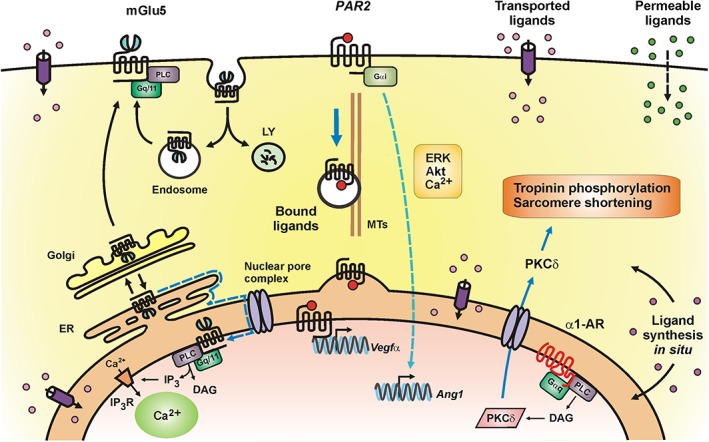
Schematic representation of selected intracellular GPCRs and ways in which they are activated. Left: proposed model of mGlu5 receptor trafficking in neurons in which >90% of mGlu5 receptors traffick through the golgi (Sergin et al., 2017). From there, between 15 and 40% (Hubert et al., 2001; López‐Bendito et al., 2002; O'Malley et al., 2003) go to the cell surface where they undergoe a cycle of constitutive endocytosis and recycling (Trivedi and Bhattacharyya, 2012). Alternatively, 60–85% of mGlu5 receptors are retrogradely trafficked back to the ER and via lateral diffusion (dotted blue line) reach the NM (Vincent et al., 2016; Sergin et al., 2017). Middle: ligand‐bound PAR2 can translocate from the retinal ganglion cell surface to the nucleus via importin‐β, Snx11 and dynein; nuclear PAR2 activates Vegfa expression. In contrast, signalling from cell surface PAR2 results in angiopoietin 1 expression (Joyal et al., 2014). Right: the https://www.google.com/url?sa=t&rct=j&q=&esrc=s&source=web&cd=3&cad=rja&uact=8&ved=0ahUKEwiDsp6cqrvVAhWr64MKHWP9AHIQFgg7MAI&url=https%3A%2F%2Fwww.ncbi.nlm.nih.gov%2Fpmc%2Farticles%2FPMC3930413%2F&usg=AFQjCNEaQB5359zmSlQuF092N7FE4mEbxAceptor (α1‐AR) is localized to the inner NM of adult cardiac myocytes where it is activated by noradrenaline transported via the http://www.guidetopharmacology.org/GRAC/FamilyDisplayForward?familyId=196#1021 located on the cell surface and ER membranes. The nuclear α1‐adrenoceptor couples to Gαq and PLC, which activate nuclear PKCδ. PKCδ is then transported out of the nucleus through the nuclear pore complex. PKCδ induces phosphorylation of troponin 1 to regulate contractility and ERK to regulate survival signalling (Wu et al., 2014; Wu and O'Connell, 2015). Intracellular GPCRs can be activated via (i) channels, transporters or exchangers recognizing specific ligands such as glutamate in the case of mGlu5 receptors or OCT3 for noradrenaline activation of α1‐adrenoceptors; (ii) alternatively, ligands sufficiently permeable can freely diffuse across cell membranes; (iii) as in the case of PAR2, receptor‐bound ligands can simply be internalized with a given GPCR; and (iv) ligands can be synthesized within the cell and either diffuse or be trafficked to a given cellular compartment.

References

    1. d'Addio M, Pizzigoni A, Bassi MT, Baschirotto C, Valetti C, Incerti B et al (2000). Defective intracellular transport and processing of OA1 is a major cause of ocular albinism type 1. Hum Mol Genet 9: 3011–3018. - PubMed
    1. Abadir PM, Foster DB, Crow M, Cooke CA, Rucker JJ, Jain A et al (2011). Identification and characterization of a functional mitochondrial angiotensin system. Proc Natl Acad Sci U S A 108: 14849–14854. - PMC - PubMed
    1. Alexander SPH, Catterall WA, Kelly E, Marrion N, Peters JA, Benson HE et al (2015a). The Concise Guide to PHARMACOLOGY 2015/16: Voltage‐gated ion channels. Br J Pharmacol 172: 5904–5941. - PMC - PubMed
    1. Alexander SPH, Davenport AP, Kelly E, Marrion N, Peters JA, Benson HE et al (2015b). The Concise Guide to PHARMACOLOGY 2015/16: G protein‐coupled receptors. Br J Pharmacol 172: 5744–5869. - PMC - PubMed
    1. Alexander SPH, Fabbro D, Kelly E, Marrion N, Peters JA, Benson HE et al (2015c). The Concise Guide to PHARMACOLOGY 2015/16: Enzymes. Br J Pharmacol 172: 6024–6109. - PMC - PubMed

Publication types

MeSH terms