


Review
doi: 10.1080/15384101.2017.1371888.
Epub 2017 Sep 25.
A role for cellular senescence in birth timing
Affiliations
- PMID: 28873006
- PMCID: PMC5731422
- DOI: 10.1080/15384101.2017.1371888
Item in Clipboard
Review
A role for cellular senescence in birth timing
Cell Cycle.
2017.
Abstract
Senescence contributes to the local and systemic aging of tissues and has been associated with age-related diseases. Recently, roles for this process during pregnancy have come to light, the dysregulation of which has been associated with adverse pregnancy outcomes such as preterm birth. Here, we summarize recent advances that support a role for senescence in birth timing and propose new aspects of study in this emerging field.
Keywords: SASP; decidua; disorders of aging; parturition; preterm birth; senescence.
Figures
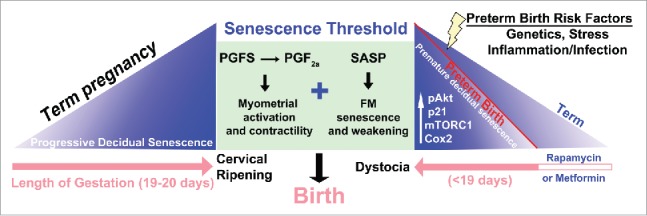
A scheme depicting potential contribution of decidual mTORC1 and senescence in setting the parturition clock. Term pregnancy encompasses progressive decidual senescence over the course of pregnancy (pink arrow) until a threshold is encountered, triggering PG synthesis, myometrial activation and contractility, culminating in birth. In the mouse model of preterm labor in which Trp53 is conditionally deleted in the uterus, decidual senescence begins prematurely due to activation of an pAkt-mTORC1-p21-Cox2 signaling axis and reaches the senescence threshold in a shorter gestational time frame, leading to preterm delivery. Several risk factors of preterm birth, including genetics, stress and inflammation/infection have been shown to contribute to the senescence process in other systems, and we speculate that these factors pathologically push decidual senescence toward the threshold. Furthermore, normal parturition involves cervical ripening along with myometrial activation in preparation for parturition, which does not occur in the p53d/d females: these females exhibit dystocia and stillbirth. Rapamycin, an inhibitor of mTORC1 signaling, can attenuate premature decidual senescence seen in p53d/d females and rescue preterm labor (Adapted from 110).
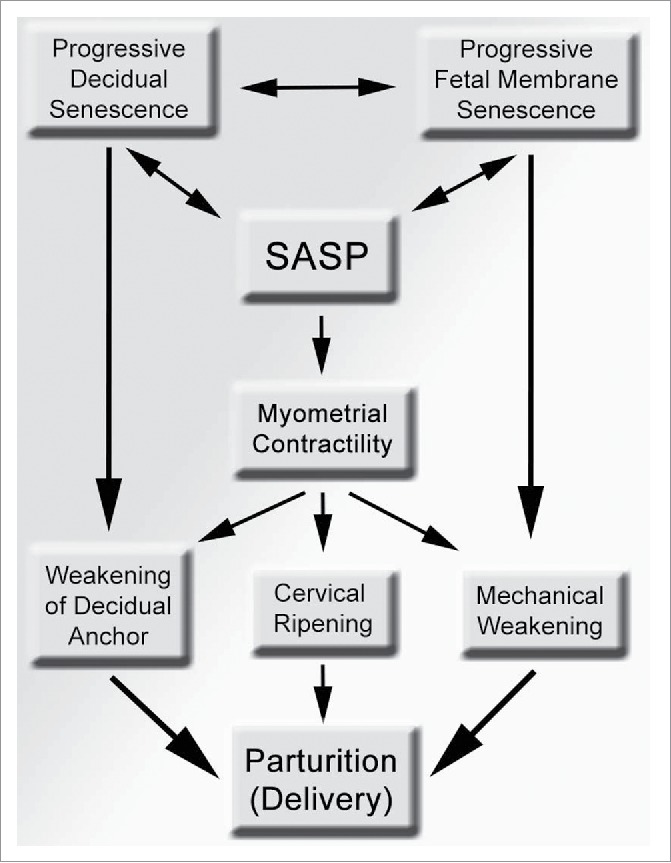
A scheme showing the potential contributions of senescence in various intrauterine tissue compartment to the process of parturition and preterm birth. Progressive senescence in the maternal decidua can structurally weakens its anchoring role to the mother, while senescence in the fetal membranes results in mechanical weakening and can lead to rupture of membranes. Myometrial contractility can also promote decidual and fetal membrane weakening via mechanical shear stress, which can be heighted by local, intrauterine SASP, resulting in parturition. SASP, senescence-associated secretory phenotype.
References
-
- March of Dimes, PMNCH, Save the Children, WHO. Born too soon: The global action report on preterm birth. Eds. Howson CP, Kinney MV, Lawn JE. Geneva, Switzerland: World Health Organization, 2012.
-
- Lawn JE, Blencowe H, Waiswa P, Amouzou A, Mathers C, Hogan D, Flenady V, Froen JF, Qureshi ZU, Calderwood C, et al.. Stillbirths: rates, risk factors, and acceleration towards 2030. Lancet. 2016;387:587-603. PMID:26794078 - PubMed
-
- Liu L, Johnson HL, Cousens S, Perin J, Scott S, Lawn JE, Rudan I, Campbell H, Cibulskis R, Li M, et al.. Global, regional, and national causes of child mortality: an updated systematic analysis for 2010 with time trends since 2000. Lancet. 2012;379:2151-61. PMID:22579125 - PubMed
-
- Rubens C, Sadovsky Y, Muglia L, Gravett M, Lackritz E, Gravett C. Prevention of preterm birth: Harnessing science to address the global epidemic. Science Translational Medicine. 2015;6:262sr5. PMID: 25391484 - PubMed
Publication types
MeSH terms
LinkOut - more resources
Full Text Sources
Other Literature Sources
Medical
