


Anti-Mullerian hormone and endometrial cancer: a multi-cohort study
- PMID: 28873086
- PMCID: PMC5672934
- DOI: 10.1038/bjc.2017.299
Anti-Mullerian hormone and endometrial cancer: a multi-cohort study
Abstract
Background: The Mullerian ducts are the embryological precursors of the female reproductive tract, including the uterus; anti-Mullerian hormone (AMH) has a key role in the regulation of foetal sexual differentiation. Anti-Mullerian hormone inhibits endometrial tumour growth in experimental models by stimulating apoptosis and cell cycle arrest. To date, there are no prospective epidemiologic data on circulating AMH and endometrial cancer risk.
Methods: We investigated this association among women premenopausal at blood collection in a multicohort study including participants from eight studies located in the United States, Europe, and China. We identified 329 endometrial cancer cases and 339 matched controls. Anti-Mullerian hormone concentrations in blood were quantified using an enzyme-linked immunosorbent assay. Conditional logistic regression was used to estimate odds ratios (ORs) and 95% confidence intervals (CI) across tertiles and for a doubling of AMH concentrations (ORlog2). Subgroup analyses were performed by ages at blood donation and diagnosis, oral contraceptive use, and tumour characteristics.
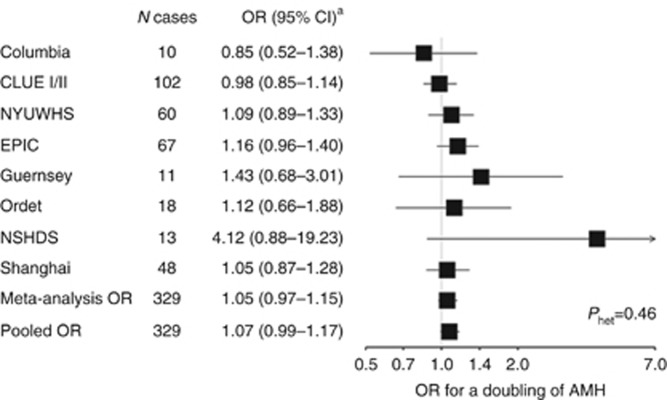
Results: Anti-Mullerian hormone was not associated with the risk of endometrial cancer overall (ORlog2: 1.07 (0.99-1.17)), or with any of the examined subgroups.
Conclusions: Although experimental models implicate AMH in endometrial cancer growth inhibition, our findings do not support a role for circulating AMH in the aetiology of endometrial cancer.
Conflict of interest statement
The authors declare no conflict of interest.
Figures
References
-
- Behringer RR (1995) The mullerian inhibitor and mammalian sexual development. Philos Trans R Soc Lond B Biol Sci 350(1333): 285–288, discussion 289. - PubMed
-
- Burks HR, Ross L, Opper N, Paulson E, Stanczyk FZ, Chung K (2015) Can highly sensitive antimullerian hormone testing predict failed response to ovarian stimulation? Fertil Steril 104(3): 643–648. - PubMed
-
- Carrarelli P, Rocha AL, Belmonte G, Zupi E, Abrao MS, Arcuri F, Piomboni P, Petraglia F (2014) Increased expression of antimullerian hormone and its receptor in endometriosis. Fertil Steril 101(5): 1353–1358. - PubMed
MeSH terms
Substances
Grants and funding
- MR/N003284/1/MRC_/Medical Research Council/United Kingdom
- R37 CA070867/CA/NCI NIH HHS/United States
- UM1 CA182934/CA/NCI NIH HHS/United States
- G1000143/MRC_/Medical Research Council/United Kingdom
- P30 ES000260/ES/NIEHS NIH HHS/United States
- 14136/CRUK_/Cancer Research UK/United Kingdom
- G0401527/MRC_/Medical Research Council/United Kingdom
- R01 CA098661/CA/NCI NIH HHS/United States
- UM1 CA182910/CA/NCI NIH HHS/United States
- MR/M012190/1/MRC_/Medical Research Council/United Kingdom
- R01 CA178949/CA/NCI NIH HHS/United States
- R01 CA163018/CA/NCI NIH HHS/United States
- P30 CA016087/CA/NCI NIH HHS/United States
- 001/WHO_/World Health Organization/International
- P30 CA006927/CA/NCI NIH HHS/United States
LinkOut - more resources
Full Text Sources
Other Literature Sources
