


Control of Phlebotomus argentipes (Diptera: Psychodidae) sand fly in Bangladesh: A cluster randomized controlled trial
- PMID: 28873425
- PMCID: PMC5600390
- DOI: 10.1371/journal.pntd.0005890
Control of Phlebotomus argentipes (Diptera: Psychodidae) sand fly in Bangladesh: A cluster randomized controlled trial
Abstract
Background: A number of studies on visceral leishmaniasis (VL) vector control have been conducted during the past decade, sometimes came to very different conclusion. The present study on a large sample investigated different options which are partially unexplored including: (1) indoor residual spraying (IRS) with alpha cypermethrin 5WP; (2) long lasting insecticide impregnated bed-net (LLIN); (3) impregnation of local bed-nets with slow release insecticide K-O TAB 1-2-3 (KOTAB); (4) insecticide spraying in potential breeding sites outside of house using chlorpyrifos 20EC (OUT) and different combinations of the above.
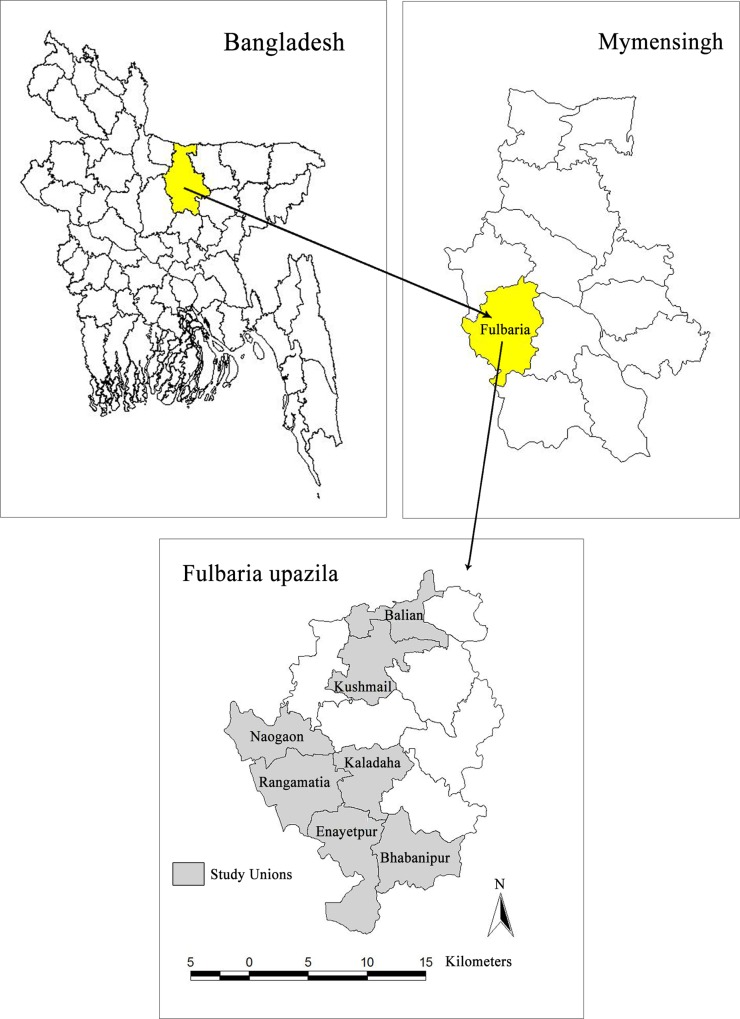
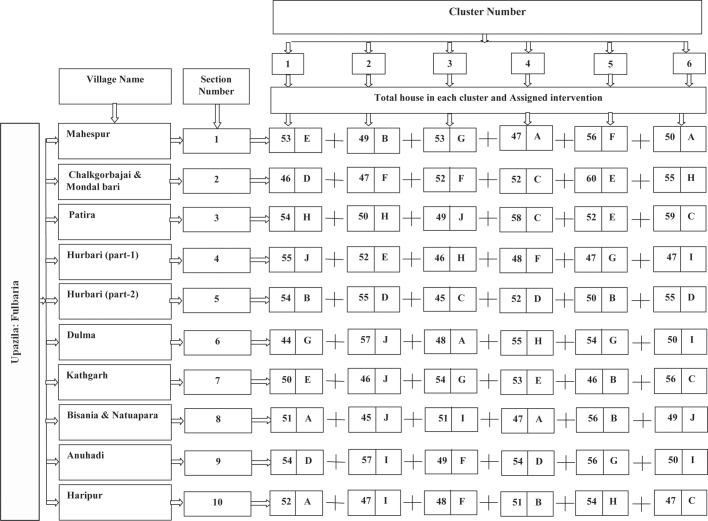
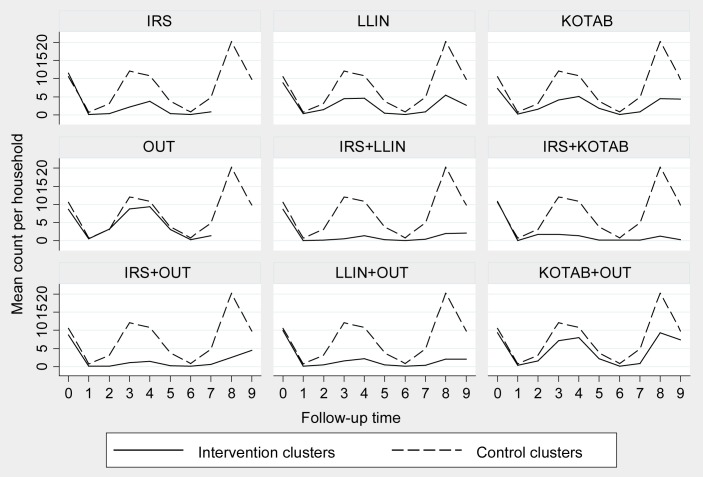
Methods: The study was a cluster randomized controlled trial where 3089 houses from 11 villages were divided into 10 sections, each section with 6 clusters and each cluster having approximately 50 houses. Based on vector density (males plus females) during baseline survey, the 60 clusters were categorized into 3 groups: (1) high, (2) medium and (3) low. Each group had 20 clusters. From these three groups, 6 clusters (about 300 households) were randomly selected for each type of intervention and control arms. Vector density was measured before and 2, 4, 5, 7, 11, 14, 15, 18 and 22 months after intervention using CDC light traps. The impact of interventions was measured by using the difference-in-differences regression model.
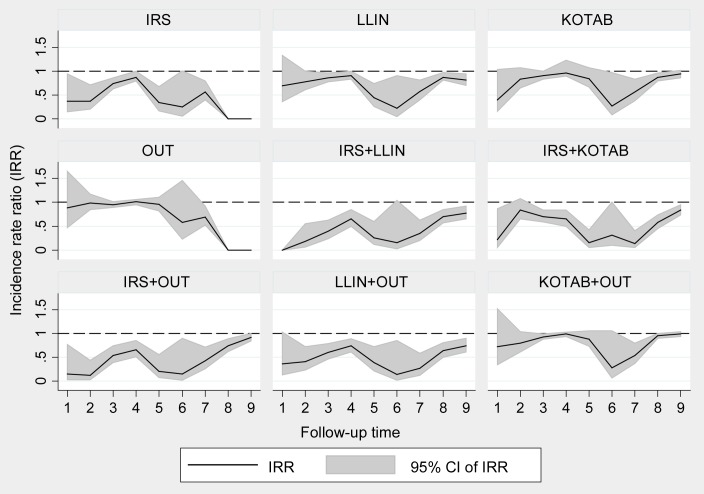
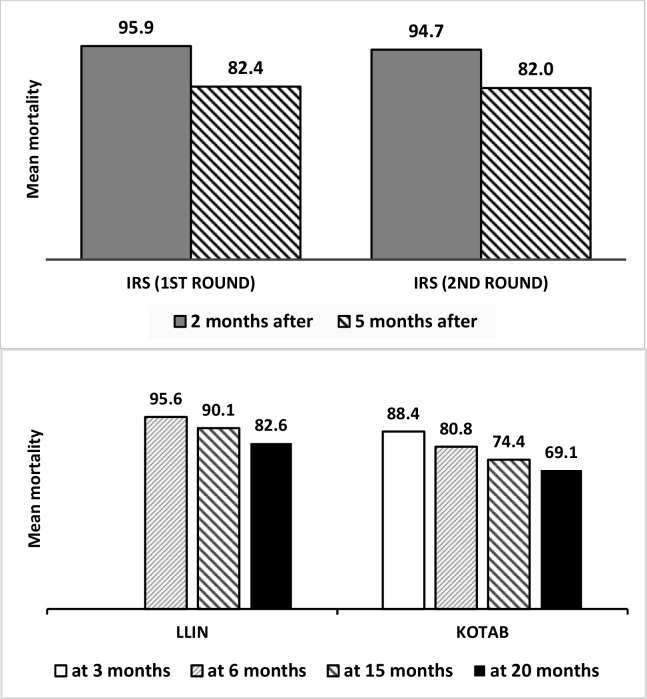
Results: A total of 17,434 sand flies were collected at baseline and during the surveys conducted over 9 months following the baseline measurements. At baseline, the average P. argentipes density per household was 10.6 (SD = 11.5) in the control arm and 7.3 (SD = 8.46) to 11.5 (SD = 20.2) in intervention arms. The intervention results presented as the range of percent reductions of sand flies (males plus females) and rate ratios in 9 measurements over 22 months. Among single type interventions, the effect of IRS with 2 rounds of spraying (applied by the research team) ranged from 13% to 75% reduction of P. argentipes density compared to the control arm (rate-ratio [RR] ranged from 0.25 to 0.87). LLINs caused a vector reduction of 9% to 78% (RR, 0.22 to 0.91). KOTAB reduced vectors by 4% to 73% (RR, 0.27 to 0.96). The combination of LLIN and OUT led to a vector reduction of 26% to 86% (RR, 0.14 to 0.74). The reduction for the combination of IRS and OUT was 8% to 88% (RR, 0.12 to 0.92). IRS and LLIN combined resulted in a vector reduction of 13% to 85% (RR, 0.15 to 0.77). The IRS and KOTAB combination reduced vector densities by 16% to 86% (RR, 0.14 to 0.84). Some intermediate measurements for KOTAB alone and for IRS plus LLIN; and IRS plus KOTAB were not statistically significant. The bioassays on sprayed surfaces or netting materials showed favourable results (>80% mortality) for 22 months (IRS tested for 12 months). In the KOTAB, a gradual decline was observed after 6 months.
Conclusions: LLIN and OUT was the best combination to reduce VL vector densities for 22 months or longer. Operationally, this is much easier to apply than IRS. A cost analysis of the preferred tools will follow. The relationship between vector density (males plus females) and leishmaniasis incidence should be investigated, and this will require estimates of the Entomological Inoculation Rate.
Conflict of interest statement
The authors have declared that no competing interests exist.
Figures
References
-
- Sanyal RK. 1985. Leishmaniasis in the Indian sub-continent In Chang KP, Bray RS eds. Leishmaniasis. Amsterdam: Elsevier Science Publishers, BV, 443–67.
-
- World Health Organization (WHO), Geneva, Switzerland. 1984. The Leishmaniasis. Tech Report Series. No. 701.
-
- Sengupta PC. 1975. Return of kala-azar. Jour Ind Med Asso; 65:89–90. - PubMed
Publication types
MeSH terms
Grants and funding
LinkOut - more resources
Full Text Sources
Other Literature Sources
Research Materials
Miscellaneous
