


Arboviruses Isolated From Mosquitoes Collected in Uganda, 2008-2012
- PMID: 28874015
- PMCID: PMC5968633
- DOI: 10.1093/jme/tjx120
Arboviruses Isolated From Mosquitoes Collected in Uganda, 2008-2012
Abstract
A large number of arthropod-borne viruses are endemic to East Africa. As a part of the process of undertaking a systematic characterization of the mosquito fauna of Uganda, we examined mosquitoes collected from 2008 through early 2012 for known and novel viruses. In all, 8,288 mosquito pools containing 157,554 mosquitoes were tested. Twenty-nine isolations of 11 different viruses were made from mosquitoes of nine distinct species and from pools identified only to genus Culex. Identified viruses were from family Togaviridae, alphaviruses Sindbis and Babanki viruses; family Rhabdoviridae, hapaviruses Mossuril and Kamese viruses; family Flaviviridae, flaviviruses West Nile and Usutu viruses; family Phenuiviridae, phlebovirus Arumowot virus; and family Peribunyaviridae, orthobunyaviruses Witwatersrand, Pongola, and Germiston viruses. In addition, a novel orthobunyavirus, provisionally named Mburo virus, was isolated from Coquillettidia metallica (Theobald). This is the first report of Babanki, Arumowot, and Mossuril virus isolation from Uganda.
Keywords: Uganda; arbovirus; mosquito.
Published by Oxford University Press on behalf of Entomological Society of America 2017. This work is written by US Government employees and is in the public domain in the US.
Figures
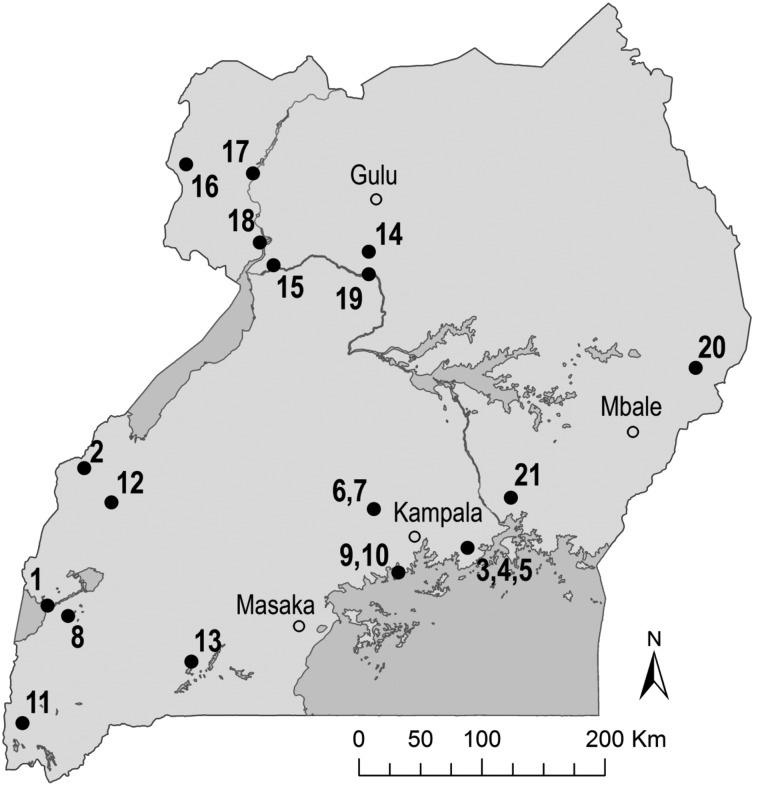
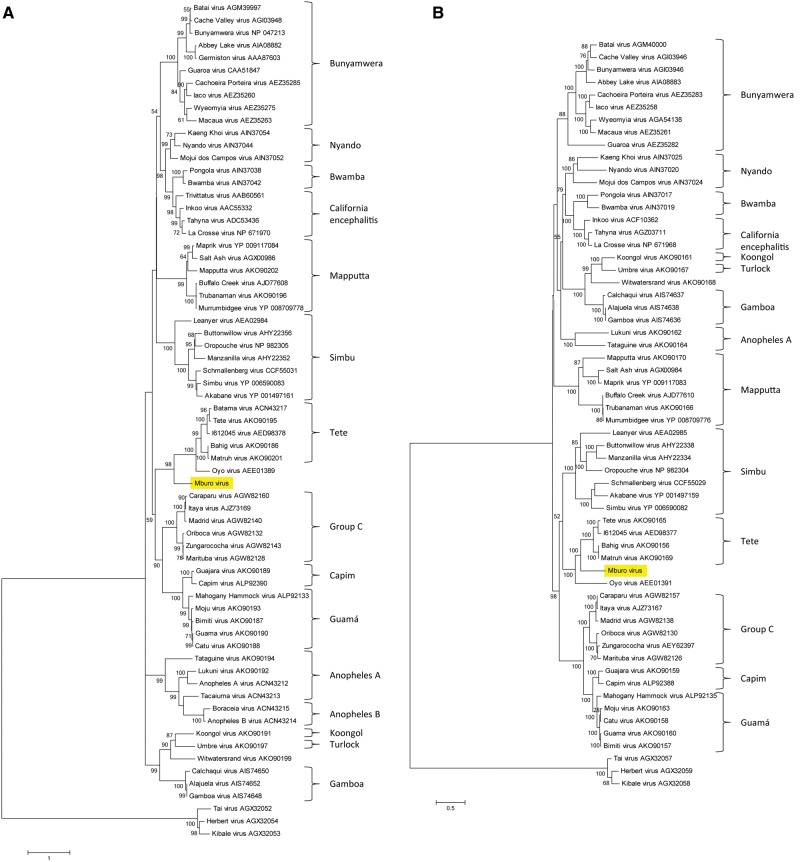
References
-
- Bakonyi T., Kolodziejek J., Rudolf I., Bercic R., Nowotny N., Hubalek Z.. 2013. Partial genetic characterization of Sedlec virus (Orthobunyavirus, Bunyaviridae). Infect. Genetics Evol. J. Mol. Epidemiol. Evol. Genetics Infect. Dis. 19: 244–249. - PubMed
-
- Beier J. C., Odago W. O., Onyango F. K., Asiago C. M., Koech D. K., Roberts C. R.. 1990. Relative abundance and blood feeding behavior of nocturnally active culicine mosquitoes in western Kenya. J. Am. Mosq. Control Assoc. 6: 207–212. - PubMed
-
- Bryant J. E., Crabtree M. B., Nam V. S., Yen N. T., Duc H. M., Miller B. R.. 2005. Isolation of arboviruses from mosquitoes collected in northern Vietnam. Am. J. Trop. Med. Hyg. 73: 470–473. - PubMed
-
- Chandler J. A., Highton R. B.. 1976. Studies on some ornithophilic mosquitoes (Diptera, Culicidae) of the Kano Plain, Kenya. Bull. Entomol. Res. 66: 133–143.
-
- Crabtree M., Sang R., Lutomiah J., Richardson J., Miller B.. 2009. Arbovirus surveillance of mosquitoes collected at sites of active Rift Valley fever virus transmission: Kenya, 2006–2007. J. Med. Entomol. 46: 961–964. - PubMed
Publication types
MeSH terms
LinkOut - more resources
Full Text Sources
Other Literature Sources
Medical
Research Materials
