. 2017 Sep 5;18(1):693.
doi: 10.1186/s12864-017-3951-8.

A miRNA catalogue and ncRNA annotation of the short-living fish Nothobranchius furzeri

Affiliations

A miRNA catalogue and ncRNA annotation of the short-living fish Nothobranchius furzeri

Mario Baumgart et al. BMC Genomics. .

Erratum in

Abstract

Background: The short-lived fish Nothobranchius furzeri is the shortest-lived vertebrate that can be cultured in captivity and was recently established as a model organism for aging research. Small non-coding RNAs, especially miRNAs, are implicated in age dependent control of gene expression.

Results: Here, we present a comprehensive catalogue of miRNAs and several other non-coding RNA classes (ncRNAs) for Nothobranchius furzeri. Analyzing multiple small RNA-Seq libraries, we show most of these identified miRNAs are expressed in at least one of seven Nothobranchius species. Additionally, duplication and clustering of N. furzeri miRNAs was analyzed and compared to the four fish species Danio rerio, Oryzias latipes, Gasterosteus aculeatus and Takifugu rubripes. A peculiar characteristic of N. furzeri, as compared to other teleosts, was a duplication of the miR-29 cluster.

Conclusion: The completeness of the catalogue we provide is comparable to that of the zebrafish. This catalogue represents a basis to investigate the role of miRNAs in aging and development in this species.

Keywords: Fish miRNA evolution; Nothobranchius furzeri; miRNome; ncRNA.


Conflict of interest statement

Ethics approval and consent to participate

The protocols of animal maintenance and experiments were approved by the local authority in the State of Thuringia (Veterinaer-und Lebensmittelueberwachungsamt) complying with the EU directive 2010/63 and the german Animal Welfare Act §4(3) on the protection of animals used for scientific purposes.

Animals were bred and maintained for generations in-house in the institute’s fish facility (Leibniz-Institute on Aging - Fritz-Lipmann-institute, Beutenbergstr. 11, 07745 Jena, German) under animal husbandry license J-SHK-2684-04-08/11.

Consent for publication

Not applicable.

Competing interests

The authors declare that they have no competing interests.

Publisher’s Note

Springer Nature remains neutral with regard to jurisdictional claims in published maps and institutional affiliations.

Figures

Fig. 1
Fig. 1
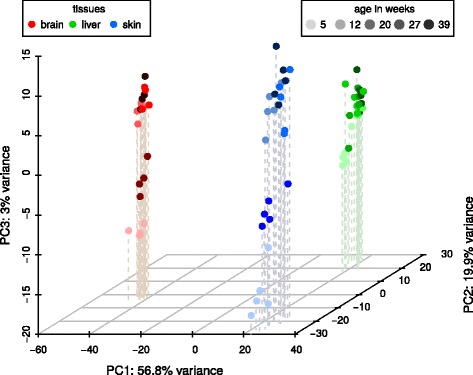
A three-dimensional PCA plot of the N. furzeri MZM small RNA-Seq libraries of all three tissues (brain – red, liver – green, blue – skin) and all investigated ages (from light to dark: 5, 12, 20, 27, 39 weeks). Whereas the samples cluster well according to their tissue belongings, a distinct separation regarding the ages can only be observed for the youngest samples in each tissue. A PCA plot of the GRZ strain, can be found in Supplement Table 2
Fig. 2
Fig. 2
Annotation, expression profiles and prediction comparison for miR-499.We annotated the pre-miR-499 on sgr09, position 55,926,017–55,926,134 and the two mature miRNAs at 55,926,048–55,926,069 and 55,926,085–55,926,106. The six methods used for miRNA detection are displayed, CID-miRNA was not able to detect this miRNA. Tools working independent of the small RNA-Seq data BLAST (cyan), Infernal (olive green) and goRAP (orange) vary in their annotation length. The latter two programs are based on covariance models, identifying mostly the complete pre-miRNA. The remaining two programs miRDeep* and Blockbuster are based on small RNA-Seq data (*) and therefore accurately annotate the mature miRNAs. MiR-499 is expressed weakly within N. furzeri MZM 12 month liver library and therefore could not be detected by miRDeep* and Blockbuster. In the N. furzeri MZM 12 month brain library, miR-499 was expressed strongs enough to be detected by both programs
Fig. 3
Fig. 3
Venn diagram of predicted miRNA genes from four tools miRDeep*, Infernal, goRap and BLAST. Only 2 of the 33 candidates predicted by CID-miRNA overlapped with any of the other miRNA candidates. Nevertheless, all 33 candidates were selected as miRNAs after manual inspectations. The total number of miRNA predictions after and before applying any filtering step are shown in brackets for each tool
Fig. 4
Fig. 4
Expression profiles of the predicted miR-215. Gray bars indicate the number of aligned reads and therefore coverage at the specific positions. Whereas no expression can be observed for this miRNA in N. furzeri, clear activation can be seen in N. korthausae, N. pienaari and N. rachovii. A. striatum, N. kadleci and N. kunthae show a weak expression for at least the 5′-mature variant of this miRNA
Fig. 5
Fig. 5
Killifish phylogeny based on the expressed miRNAs calculated via hierarchical clustering using the R package pvclust [55]. Bootstrap values are given as percentages at the corresponding branches. The amount of identified expressed miRNAs is given next to the species names. The numbers in green indicate the number of these expressed miRNAs, which were annotated but not expressed in any of the sequenced N. furzeri samples
Fig. 6
Fig. 6
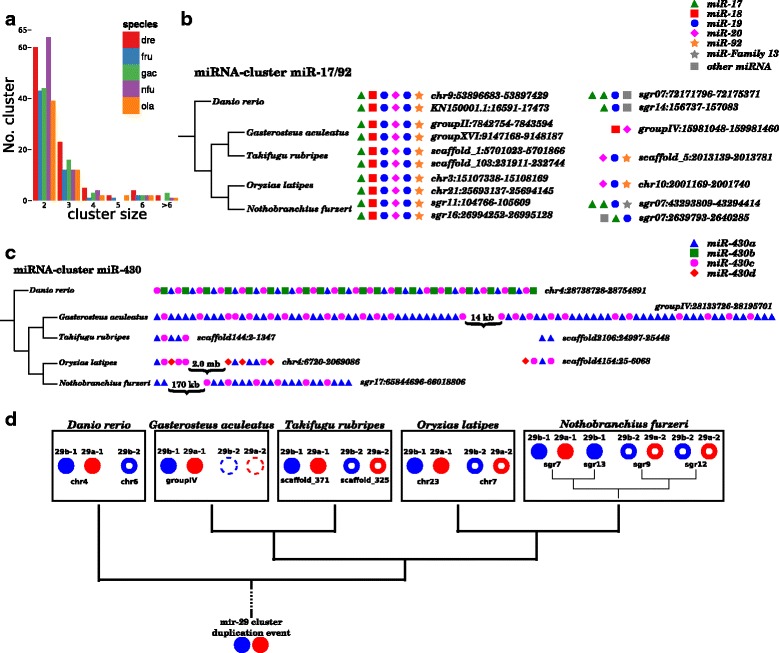
MiRNA cluster comparison between fish. a Amount of clusters and their respective sizes with a maximum distance of 10,000 bp between two miRNAs. (nfu - Nothobranchius furzeri, dre - Danio rerio, ola - Oryzias latipes, gac - Gasterosteus aculeatus, tru - Takifugu rubripes). b Structure comparison of the miR-17/92 cluster. Two highly conserved clusters could be identified for each species, as well as some smaller less conserved clusters, containing at least two miRNAs of the miR-17/92 cluster. c Structure comparison of the miR-430 cluster. No structural similarity between the different species can be observed. However, D. rerio, G. aculeatus and N. furzeri show some distinct but individual repeating pattern. Even though the gene variants miR-430b and miR-430d seem to be unique to D. rerio and O. latipes, they can be clearly distinguished, based on sequence alignments. d After the ancestral duplication event, the mir-29 cluster is distinguished in the mir-29a/b-1 (filled red and blue dots) and the mir-29a/b-2 cluster (red and blue circles). Whereas for D. rerio the mir-29a-2 gene seems to be lost, we assume that for G. aculeatus the whole second mir-29 cluster (dashed circles) is only missing, because of the low quality genome sequencing and assembly. In N. furzeri we observe an additional copy for each of the two clusters, except that the mir-29a/b-1 pair was only partially duplicated or the second mir-29a-1 gene was lost again

References

    1. An J, Lai J, Lehman ML, Nelson CC. miRDeep*: an integrated application tool for miRNA identification from RNA sequencing data. Nucleic Acids Res. 2013;41(2):727–737. doi: 10.1093/nar/gks1187. - DOI - PMC - PubMed
    1. Baumgart M, Groth M, Priebe S, Appelt J, Guthke R, Platzer M, Cellerino A. Age-dependent regulation of tumor-related microRNAs in the brain of the annual fish Nothobranchius Furzeri. Mech Ageing Dev. 2012;133(5):226–233. doi: 10.1016/j.mad.2012.03.015. - DOI - PubMed
    1. Baumgart M, Groth M, Priebe S, Savino A, Testa G, Dix A, Ripa R, Spallotta F, Gaetano C, Ori M, et al. RNA-Seq of the aging brain in the short-lived fish n. furzeri–conserved pathways and novel genes associated with neurogenesis. Aging Cell. 2014;13(6):965–974. doi: 10.1111/acel.12257. - DOI - PMC - PubMed
    1. Benjamini Y, Hochberg Y. Controlling the false discovery rate: a practical and powerful approach to multiple testing. J Royal Stat Soc Ser B (Methodol) 1995;57(1):289–300.
    1. Bentley DR, Balasubramanian S, Swerdlow HP, Smith GP, Milton J, Brown CG, Hall KP, Evers DJ, Barnes CL, Bignell HR, et al. Accurate whole human genome sequencing using reversible terminator chemistry. Nature. 2008;456(7218):53–59. doi: 10.1038/nature07517. - DOI - PMC - PubMed