


Development and external validation of nomograms to predict the risk of skeletal metastasis at the time of diagnosis and skeletal metastasis-free survival in nasopharyngeal carcinoma
- PMID: 28874126
- PMCID: PMC5586019
- DOI: 10.1186/s12885-017-3630-9
Development and external validation of nomograms to predict the risk of skeletal metastasis at the time of diagnosis and skeletal metastasis-free survival in nasopharyngeal carcinoma
Abstract
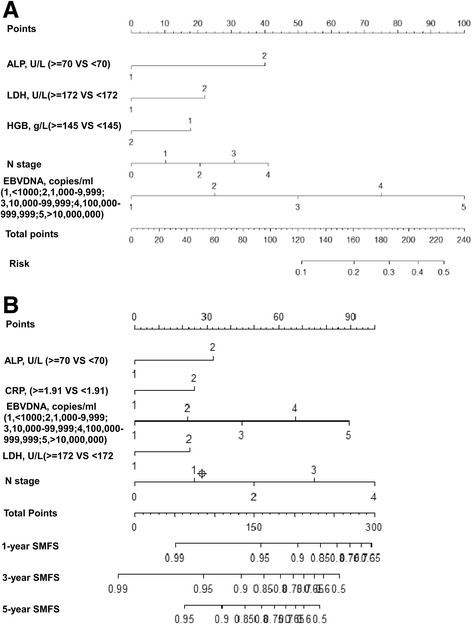
Background: The skeletal system is the most common site of distant metastasis in nasopharyngeal carcinoma (NPC); various prognostic factors have been reported for skeletal metastasis, though most studies have focused on a single factor. We aimed to establish nomograms to effectively predict skeletal metastasis at initial diagnosis (SMAD) and skeletal metastasis-free survival (SMFS) in NPC.
Methods: A total of 2685 patients with NPC who received bone scintigraphy (BS) and/or 18F-deoxyglucose positron emission tomography/computed tomography (18F-FDG PET/CT) and 2496 patients without skeletal metastasis were retrospectively assessed to develop individual nomograms for SMAD and SMFS. The models were validated externally using separate cohorts of 1329 and 1231 patients treated at two other institutions.
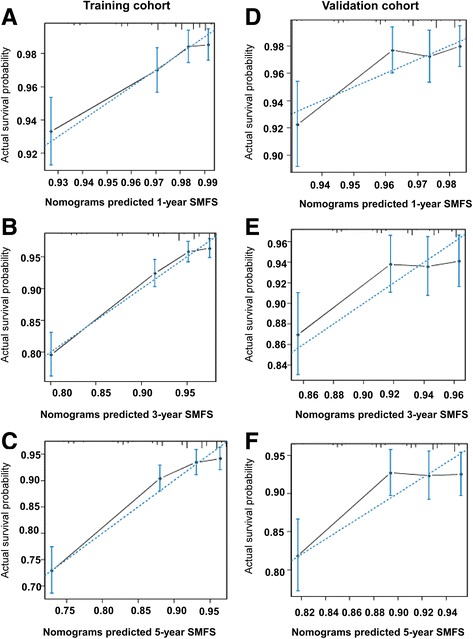
Results: Five independent prognostic factors were included in each nomogram. The SMAD nomogram had a significantly higher c-index than the TNM staging system (training cohort, P = 0.005; validation cohort, P < 0.001). The SMFS nomogram had significantly higher c-index values in the training and validation sets than the TNM staging system (P < 0.001 and P = 0.005, respectively). Three proposed risk stratification groups were created using the nomograms, and enabled significant discrimination of SMFS for each risk group.
Conclusion: The prognostic nomograms established in this study enable accurate stratification of distinct risk groups for skeletal metastasis, which may improve counseling and facilitate individualized management of patients with NPC.
Keywords: Nasopharyngeal carcinoma; Nomograms; Prognosis; Skeletal metastasis at the time of diagnosis (SMAD); Skeletal metastasis free survival (SMFS).
Conflict of interest statement
Ethics approval and consent to participate
Ethical approval was obtained from the institution through the respective institutional review boards, which belong to the Ethics Committee of Sun Yat-sen University Cancer Center. All patients provided written informed consent to participate in this study.
Consent for publication
Not applicable
Competing interests
The authors declare that they have no competing interests.
Publisher’s Note
Springer Nature remains neutral with regard to jurisdictional claims in published maps and institutional affiliations.
Figures

References
-
- Fong KW, Chua EJ, Chua ET, Khoo-Tan HS, Lee KM, Lee KS, Sethi VK, Tan BC, Tan TW, Wee J, et al. Patient profile and survival in 270 computer tomography-staged patients with nasopharyngeal cancer treated at the Singapore General Hospital. Ann Acad Med Singap. 1996;25(3):341–346. - PubMed
-
- Heng DM, Wee J, Fong KW, Lian LG, Sethi VK, Chua ET, Yang TL, Khoo Tan HS, Lee KS, Lee KM, et al. Prognostic factors in 677 patients in Singapore with nondisseminated nasopharyngeal carcinoma. Cancer. 1999;86(10):1912–1920. doi: 10.1002/(SICI)1097-0142(19991115)86:10<1912::AID-CNCR6>3.0.CO;2-S. - DOI - PubMed
MeSH terms
Substances
LinkOut - more resources
Full Text Sources
Other Literature Sources
Medical
