doi: 10.1136/bmj.j2440.
Antibiotic residues in the environment of South East Asia
Affiliations
- PMID: 28874355
- PMCID: PMC5598253
- DOI: 10.1136/bmj.j2440
Item in Clipboard
Antibiotic residues in the environment of South East Asia
BMJ.
.
Abstract
Cecilia Stålsby Lundborg and Ashok Tamhankar discuss how antibiotic residues in the environment contribute to antibiotic resistance in South East Asia and propose actions to mitigate the problem
Conflict of interest statement
Competing interests: We have read and understood BMJ’s policy on declaration of interest and have no relevant interests to declare. This work was commissioned by the WHO Regional Office of South East Asia using the UK government’s Fleming Fund. The authors alone are responsible for the views expressed in this article, which does not necessarily represent the views, decisions, or policies of the institutions with which the authors are affiliated.
Figures
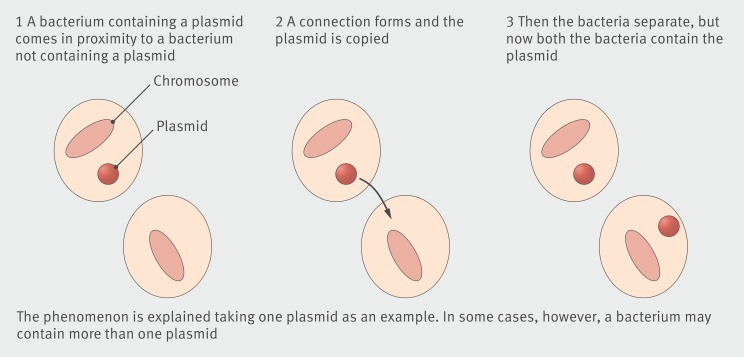
Figure 1 How a plasmid, which might contain antibiotic resistance genes, gets copied from one bacterium to another
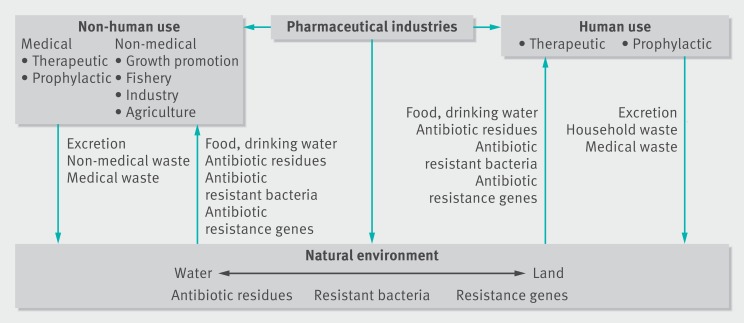
Figure 2 Potential routes of creation of antibiotic residues in the environment and transmission to and from the environment of antibiotic residues, antibiotic resistant bacteria, and antibiotic resistance genes
References
-
- World Health Organization. Global action plan on antimicrobial resistance. 2015. www.wpro.who.int/entity/drug_resistance/resources/global_action_plan_eng.... - PubMed
-
- Ashbolt NJ, Amézquita A, Backhaus T, et al. Human Health Risk Assessment (HHRA) for environmental development and transfer of antibiotic resistance. Environ Health Perspect 2013;121:993-1001.pmid:23838256. - PMC - PubMed
-
- Kümmerer K. Antibiotics in the aquatic environment: a review: part I. Chemosphere 2009;75:417-34. 10.1016/j.chemosphere.2008.11.086 pmid:19185900. - DOI - PubMed
-
- Rehman MS, Rashid N, Ashfaq M, Saif A, Ahmad N, Han JI. Global risk of pharmaceutical contamination from highly populated developing countries. Chemosphere 2015;138:1045-55. 10.1016/j.chemosphere.2013.02.036 pmid:23535471. - DOI - PubMed
-
- Larsson DGJ, de Pedro C, Paxeus N. Effluent from drug manufactures contains extremely high levels of pharmaceuticals. J Hazard Mater 2007;148:751-5. 10.1016/j.jhazmat.2007.07.008 pmid:17706342. - DOI - PubMed
MeSH terms
Substances
LinkOut - more resources
Full Text Sources
Other Literature Sources
Medical