


Direct dating of Neanderthal remains from the site of Vindija Cave and implications for the Middle to Upper Paleolithic transition
- PMID: 28874524
- PMCID: PMC5635904
- DOI: 10.1073/pnas.1709235114
Direct dating of Neanderthal remains from the site of Vindija Cave and implications for the Middle to Upper Paleolithic transition
Abstract
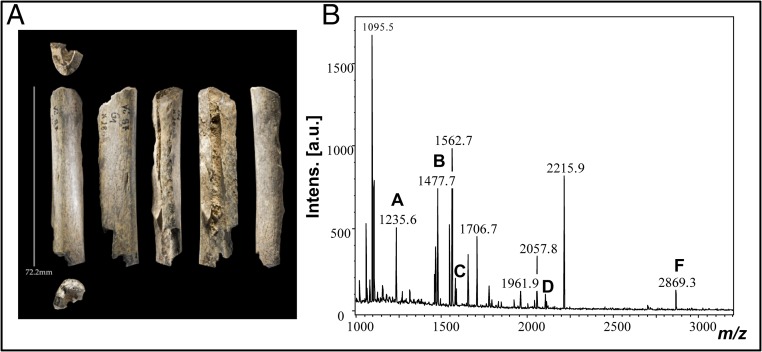
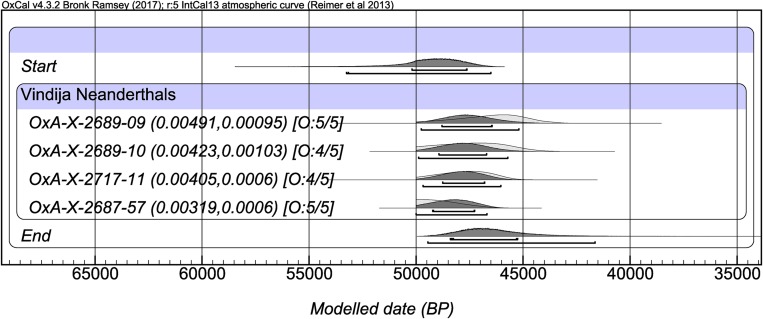
Previous dating of the Vi-207 and Vi-208 Neanderthal remains from Vindija Cave (Croatia) led to the suggestion that Neanderthals survived there as recently as 28,000-29,000 B.P. Subsequent dating yielded older dates, interpreted as ages of at least ∼32,500 B.P. We have redated these same specimens using an approach based on the extraction of the amino acid hydroxyproline, using preparative high-performance liquid chromatography (Prep-HPLC). This method is more efficient in eliminating modern contamination in the bone collagen. The revised dates are older than 40,000 B.P., suggesting the Vindija Neanderthals did not live more recently than others across Europe, and probably predate the arrival of anatomically modern humans in Eastern Europe. We applied zooarchaeology by mass spectrometry (ZooMS) to find additional hominin remains. We identified one bone that is Neanderthal, based on its mitochondrial DNA, and dated it directly to 46,200 ± 1,500 B.P. We also attempted to date six early Upper Paleolithic bone points from stratigraphic units G1, Fd/d+G1 and Fd/d, Fd. One bone artifact gave a date of 29,500 ± 400 B.P., while the remainder yielded no collagen. We additionally dated animal bone samples from units G1 and G1-G3 These dates suggest a co-occurrence of early Upper Paleolithic osseous artifacts, particularly split-based points, alongside the remains of Neanderthals is a result of postdepositional mixing, rather than an association between the two groups, although more work is required to show this definitively.
Keywords: DNA analysis; Middle to Upper Paleolithic transition; Vindija Cave (Croatia); single-compound AMS dating; zooarchaeology by mass spectrometry.
Conflict of interest statement
The authors declare no conflict of interest.
Figures
Comment in
-
The last Neanderthal.Proc Natl Acad Sci U S A. 2017 Oct 3;114(40):10520-10522. doi: 10.1073/pnas.1714533114. Epub 2017 Sep 25. Proc Natl Acad Sci U S A. 2017. PMID: 28973864 Free PMC article. No abstract available.
References
-
- Mellars P. A new radiocarbon revolution and the dispersal of modern humans in Eurasia. Nature. 2006;439:931–935. - PubMed
-
- Hublin J-J. The modern human colonization of western Eurasia: When and where? Quat Sci Rev. 2015;118:194–210.
-
- Mellars P. Neanderthals and the modern human colonization of Europe. Nature. 2004;432:461–465. - PubMed
-
- Higham T, et al. The timing and spatiotemporal patterning of Neanderthal disappearance. Nature. 2014;512:306–309. - PubMed
Publication types
MeSH terms
LinkOut - more resources
Full Text Sources
Other Literature Sources
Miscellaneous
