


Self-report captures 27 distinct categories of emotion bridged by continuous gradients
- PMID: 28874542
- PMCID: PMC5617253
- DOI: 10.1073/pnas.1702247114
Self-report captures 27 distinct categories of emotion bridged by continuous gradients
Abstract
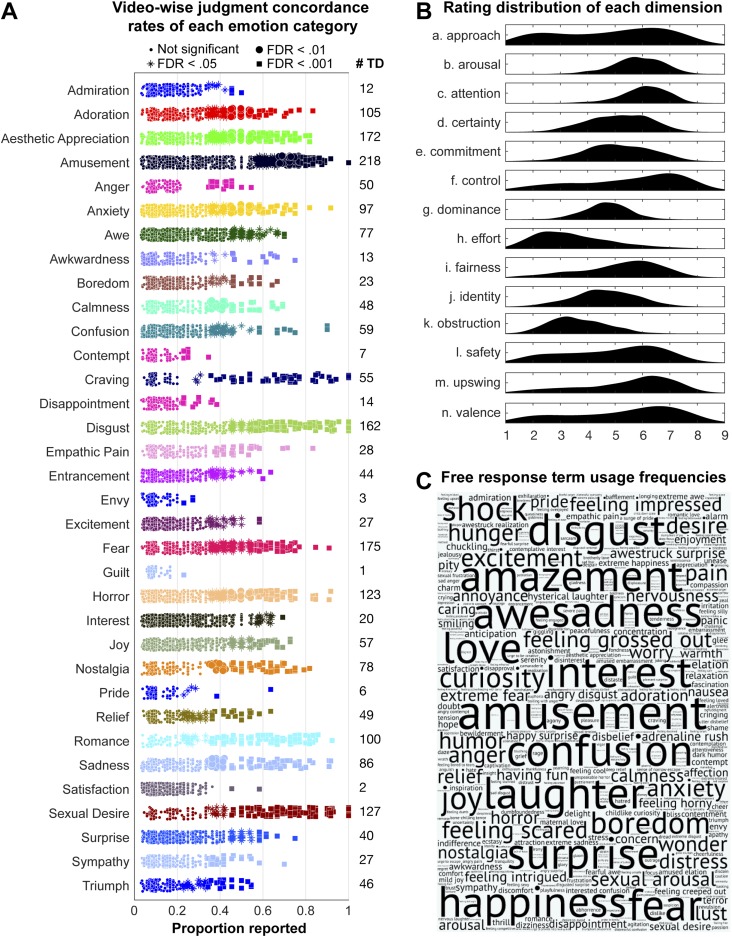
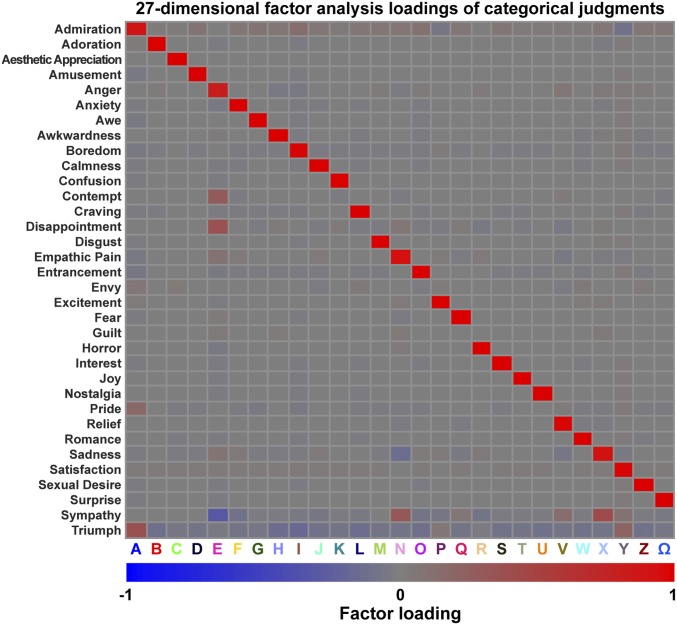
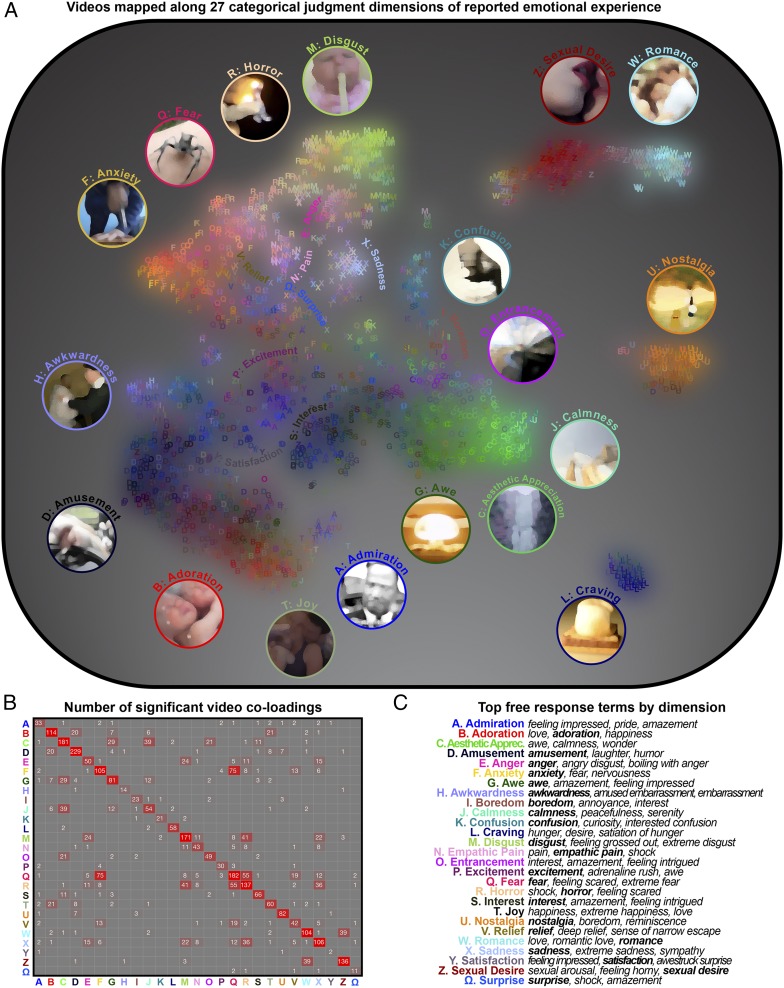
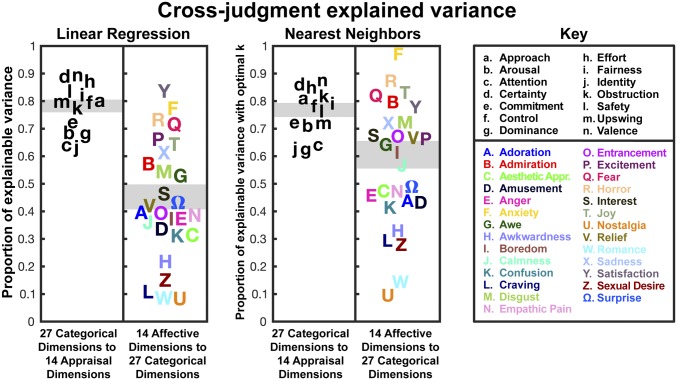
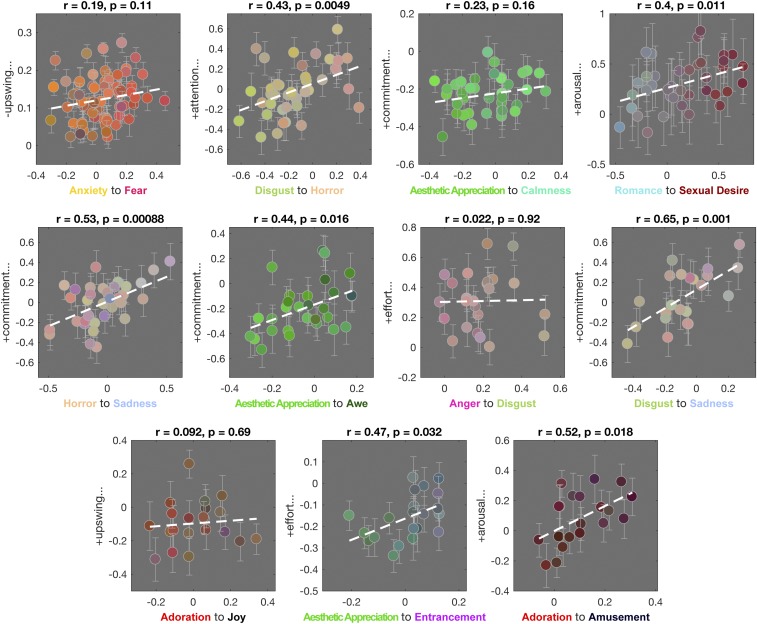
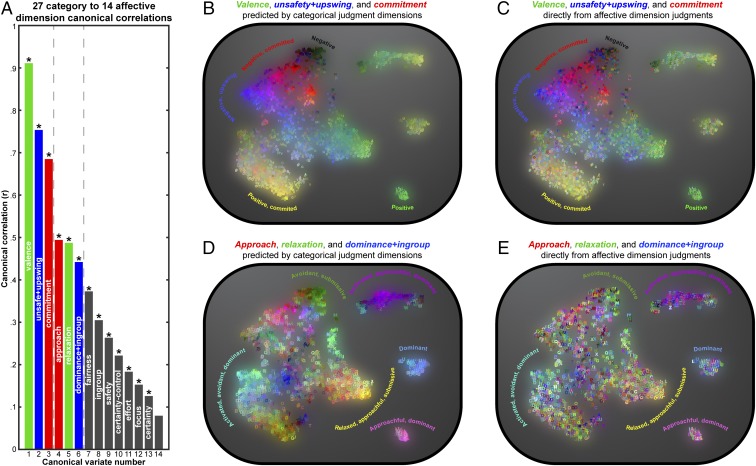
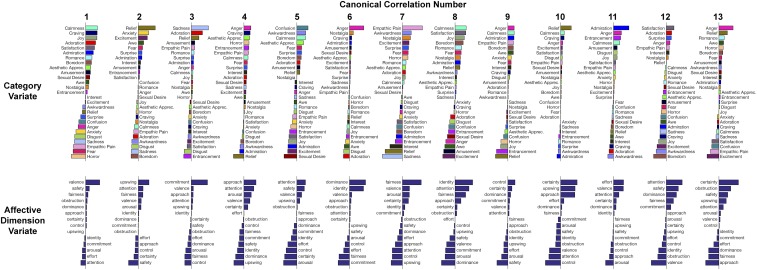
Emotions are centered in subjective experiences that people represent, in part, with hundreds, if not thousands, of semantic terms. Claims about the distribution of reported emotional states and the boundaries between emotion categories-that is, the geometric organization of the semantic space of emotion-have sparked intense debate. Here we introduce a conceptual framework to analyze reported emotional states elicited by 2,185 short videos, examining the richest array of reported emotional experiences studied to date and the extent to which reported experiences of emotion are structured by discrete and dimensional geometries. Across self-report methods, we find that the videos reliably elicit 27 distinct varieties of reported emotional experience. Further analyses revealed that categorical labels such as amusement better capture reports of subjective experience than commonly measured affective dimensions (e.g., valence and arousal). Although reported emotional experiences are represented within a semantic space best captured by categorical labels, the boundaries between categories of emotion are fuzzy rather than discrete. By analyzing the distribution of reported emotional states we uncover gradients of emotion-from anxiety to fear to horror to disgust, calmness to aesthetic appreciation to awe, and others-that correspond to smooth variation in affective dimensions such as valence and dominance. Reported emotional states occupy a complex, high-dimensional categorical space. In addition, our library of videos and an interactive map of the emotional states they elicit (https://s3-us-west-1.amazonaws.com/emogifs/map.html) are made available to advance the science of emotion.
Keywords: dimensions; discrete emotion; emotional experience; semantic space.
Conflict of interest statement
The authors declare no conflict of interest.
Figures
Comment in
-
Nature of Emotion Categories: Comment on Cowen and Keltner.Trends Cogn Sci. 2018 Feb;22(2):97-99. doi: 10.1016/j.tics.2017.12.004. Epub 2018 Jan 16. Trends Cogn Sci. 2018. PMID: 29373283 Free PMC article.
-
Clarifying the Conceptualization, Dimensionality, and Structure of Emotion: Response to Barrett and Colleagues.Trends Cogn Sci. 2018 Apr;22(4):274-276. doi: 10.1016/j.tics.2018.02.003. Epub 2018 Feb 21. Trends Cogn Sci. 2018. PMID: 29477775 Free PMC article.
References
-
- Izard CE. Basic emotions, natural kinds, emotion schemas, and a new paradigm. Perspect Psychol Sci. 2007;2:260–280. - PubMed
-
- Izard CE. Emotion feelings stem from evolution and neurobiological development, not from conceptual acts: Corrections for Barrett et al., 2007. Perspect Psychol Sci. 2007;2:404–405. - PubMed
-
- Goldie P. Emotion, feeling, and knowledge of the world. In: Solomon RC, editor. Thinking About Feeling: Contemporary Philosophers on Emotions. Oxford Univ Press; Oxford: 2004.
-
- Frijda NH. Emotions and hedonic experience. In: Kahneman D, Schwarz N, Diener E, editors. Well-Being: Foundations of Hedonic Psychology. Russell Sage Foundation; New York: 2003.
Publication types
MeSH terms
Grants and funding
LinkOut - more resources
Full Text Sources
Other Literature Sources
