. 2017 Sep 5;7(1):10537.
doi: 10.1038/s41598-017-07692-w.

Sargassum muticum and Jania rubens regulate amino acid metabolism to improve growth and alleviate salinity in chickpea

Affiliations

Sargassum muticum and Jania rubens regulate amino acid metabolism to improve growth and alleviate salinity in chickpea

Arafat Abdel Hamed Abdel Latef et al. Sci Rep. .

Abstract

The present study evaluates the potential of Sar gassum muticum (Sar) and Jan ia rubens (Jan) seaweeds for enhancing growth and mitigating soil-salinity in chickpea (Cicer arietinum L.). Under control conditions, Sar and Jan extracts improved chickpea growth which was attributed to their potential for increasing photosynthetic pigments, K+ and amino acids, particularly proline, in comparison with water-sprayed control. Upon stress imposition, chickpea growth was reduced in NaCl concentration-dependent manner, and principal component analysis (PCA) revealed Na+ accumulation and oxidative damage as major determinants of sensitivity at high salinity. Furthermore, amino acid quantification indicated activation/deactivation of overall metabolism in roots/shoots, as an adaptive strategy, for maintaining plant growth under salt stress. Sar and Jan extract supplementations provided stress amelioration, and PCA confirmed that improved growth parameters at high salinity were associated with enhanced activities of superoxide dismutase and peroxidase. Besides, four key amino acids, including serine, threonine, proline and aspartic acids, were identified from roots which maximally contribute to Sar- and Jan-mediated stress amelioration. Sar showed higher effectiveness than Jan under both control and salt stress conditions. Our findings highlight "bio-stimulant" properties of two seaweeds and provide mechanistic insight into their salt-ameliorating action which is relevant for both basic and applied research.


Conflict of interest statement

The authors declare that they have no competing interests.

Figures
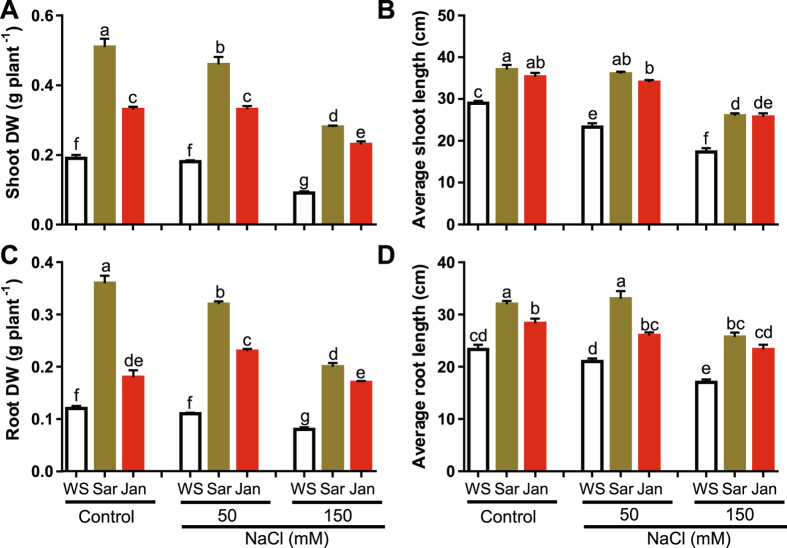
Figure 1
Figure 1
Effects of Sar and Jan extract applications on plant growth attributes of 35 day-old chickpea plants under normal and soil-saline conditions. (A) shoot dry weight (DW), (B) shoot length, (C) root DW and (D) root length. Data represent means and standard errors (error bars) of three biological replicates. Different letters indicate significant difference (p < 0.05), according to a Duncan’s multiple range test. WS, Sar and Jan represent plants receiving foliar application of water, Sar and Jan extracts, respectively.
Figure 2
Figure 2
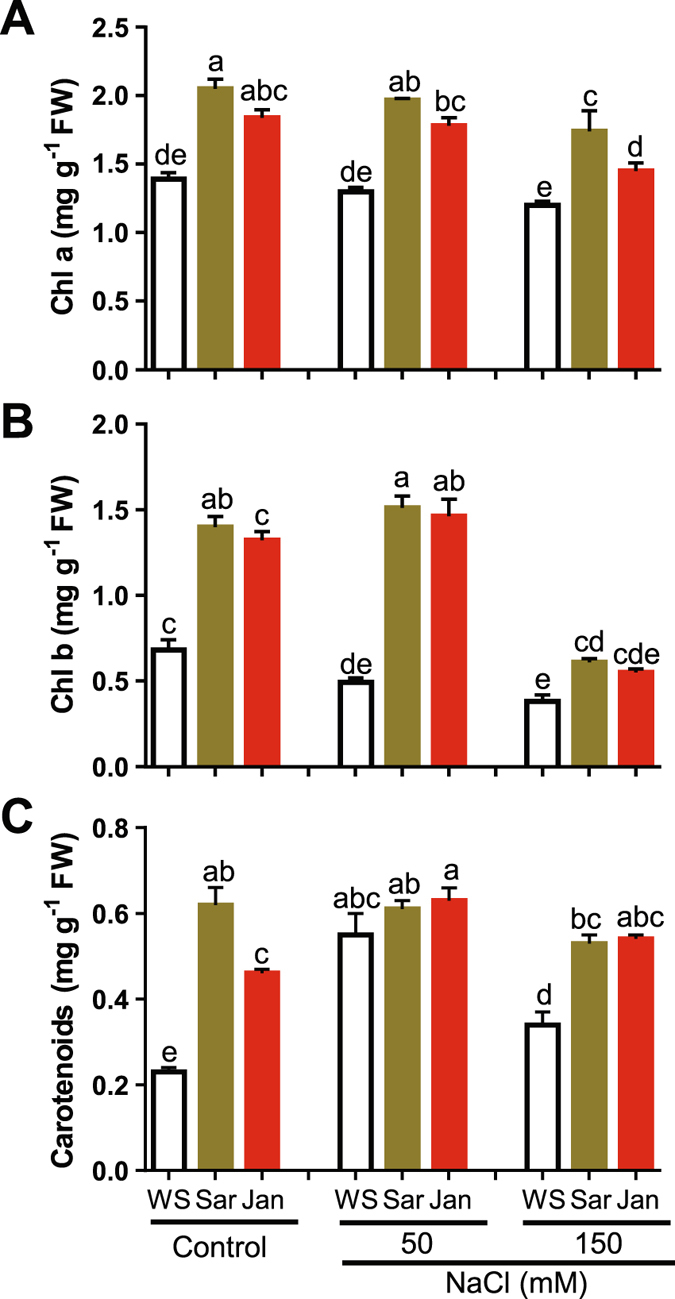
Effects of Sar and Jan extract applications on biosynthesis of photosynthetic pigments in 35 day-old chickpea plants under normal and soil-saline conditions. (A) chlorophyll a (Chl a), (B) chlorophyll b (Chl b), and (C) carotenoid contents. Data represent means and standard errors (error bars) of three biological replicates. Different letters indicate significant difference (p < 0.05), according to Duncan’s multiple range test. WS, Sar and Jan represent plants receiving foliar application of water, Sar and Jan extracts, respectively. FW, fresh weight.
Figure 3
Figure 3
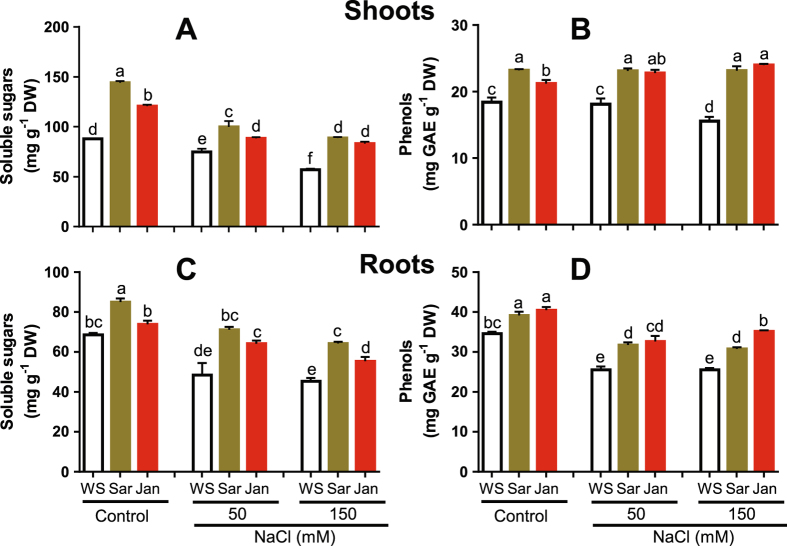
Effects of Sar and Jan extract applications on various metabolite contents in 35 day-old chickpea plants under normal and soil-saline conditions. (A) soluble sugar contents in shoots, (B) phenol contents in shoots, (C) soluble sugar contents in roots (D) phenol contents in roots. Data represent means and standard errors (error bars) of three biological replicates. Different letters indicate significant difference (p < 0.05), according to a Duncan’s multiple range test. WS, Sar and Jan represent plants receiving foliar application of water, Sar and Jan extracts, respectively. DW, dry weight; GAE, gallic acid equivalent.
Figure 4
Figure 4
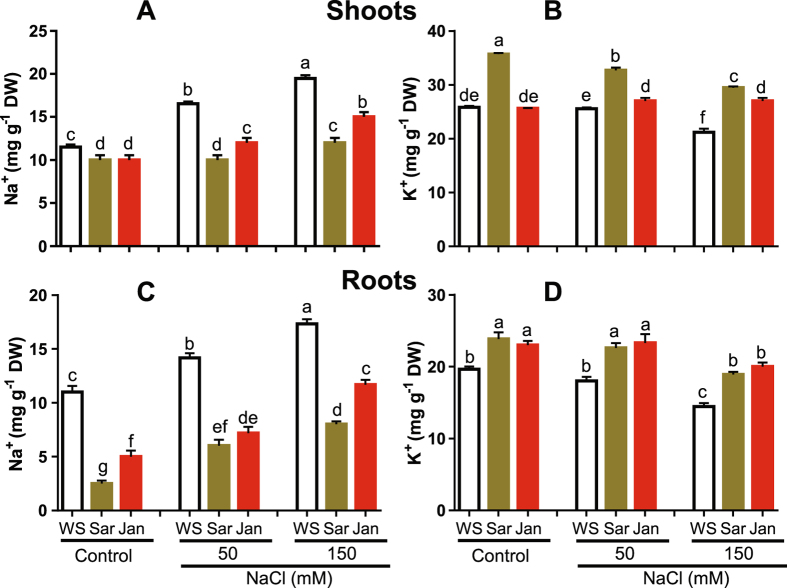
Effects of Sar and Jan extract applications on ion accumulations in 35 day-old chickpea plants under normal and soil-saline conditions. (A) shoot-Na+, (B) shoot-K+, (C) root-Na+ and (D) root-K+ contents. Data represent means and standard errors (error bars) of three biological replicates. Different letters indicate significant difference (p < 0.05), according to a Duncan’s multiple range test. WS, Sar and Jan represent plants receiving foliar application of water, Sar and Jan extracts, respectively. DW, dry weight.
Figure 5
Figure 5
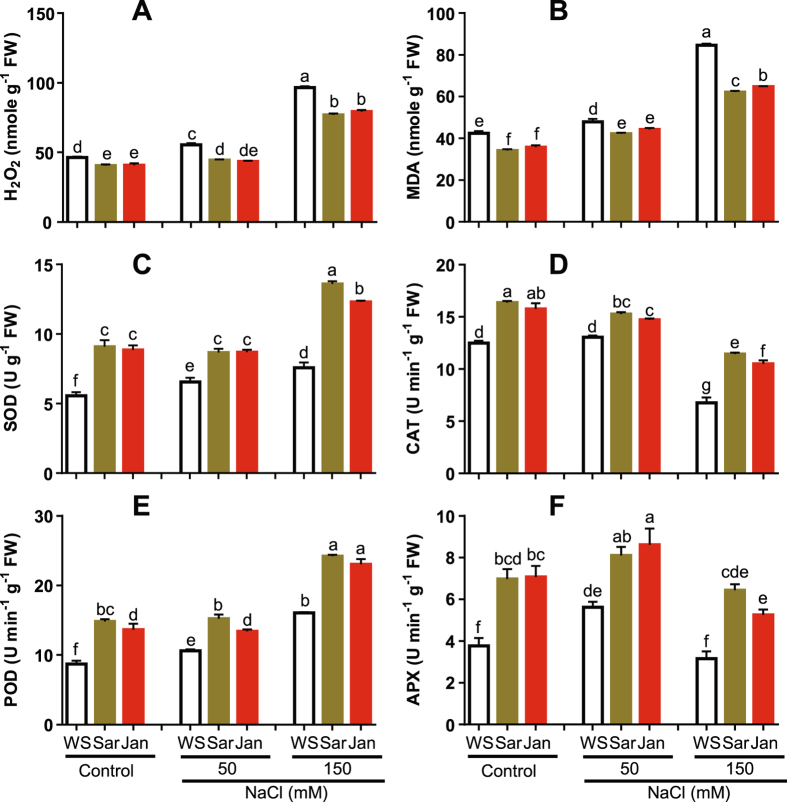
Effects of Sar and Jan extract applications on contents of malondialdehyde (MDA) and hydrogen peroxide (H2O2), and activities of antioxidant enzymes in 35 day-old chickpea plants under normal and soil-saline conditions. (A) H2O2 content, (B) MDA content, (C) superoxide dismutase (SOD), (D) catalase (CAT), (E) peroxidase (POD) and (F) ascorbate peroxidase (APX) activities. Data represent means and standard errors (error bars) of three biological replicates. Different letters indicate significant difference (p < 0.05) according to a Duncan’s multiple range test. WS, Sar and Jan represent plants receiving foliar application of water, Sar and Jan extracts, respectively. FW, fresh weight.
Figure 6
Figure 6
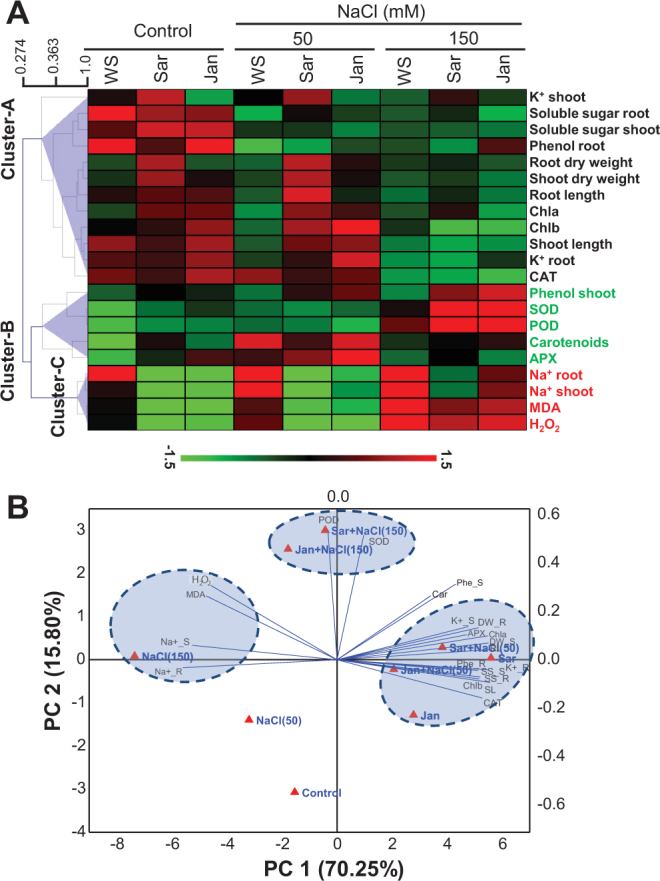
Hierchial clustering and principal component analysis (PCA) to understand treatment-variable relationships in chickpea plants. (A) The mean values of different parameters were normalized and clustered. Variables associated with three major clusters A, B and C are demarcated with black, green and red color, respectively. (B) The entire data were analyzed using PCA. The lines originating from central point of biplots indicate positive or negative correlations of different variables; where their closeness indicates correlation strength with particular treatment. The variables included DW_R (root dry weight), DW_S (shoot dry weight), RL (root length), SL (shoot length), Chl a (chlorophyll a), Chl b (chlorophyll b), Car (carotenoids), SS_R (root-soluble sugars), SS_S (shoot-soluble sugars), Phe_R (root-phenols), Phe_S (shoot-phenols), Na+_R (root-Na+), Na+_S (shoot-Na+), K+_R (root-K+), K+_S (shoot-K+), SOD (superoxide dismutase), CAT (catalase), POD (peroxidase), APX (ascorbate peroxidase), MDA (malondialdehyde) and H2O2 (hydrogen peroxide). Refer to Supplementary Table 1 for cumulative PCA scores for each treatment. WS, Sar and Jan represent plants receiving foliar application of water, Sar and Jan extracts, respectively.
Figure 7
Figure 7
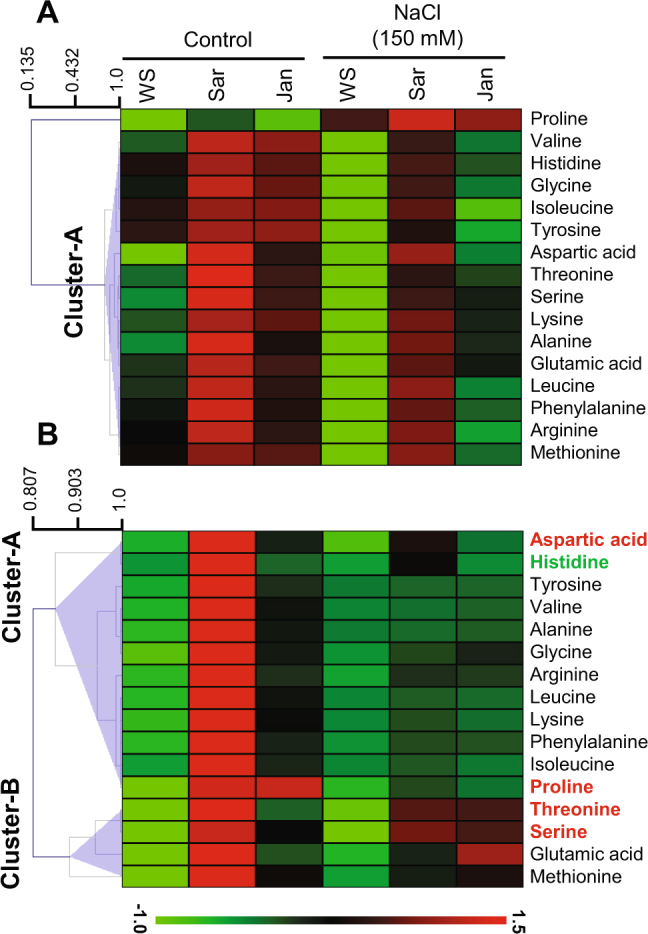
Profiling of different amino acids in 35 day-old chickpea plants under normal and soil-salinity conditions. (A) shoot and (B) root amino acid patterns. Heat-map represents the normalized mean values of three independent biological replicates. In roots, key amino acid showing more than 1.5 fold increase in both Sar and Jan treated plant under 150 mM NaCl as compared with stressed WS plants are marked as bold red while that increased under Sar alone is marked as bold green. Refer to Supplementary Table 2 for absolute changes in amino acid level under different treatments. WS, Sar and Jan represent plants receiving foliar application of water, Sar and Jan extracts, respectively. FW, fresh weight.

References

    1. Craigie JS. Seaweed extract stimuli in plant science and agriculture. J Appl Phycol. 2011;23:371–393. doi: 10.1007/s10811-010-9560-4. - DOI
    1. Nayar S, Bott K. Current status of global cultivated seaweed production and markets. World Aquaculture. 2014;45:32–37.
    1. FIPS, F. FAO year book: fishery and aquaculture statistics 2010. FAO, Rome (2012).
    1. Khan W, et al. Seaweed extracts as biostimulants of plant growth and development. J Plant Growth Regul. 2009;28:386–399. doi: 10.1007/s00344-009-9103-x. - DOI
    1. Lötze E, Hoffman EW. Nutrient composition and content of various biological active compounds of three South African-based commercial seaweed biostimulants. J Appl Phycol. 2016;28:1379–1386. doi: 10.1007/s10811-015-0644-z. - DOI

Publication types

LinkOut - more resources