. 2017 Sep 5;7(1):10555.
doi: 10.1038/s41598-017-11215-y.

A cross-sectional comparative study of gut bacterial community of Indian and Finnish children

Affiliations

A cross-sectional comparative study of gut bacterial community of Indian and Finnish children

Shreyas V Kumbhare et al. Sci Rep. .

Abstract

The human gut microbiome plays a crucial role in the compositional development of gut microbiota. Though well documented in western pediatrics population, little is known about how various host conditions affect populations in different geographic locations such as the Indian subcontinent. Given the impact of distinct environmental conditions, our study assess the gut bacterial diversity of a small cohort of Indian and Finnish children and investigated the influence of FUT2 secretor status and birth mode on the gut microbiome of these populations. Using multiple profiling techniques, we show that the gut bacterial community structure in 13-14-year-old Indian (n = 47) and Finnish (n = 52) children differs significantly. Specifically, Finnish children possessed higher Blautia and Bifidobacterium, while genera Prevotella and Megasphaera were predominant in Indian children. Our study also demonstrates a strong influence of FUT2 and birth mode variants on specific gut bacterial taxa, influence of which was noticed to differ between the two populations under study.


Conflict of interest statement

The authors declare that they have no competing interests.

Figures
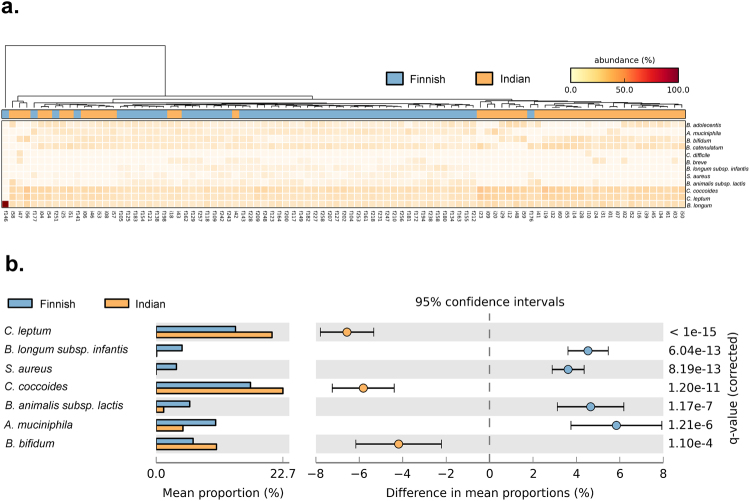
Figure 1
Figure 1
Real time quantification of bacterial species. (a) Heat Map is illustrating the extent of differences in the abundance of targeted bacterial species across samples from a Finnish and Indian population. (b) Extended bar plot is representing the differential abundance of significantly different bacterial species based on real time quantification data.
Figure 2
Figure 2
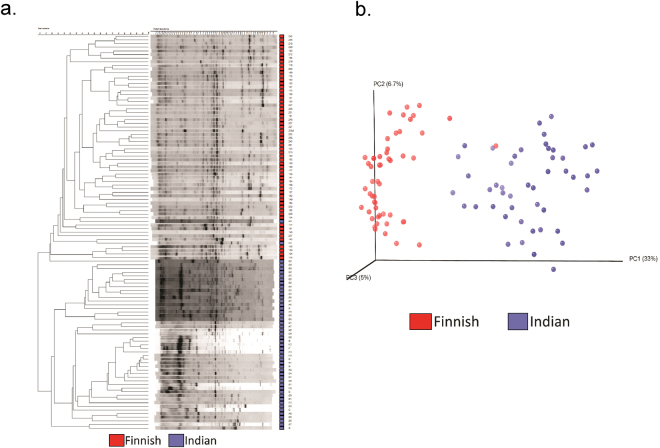
DGGE based diversity analysis. (a) UPGMA Cluster analysis based on PCR-DGGE analysis fingerprints from all samples. Finnish samples (red) and Indian samples (purple). (b) PCoA plot using Euclidean distances based on the prevalence of bands, representing differences in diversity between two populations: Finnish samples (red) and Indian samples (purple).
Figure 3
Figure 3
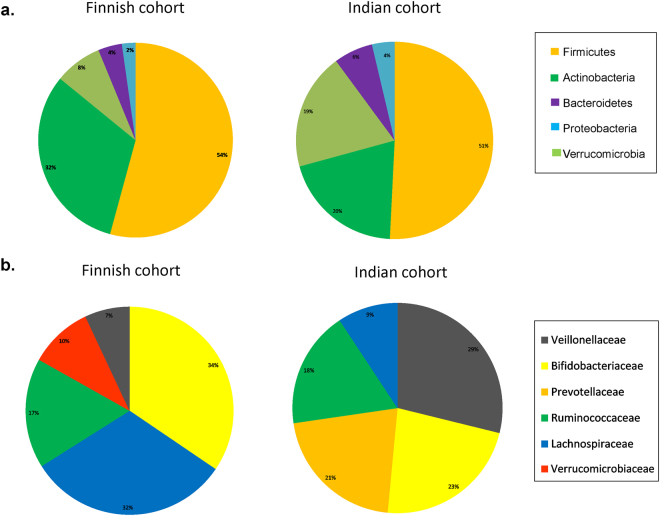
Gut bacterial community composition. (a) Phylum level distribution of dominant gut bacterial groups within Indian and Finnish children. (b) Family level distribution of dominant gut bacterial groups within Indian and Finnish children.
Figure 4
Figure 4
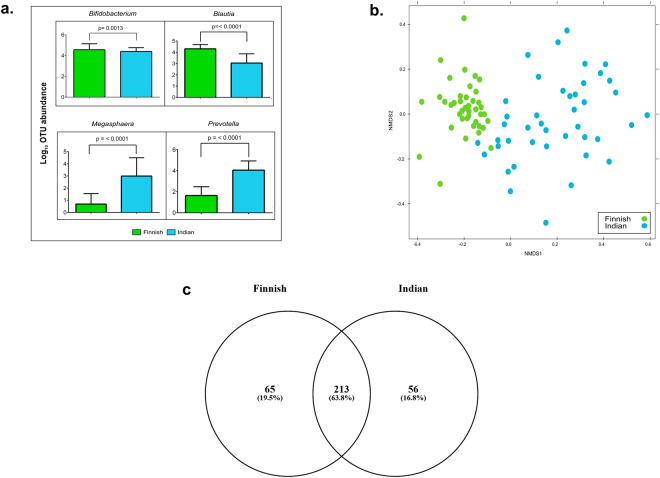
Beta diversity analysis. (a) Box plot illustrating differences in relative abundances of key contributors (most dominant) of bacterial community between Indian (blue) and Finnish children (green). (b) Beta diversity analysis using NMDS plot based on OTU level differences between Finnish (green) and Indian (blue) children (c) Venn diagram representing shared and unique bacterial genera between the gut bacterial community of Finnish and Indian children.
Figure 5
Figure 5
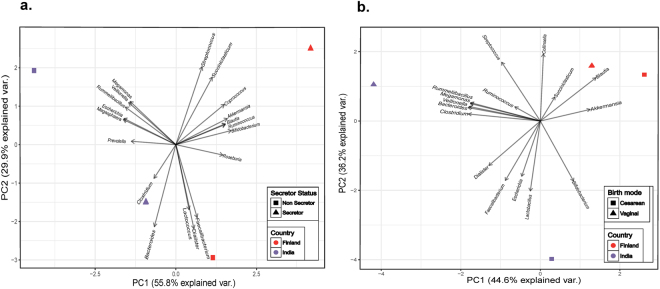
Principal Component Analysis. PCA was performed using the bacterial genera data; relative abundances were observed to be differing with FUT2 secretor state and birth mode in both the populations (Supplementary Figs S4 and S5). Results were plotted according to the PC1 and PC2 scores with the percent variation explained by respective axis. Specific colors were used to indicate the region and different shapes to indicate either the secretor state (a) or birth mode (b). Arrows indicate bacterial genera with their names.
Figure 6
Figure 6
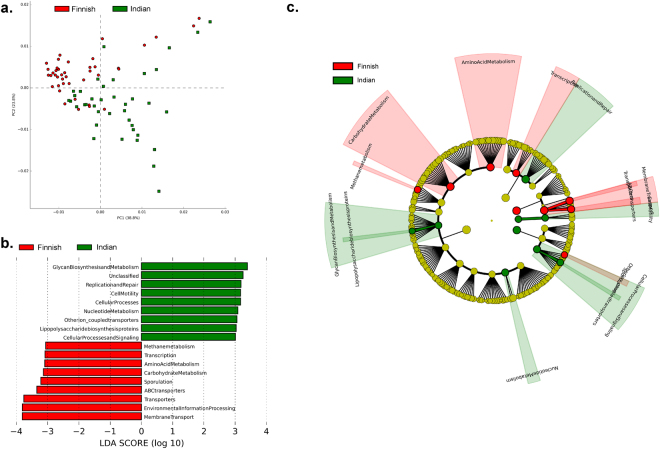
Imputed metagenomic functions of the gut bacterial community. (a) PCA plot is illustrating differences in metabolic functions of the gut bacterial community of Finnish (red) and Indian (green) children. (b) Bar chart is representing specific metabolic function differential abundant in Finnish and Indian children (Effect size filter = >2.0). (c) Cladogram representing differences in abundance of microbial genes between the gut bacterial community of Finnish and Indian children contributing in specific metabolic pathways.
Figure 7
Figure 7
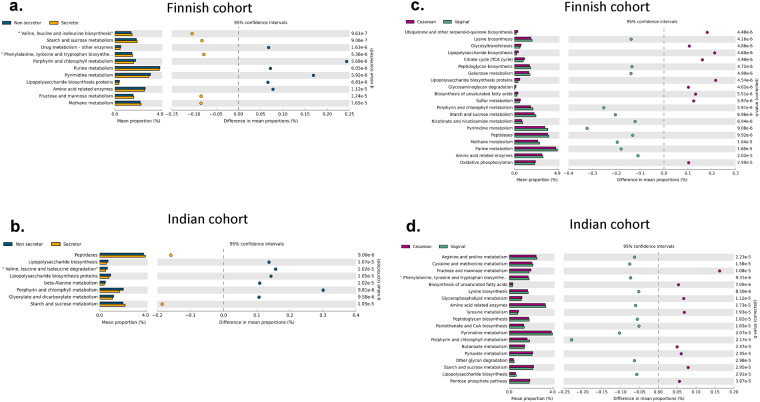
Effect of FUT2 secretor status and birth mode on the pattern of microbial metabolic functions. (a and b) Extended bar plots are representing significantly different KEGG orthologs associated with microbial metabolic functions between secretor and non-secretor children of the Finnish and Indian population respectively. (c and d) Extended bar plots are representing significantly different KEGG orthologs associated with microbial metabolic functions between vaginally born and cesarean born children of the Finnish and Indian population respectively. Appropriate effect size filter was employed to represent highly affected features.

References

    1. Kau AL, Ahern PP, Griffin NW, Goodman AL, Gordan JI. Human nutrition, the gut microbiome, and immune system: envisioning the future. Nature. 2012;474:327–336. doi: 10.1038/nature10213. - DOI - PMC - PubMed
    1. Round JL, Mazmanian SK. The gut microbiota shapes intestinal immune responses during health and disease. Nat Rev Immunol. 2009;9:313–323. doi: 10.1038/nri2515. - DOI - PMC - PubMed
    1. Thaiss CA, Zmora N, Levy M, Elinav E. The microbiome and innate immunity. Nature. 2016;535:65–74. doi: 10.1038/nature18847. - DOI - PubMed
    1. Bonder MJ, et al. The effect of host genetics on the gut microbiome. Nat. Genet. 2016;48:1407–1412. doi: 10.1038/ng.3663. - DOI - PubMed
    1. Brown K, DeCoffe D, Molcan E, Gibson DL. Diet-induced dysbiosis of the intestinal microbiota and the effects on immunity and disease. Nutrients. 2012;4:1095–1119. doi: 10.3390/nu4081095. - DOI - PMC - PubMed

Publication types

Substances

LinkOut - more resources