


Predictors of Return Visits Among Insured Emergency Department Mental Health and Substance Abuse Patients, 2005-2013
- PMID: 28874941
- PMCID: PMC5576625
- DOI: 10.5811/westjem.2017.6.33850
Predictors of Return Visits Among Insured Emergency Department Mental Health and Substance Abuse Patients, 2005-2013
Abstract
Introduction: Our goal was to describe the pattern and identify risk factors of early-return ED visits or inpatient admissions following an index mental health and substance abuse (MHSA)-related ED visit in the United States.
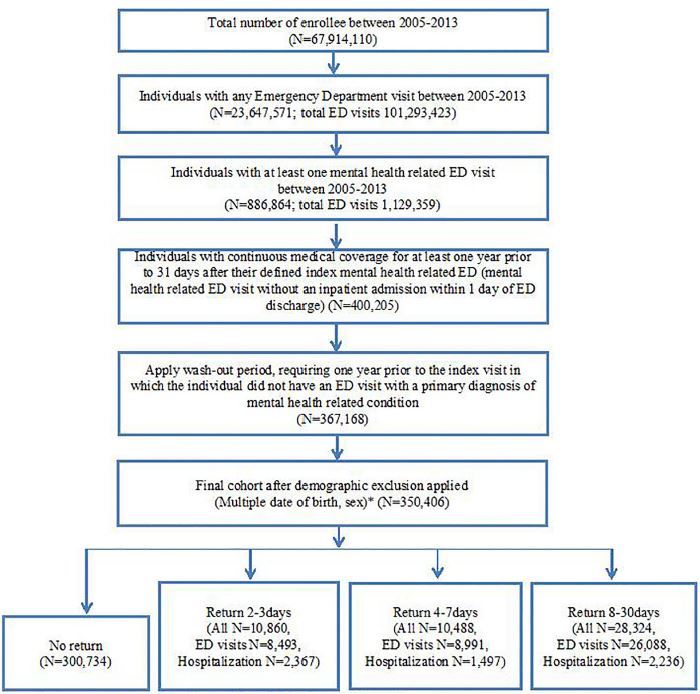
Methods: We performed a retrospective cohort study using Optum Labs Data Warehouse, a nationally representative database containing administrative claims data on privately insured and Medicare Advantage enrollees. Authors identified patients presenting to an ED with a primary diagnosis of MHSA between 2005 and 2013 who were discharged home. Study inclusion required continuous insurance enrollment for the 12 months preceding and the 31 days following the index ED visit. During the study period we included only the first ED visit for each patient.
Results: A total of 49,672 (14.2%) had a return visit to the ED or had a hospitalization within 30 days following discharge. Mean time to the next ED visit or inpatient admission was 11.7 days. An increased age (age 65+ vs. age <18 years; OR 1.65, 95% CI [1.57 to 1.74]), chronic medical comorbidities (Hwang comorbidity 5+ vs 0; OR 1.31, 95% CI [1.27 to 1.35]), prior ED and inpatient utilization (4+ visits vs 0 visits; OR 5.59, 95% CI [5.41 to 5.78]) were associated with return visits within 30 days following discharge.
Conclusion: In an analysis of nearly 350,000 ED visits for MHSA, 14.2 % of patients returned to the ED or hospital within 30 days. This study identified a number of factors associated with return visits for acute care.
Conflict of interest statement
Conflicts of Interest: By the WestJEM article submission agreement, all authors are required to disclose all affiliations, funding sources and financial or management relationships that could be perceived as potential sources of bias. This publication was made possible by funding from the Mayo Clinic Robert D. and Patricia E. Kern Center for Science of Health Care Delivery. The finding was presented at the American College of Emergency Physicians Scientific Assembly in Boston, MA in 2015.
Figures
References
-
- US Substance Abuse and Mental Health Services Administration. Nearly one in five adult Americans experienced mental illness in 2013. US Substance Abuse and Mental Health Services Administration; 2014.
-
- Torrey E, Entsminger K, Jaffe D. A Report of the Treatment Advocacy Center. The Shortage of Public Hospital Beds for Mentally Ill Persons.
-
- Larkin GL, Claassen CA, Emond JA, et al. Trends in U.S. emergency department visits for mental health conditions, 1992 to 2001. Psychiatr Serv. 2005;56(6):671–7. - PubMed
-
- Owens PL, Barrett ML, Gibson TB, et al. Emergency department care in the United States: a profile of national data sources. Ann Emerg Med. 2010;56(2):150–65. - PubMed
-
- Owens PL, Stocks C. Mental Health and Substance Abuse-Related Emergency Department Visits among Adults. AHRQ. 2007 Statistical brief #92, HCUP project. - PubMed
MeSH terms
LinkOut - more resources
Full Text Sources
Other Literature Sources
Medical