Review
. 2018 Jan;33(1):88-96.
doi: 10.1007/s11606-017-4161-4. Epub 2017 Sep 5.

Empirical Consequences of Current Recommendations for the Design and Interpretation of Noninferiority Trials

Affiliations
Review

Empirical Consequences of Current Recommendations for the Design and Interpretation of Noninferiority Trials

Scott K Aberegg et al. J Gen Intern Med. 2018 Jan.

Abstract

Background: Noninferiority trials are increasingly common, though they have less standardized designs and their interpretation is less familiar to clinicians than superiority trials.

Objective: To empirically evaluate a cohort of noninferiority trials to determine 1) their interpretation as recommended by CONSORT, 2) choice of alpha threshold and its sidedness, and 3) differences between methods of analysis such as intention-to-treat and per-protocol.

Design: We searched MEDLINE for parallel-group randomized controlled noninferiority trials published in the five highest-impact general medical journals between 2011 and 2016.

Main measures: Data abstracted included trial design parameters, results, and interpretation of results based on CONSORT recommendations.

Key results: One hundred sixty-three trials and 182 noninferiority comparisons were included in our analysis. Based on CONSORT-recommended interpretation, 79% of experimental therapies met criteria for noninferiority, 13% met criteria for superiority, 20% were declared inconclusive, and 2% met criteria for inferiority. However, for 12% of trials, the experimental therapy was statistically significantly worse than the active control, but CONSORT recommended an interpretation of inconclusive or noninferior. A two-sided alpha equivalent of greater than 0.05 was used in 34% of the trials, and in five of these trials, the use of a standard two-sided alpha of 0.05 led to changes in the interpretation of results that disfavored the experimental therapy. In four of the five comparisons where different methods of analysis (e.g., intention-to-treat and per-protocol) yielded different results, the intention-to-treat analysis was the more conservative. In 11% of trials, a secondary advantage of the new therapy was neither reported nor could it be inferred by reviewers.

Conclusions: In this cohort, the design and interpretation of noninferiority trials led to significant and systematic bias in favor of the experimental therapy. Clinicians should exercise caution when interpreting these trials. Future trials may be more reliable if design parameters are standardized.


Conflict of interest statement

The authors declare that they have no conflict of interest.

Figures
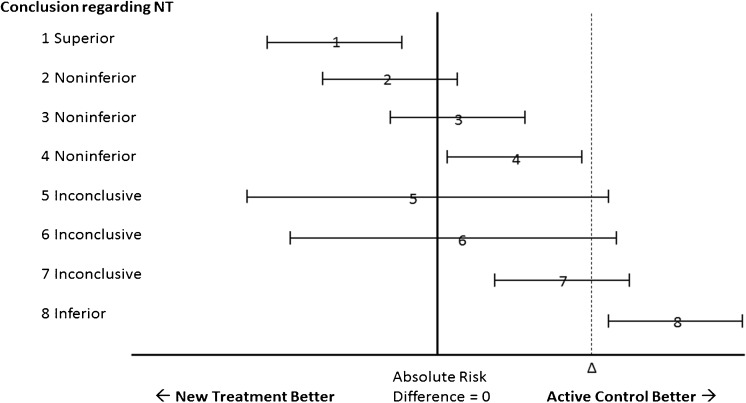
Figure 1
Figure 1
Simulacrum of the CONSORT diagram for interpreting the results of noninferiority trials. According to CONSORT, noninferiority can be declared whenever the upper bound of the confidence interval of the difference between the two therapies does not include delta, as in scenarios 1–4. Whenever the upper bound of the confidence interval exceeds delta, as in scenarios 5–7, noninferiority cannot be declared, because the plausible values of the parameter include some values greater than delta. When both the upper and lower bounds of the confidence interval exceed delta, the NT is declared inferior to the AC, as in scenario 8. Scenario 1 represents all situations in which the upper bound of the confidence interval is less than zero—that is, any statistically significant result favoring the NT garners a declaration of superiority for the NT. By contrast, in scenarios 4 and 7, where there is a statistically significant difference favoring the AC, the NT is not declared inferior in this schematic, but rather noninferior (scenario 4) or inconclusive (scenario 7). NT, new treatment; AC, active control; Δ, delta (the pre-specified margin of noninferiority).
Figure 2
Figure 2
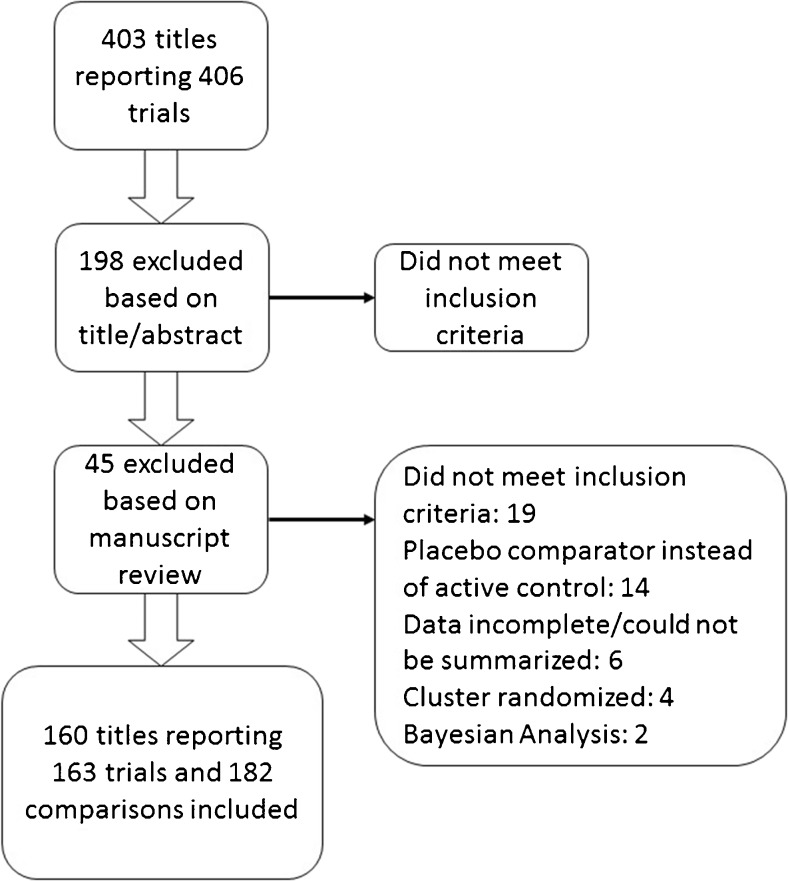
Flow diagram showing the results of our search.
Figure 3
Figure 3
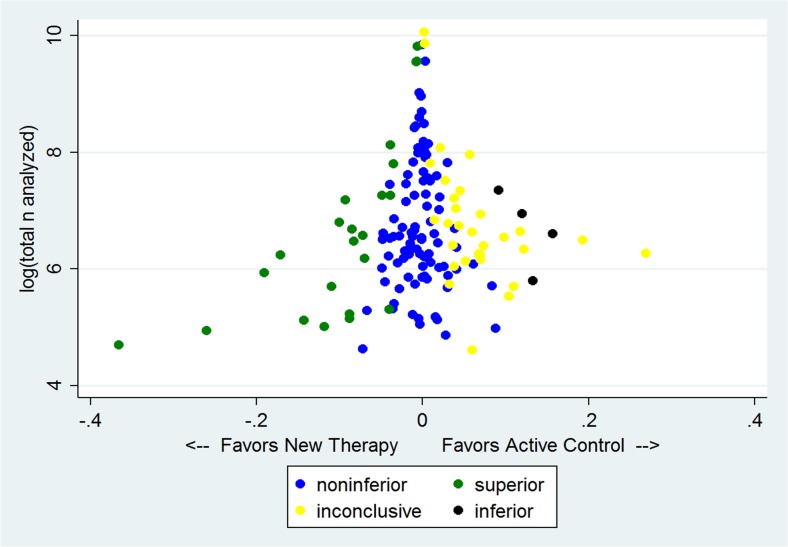
Plot of 151 comparisons of absolute risk differences as a function of the log of the total number of patients analyzed in the trial, color coded by the interpretation of the results as recommended by CONSORT. See text for details.
Figure 4
Figure 4
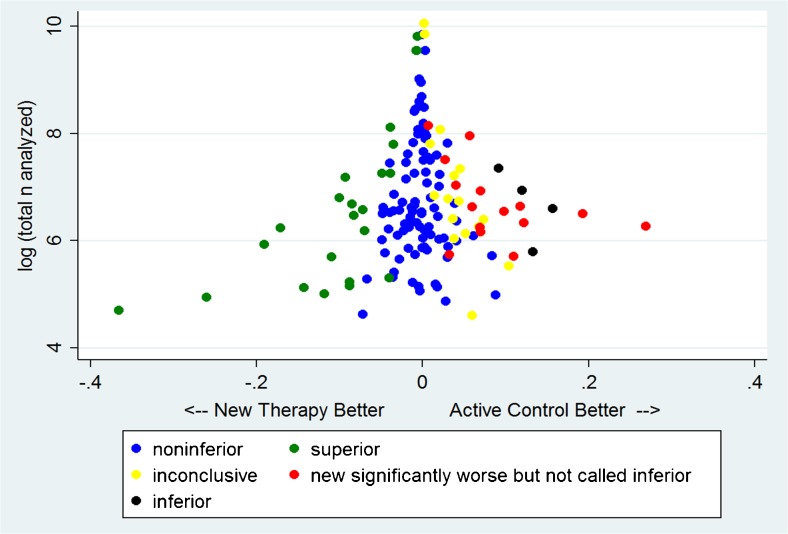
Plot of 151 comparisons with a calculable absolute risk difference as in Figure 3, but with statistically significant results in favor of active control (AC), coded as inconclusive or noninferior in Figure 3, denoted by red in Figure 4.
Figure 5
Figure 5
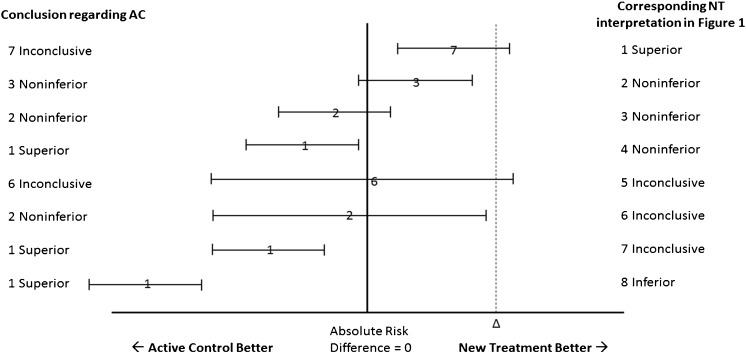
The effect of asymmetrical interpretation of noninferiority results. This schematic shows how the conclusions of a noninferiority trial will differ depending upon which agent, NT or AC, is assigned preferential status on the left of the interpretative diagram. The confidence intervals in this diagram are the mirror images of the confidence intervals in Figure 1, but the NT is now on the right, and AC is on the left (favored side) of the diagram. The absolute risk differences between NT and AC are the same as in Figure 1, and the diagram represents the interpretation that would result if the hypothesis were set up in reverse, to test the noninferiority of AC to NT. The top confidence interval shows a statistically significant difference favoring the new treatment, but instead of a conclusion of superiority (designation 1 in Fig. 1), the result is inconclusive because the upper bound of the confidence interval crosses delta. For the second and third confidence intervals, the conclusion of noninferiority does not change. For the fourth confidence interval, the prior designation 4 (NT is noninferior to AC) becomes a designation 1 (AC superior to NT). The designation of the fifth confidence interval does not change, but the sixth, previously designated inconclusive, becomes a noninferior result for AC. The seventh and eighth confidence intervals, previously showing inconclusive and inferior results for NT, are now designated superior results for AC. Note that the experimental results have not changed—only the assignment of one agent to preferential status on the left of the diagram. Among the eight confidence intervals, four conclusions are materially changed when preferential status is changed.

Comment in

References

    1. Murthy VL, Desai NR, Vora A, Bhatt DL. Increasing proportion of clinical trials using noninferiority end points. Clin Cardiol. 2012;35(9):522–523. doi: 10.1002/clc.22040. - DOI - PMC - PubMed
    1. Suda KJ, Hurley AM, McKibbin T, Motl Moroney SE. Publication of noninferiority clinical trials: changes over a 20-year interval. Pharmacotherapy. 2011;31(9):833–839. doi: 10.1592/phco.31.9.833. - DOI - PubMed
    1. D'Agostino RB, Sr, Massaro JM, Sullivan LM. Non-inferiority trials: design concepts and issues - the encounters of academic consultants in statistics. Stat Med. 2003;22(2):169–186. doi: 10.1002/sim.1425. - DOI - PubMed
    1. Fleming TR. Current issues in non-inferiority trials. Stat Med. 2008;27(3):317–332. doi: 10.1002/sim.2855. - DOI - PubMed
    1. Piaggio G, Elbourne DR, Altman DG, Pocock SJ, Evans SJ. Reporting of noninferiority and equivalence randomized trials: an extension of the CONSORT statement. JAMA. 2006;295(10):1152–1160. doi: 10.1001/jama.295.10.1152. - DOI - PubMed

MeSH terms

LinkOut - more resources