


The Spatial Association Between Federally Qualified Health Centers and County-Level Reported Sexually Transmitted Infections: A Spatial Regression Approach
- PMID: 28876293
- PMCID: PMC6771422
- DOI: 10.1097/OLQ.0000000000000692
The Spatial Association Between Federally Qualified Health Centers and County-Level Reported Sexually Transmitted Infections: A Spatial Regression Approach
Abstract
Background: The number of categorical sexually transmitted disease (STD) clinics is declining in the United States. Federally qualified health centers (FQHCs) have the potential to supplement the needed sexually transmitted infection (STI) services. In this study, we describe the spatial distribution of FQHC sites and determine if reported county-level nonviral STI morbidity were associated with having FQHC(s) using spatial regression techniques.
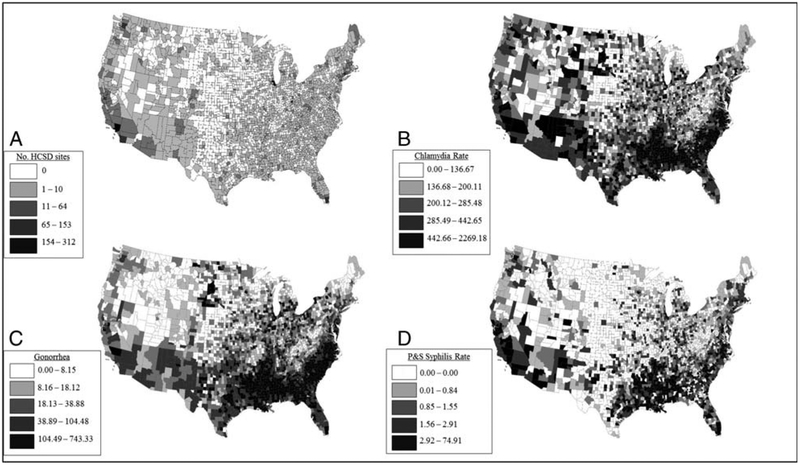
Methods: We extracted map data from the Health Resources and Services Administration data warehouse on FQHCs (ie, geocoded health care service delivery [HCSD] sites) and extracted county-level data on the reported rates of chlamydia, gonorrhea and, primary and secondary (P&S) syphilis (2008-2012) from surveillance data. A 3-equation seemingly unrelated regression estimation procedure (with a spatial regression specification that controlled for county-level multiyear (2008-2012) demographic and socioeconomic factors) was used to determine the association between reported county-level STI morbidity and HCSD sites.
Results: Counties with HCSD sites had higher STI, poverty, unemployment, and violent crime rates than counties with no HCSD sites (P < 0.05). The number of HCSD sites was associated (P < 0.01) with increases in the temporally smoothed rates of chlamydia, gonorrhea, and P&S syphilis, but there was no significant association between the number of HCSD per 100,000 population and reported STI rates.
Conclusions: There is a positive association between STI morbidity and the number of HCSD sites; however, this association does not exist when adjusting by population size. Further work may determine the extent to which HCSD sites can meet unmet needs for safety net STI services.
Conflict of interest statement
Conflict of interest and sources of funding: None declared.
Figures
References
-
- Satterwhite CL, Torrone E, Meites E, et al. Sexually transmitted infections among US women and men: Prevalence and incidence estimates, 2008. Sex Transm Dis 2013; 40:187–193. - PubMed
-
- Centers for Disease Control and Prevention. Sexually transmitted disease surveillance, 2015. Atlanta, GA: U.S. Department of Health and Human Services; 2016.
-
- Owusu-Edusei K Jr., Chesson HW, Gift TL, et al. The estimated direct medical cost of selected sexually transmitted infections in the United States, 2008. Sex Transm Dis 2013; 40:197–201. - PubMed
-
- Chorba T, Scholes D, BlueSpruce J, et al. Sexually transmitted diseases and managed care: an inquiry and review of issues affecting service delivery. Am J Med Qual 2004; 19:145–156. - PubMed
-
- Owusu-Edusei K Jr, Doshi SR. Assessing spatial gaps in sexually transmissible infection services and morbidity: An illustration with Texas county-level data from 2007. Sex Health 2012; 9:334–340. - PubMed
MeSH terms
Supplementary concepts
Grants and funding
LinkOut - more resources
Full Text Sources
Other Literature Sources
Medical
Research Materials
