


Modernizing Field Services for Human Immunodeficiency Virus and Sexually Transmitted Infections in the United States
- PMID: 28876325
- PMCID: PMC5637519
- DOI: 10.1097/OLQ.0000000000000652
Modernizing Field Services for Human Immunodeficiency Virus and Sexually Transmitted Infections in the United States
Abstract
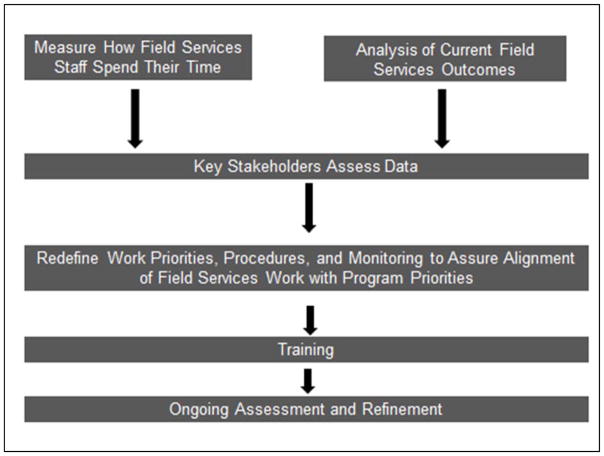
Public health field services for sexually transmitted infections (STIs) have not adequately evolved to address the expanding scale of the STI problem, its concentration among men who have sex with men, the emergence of new communication technologies and the availability of antiretroviral therapy as a cornerstone of human immunodeficiency virus (HIV) prevention. Field services need to modernize. Modernization should seek to expand field services objectives beyond sex partner STI testing and treatment to include: HIV testing of persons with bacterial STI and their partners, including efforts to promote frequent HIV/STI testing; increased condom access; linkage and relinkage to HIV care and promotion of viral suppression; preexposure prophylaxis promotion; linkage to long-acting contraception; and referral for health insurance. Field services programs cannot advance these new objectives while simultaneously doing all of the work they have traditionally done. Modernization will require a willingness to reconsider some longstanding aspects of field services work, including the centrality of face-to-face interviews and field investigations. Health departments seeking to modernize will need to carefully assess their ongoing activities and reorganize to align the use of field services resources with program priorities. In some instances, this may require reorganization to allow the staff greater specialization and closer integration with surveillance activities. Adapting programs will require new staff training, improvements in data management systems, and a greater investment in monitoring and evaluation. Although modernization is likely to evolve over many years, the time to start is now.
Figures
References
-
- Centers for Disease Control and Prevention. Sexually Transmitted Disease Statistics 1984. Atlanta, GA: Dec, 1985. p. 134.
-
- Gottlieb MS, Schroff R, Schanker HM, et al. Pneumocystis carinii pneumonia and mucosal candidiasis in previously healthy homosexual men: evidence of a new acquired cellular immunodeficiency. N Engl J Med. 1981;305(24):1425–1431. - PubMed
-
- Centers for Disease Control and Prevention. HIV Surveillance - Epidemiology of HIV Infection. 2013.
Publication types
MeSH terms
Grants and funding
LinkOut - more resources
Full Text Sources
Other Literature Sources
Medical
