


Intestinal and Circulating MicroRNAs in Coeliac Disease
- PMID: 28878141
- PMCID: PMC5618556
- DOI: 10.3390/ijms18091907
Intestinal and Circulating MicroRNAs in Coeliac Disease
Abstract
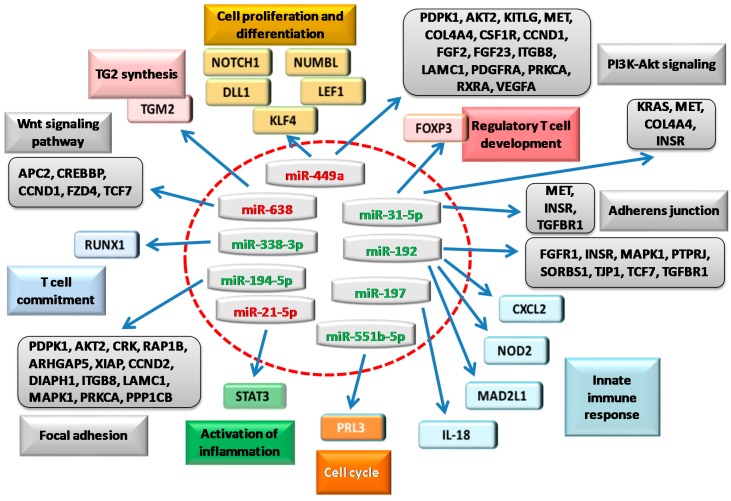
MicroRNAs (miRNAs) are short non-coding RNAs that regulate gene expression at the post-transcriptional level and play a key role in the pathogenesis of autoimmune and gastrointestinal diseases. Previous studies have revealed that miRNAs are dysregulated in intestinal biopsies of patients affected by coeliac disease (CD). Combined bioinformatics analyses of miRNA expression profiles and mRNA target genes as classified by Gene Ontology, are powerful tools to investigate the functional role of miRNAs in coeliac disease. However, little is still known about the function of circulating miRNAs, their expression level compared to tissue miRNAs, and whether the mechanisms of post-transcriptional regulation are the same of tissue miRNAs. In any case, if we assume that a cell-cell communication process has to occur, and that circulating miRNAs are delivered to recipient cells, we can derive useful information by performing target predictions. Interestingly, all of the mRNA targets of dysregulated miRNAs reported in the literature (i.e., miR-31-5p, miR-192, miR-194, miR-449a and miR-638) belong to several important biological processes, such as Wnt signaling, cell proliferation and differentiation, and adherens junction pathways. Although we think that these predictions have to be necessarily confirmed by "wet-lab" data, the miRNAs dysregulated during the development of CD could be potentially involved in the pathogenesis of coeliac disease and their correlation with circulating miRNAs offers new possibilities to use them as disease biomarkers.
Keywords: biomarkers; circulating microRNAs; coeliac disease; tissue microRNAs.
Conflict of interest statement
The authors declare no conflict of interest. The founding sponsors had no role in the design of the study; in the collection, analyses, or interpretation of data; in the writing of the manuscript, and in the decision to publish the results.
Figures
References
Publication types
MeSH terms
Substances
LinkOut - more resources
Full Text Sources
Other Literature Sources
Medical
Miscellaneous
