Review
. 2017 Aug 23:8:1469.
doi: 10.3389/fpls.2017.01469. eCollection 2017.

CRISPR/Cas9: A Practical Approach in Date Palm Genome Editing

Affiliations
Review

CRISPR/Cas9: A Practical Approach in Date Palm Genome Editing

Muhammad N Sattar et al. Front Plant Sci. .

Abstract

The genetic modifications through breeding of crop plants have long been used to improve the yield and quality. However, precise genome editing (GE) could be a very useful supplementary tool for improvement of crop plants by targeted genome modifications. Various GE techniques including ZFNs (zinc finger nucleases), TALENs (transcription activator-like effector nucleases), and most recently clustered regularly interspaced short palindromic repeats (CRISPR)/Cas9 (CRISPR-associated protein 9)-based approaches have been successfully employed for various crop plants including fruit trees. CRISPR/Cas9-based approaches hold great potential in GE due to their simplicity, competency, and versatility over other GE techniques. However, to the best of our knowledge no such genetic improvement has ever been developed in date palm-an important fruit crop in Oasis agriculture. The applications of CRISPR/Cas9 can be a challenging task in date palm GE due to its large and complex genome, high rate of heterozygosity and outcrossing, in vitro regeneration and screening of mutants, high frequency of single-nucleotide polymorphism in the genome and ultimately genetic instability. In this review, we addressed the potential application of CRISPR/Cas9-based approaches in date palm GE to improve the sustainable date palm production. The availability of the date palm whole genome sequence has made it feasible to use CRISPR/Cas9 GE approach for genetic improvement in this species. Moreover, the future prospects of GE application in date palm are also addressed in this review.

Keywords: CRISPR/Cas9; date palm; genome editing; loss of and gain-of-functions; multiplexing.


Figures
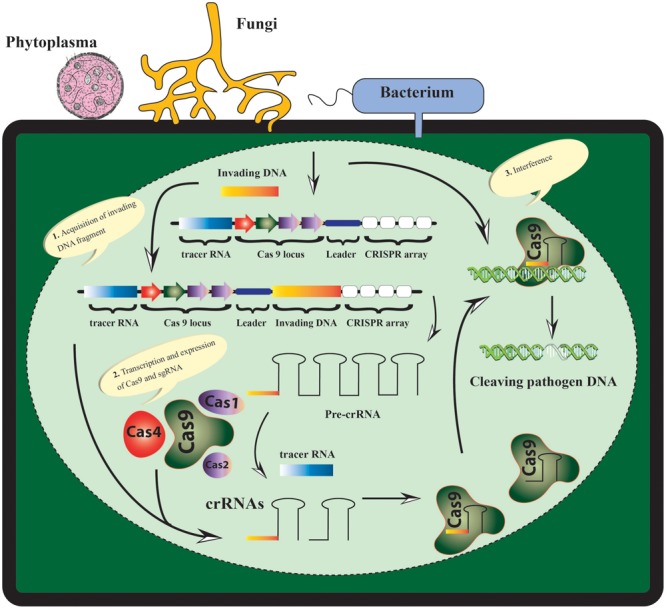
FIGURE 1
FIGURE 1
The CRISPR/Cas9-based resistance model in date palm depicting the recognition and disruption of the pathogen genetic material in three steps: acquisition, expression, and interference). During acquisition the invading DNA is integrated and duplicated into the CRISPR-locus at the leader side. The expression step involves the active transcription and expression of pre-CRISPR RNA (Pre-crRNA), which is further processed into mature crRNAs specifically with the help of different Cas proteins. During the third step of interference, any complementary target region of the foreign genetic material is recognized and cleaved as guided by crRNA and Cas9 protein.
FIGURE 2
FIGURE 2
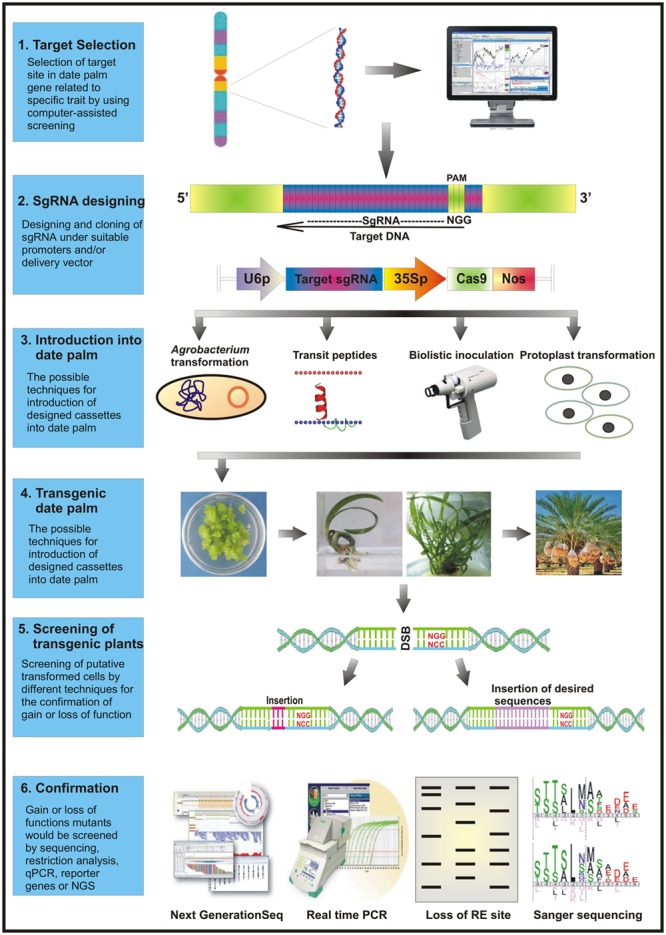
A schematic diagram representing the execution of CRISPR/Cas9 based system in date palm genome editing. The most vulnerable target sites in the desired gene(s) are selected specifically using online available web sourcing to design primers for complementary 20-nucleotides. The target specific sgRNA and Cas9 cassettes are constructed either in a single binary vector or separate expression vectors. These cassettes are then co-transformed in vivo into the plant cells employing a suitable transformation method. Following the putative transformation, the mutated cells are screened an analyzed for target-specific mutations using reporter genes, endonucleases, polyacrylamide gel electrophoreses, or high throughput sequencing techniques. The successfully transformed cells are then selected for further downstream applications and analysis.
FIGURE 3
FIGURE 3
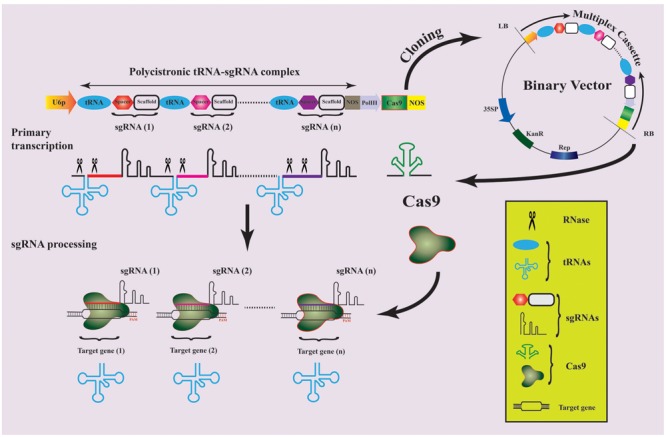
Schematic presentation of multiplex genome editing strategy in date palm. A preferred assemblage of multiplex cassette is shown for different sgRNAs to target different genes simultaneously. The spacers and sgRNA scaffold can be inserted between adjacent tRNAs followed by a NOS terminator at the end. The second cassette can be expressed from Pol-III promotor and NOS terminator sequences sharing the same binary vector with sgRNA cassette. The whole multiplex cassette can then be transcribed and expressed separately in the date palm genome to carry out genome editing.
FIGURE 4
FIGURE 4
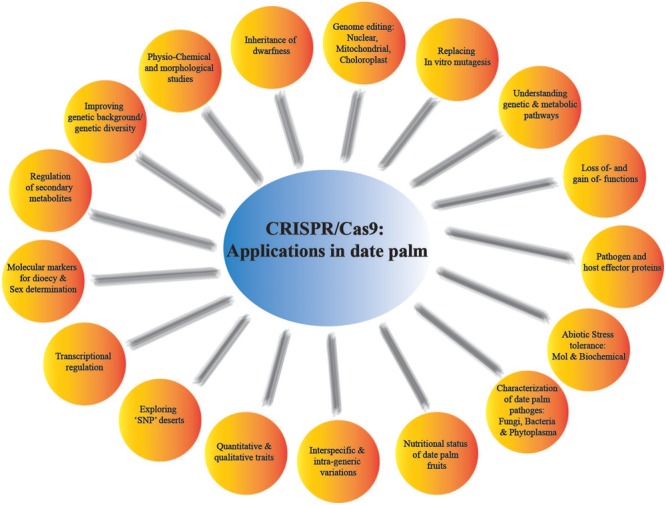
Depicted future applications of CRISPR/Cas9 in date palm genome editing and beyond.

References

    1. Ainley W. M., Sastry-Dent L., Welter M. E., Murray M. G., Zeitler B., Amora R., et al. (2013). Trait stacking via targeted genome editing. Plant Biotechnol. J. 11 1126–1134. 10.1111/pbi.12107 - DOI - PubMed
    1. Al-Dous E. K., George B., Al-Mahmoud M. E., Al-Jaber M. Y., Wang H., Salameh Y. M., et al. (2011). De novo genome sequencing and comparative genomics of date palm (Phoenix dactylifera). Nat. Biotechnol. 29 521–527. 10.1038/nbt.1860 - DOI - PubMed
    1. Ali Z., Abul-faraj A., Li L., Ghosh N., Piatek M., Mahjoub A., et al. (2015). Efficient virus-mediated genome editing in plants using the CRISPR/Cas9 system. Mol. Plant 8 1288–1291. 10.1016/j.molp.2015.02.011 - DOI - PubMed
    1. Al-Khayri J. M., Jain S. M., Johnson D. V. (2015). Date Palm Genetic Resourse and Utilization. Berlin: Springer.
    1. Al-Mssallem I. S., Hu S., Zhang X., Lin Q., Liu W., Tan J., et al. (2013). Genome sequence of the date palm Phoenix dactylifera L. Nat. Commun. 4 2274 10.1038/ncomms3274 - DOI - PMC - PubMed

LinkOut - more resources