


Innate lymphoid cells in tissue homeostasis and diseases
- PMID: 28878863
- PMCID: PMC5569277
- DOI: 10.4254/wjh.v9.i23.979
Innate lymphoid cells in tissue homeostasis and diseases
Abstract
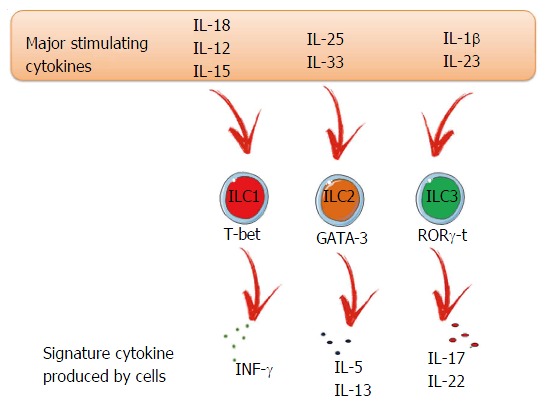
Innate lymphoid cells (ILCs) are the most recently discovered family of innate immune cells. They are a part of the innate immune system, but develop from the lymphoid lineage. They lack pattern-recognition receptors and rearranged receptors, and therefore cannot directly mediate antigen specific responses. The progenitors specifically associated with the ILCs lineage have been uncovered, enabling the distinction between ILCs and natural killer cells. Based on the requirement of specific transcription factors and their patterns of cytokine production, ILCs are categorized into three subsets (ILC1, ILC2 and ILC3). First observed in mucosal surfaces, these cell populations interact with hematopoietic and non-hematopoietic cells throughout the body during homeostasis and diseases, promoting immunity, commensal microbiota tolerance, tissue repair and inflammation. Over the last 8 years, ILCs came into the spotlight as an essential cell type able to integrate diverse host immune responses. Recently, it became known that ILC subsets play a key role in immune responses at barrier surfaces, interacting with the microbiota, nutrients and metabolites. Since the liver receives the venous blood directly from the intestinal vein, the intestine and liver are essential to maintain tolerance and can rapidly respond to infections or tissue damage. Therefore, in this review, we discuss recent findings regarding ILC functions in homeostasis and disease, with a focus on the intestine and liver.
Keywords: Homeostasis; Inflammatory diseases; Innate lymphoid cells; Intestine; Liver.
Conflict of interest statement
Conflict-of-interest statement: The authors declare that there is no conflict of interest regarding the publication of this paper.
Figures
References
-
- Spits H, Cupedo T. Innate lymphoid cells: emerging insights in development, lineage relationships, and function. Annu Rev Immunol. 2012;30:647–675. - PubMed
-
- Mebius RE. Organogenesis of lymphoid tissues. Nat Rev Immunol. 2003;3:292–303. - PubMed
-
- Spits H, Artis D, Colonna M, Diefenbach A, Di Santo JP, Eberl G, Koyasu S, Locksley RM, McKenzie AN, Mebius RE, et al. Innate lymphoid cells--a proposal for uniform nomenclature. Nat Rev Immunol. 2013;13:145–149. - PubMed
Publication types
LinkOut - more resources
Full Text Sources
Other Literature Sources
