


Changes in consumption of food away from home and intakes of energy and other nutrients among US working-age adults, 2005-2014
- PMID: 28879825
- PMCID: PMC10261579
- DOI: 10.1017/S1368980017002403
Changes in consumption of food away from home and intakes of energy and other nutrients among US working-age adults, 2005-2014
Abstract
Objective: To document changes in consumption of food away from home (FAFH) and intakes of selected nutrients by working-age adults between 2005-06 and 2013-14, covering the most recent recessionary period and recovery.
Design: Means were compared across survey rounds relative to 2005-06. Multivariate regression was used to account for changes in demographic characteristics over time.
Setting: National Health and Nutrition Examination Survey (NHANES), 2005-2014.
Subjects: Working-age adults born in 1951-80 (n 12 129) and adolescents and young adults born in 1981-90 (n 5197) who reported day 1 dietary intake data.
Results: Approximately 34 % of energy consumed by working-age adults came from FAFH (14 % from fast foods) in 2005-06. Levels of FAFH consumption were lowest in 2009-10, at 28 and 11 % of energy from FAFH and fast foods, respectively. Percentage of energy from fast foods was 1·9 percentage points higher in 2013-14. Percentage of energy from saturated fat and total mg of cholesterol consumed were lower in 2009-14, while intake of fibre was higher in 2011-14. At-home foods had less saturated fat and more fibre in 2009-14. The greater the percentage of energy from FAFH in the day, the greater the intakes of fat and cholesterol. Percentage of energy from FAFH was highest among those born in 1981-90 and lowest among those born in 1951-60.
Conclusions: FAFH is a significant source of energy, fat and cholesterol among working-age adults. Menu labelling may lower FAFH's energy content and make it easier for consumers to choose more healthful items.
Keywords: Diet quality; Food away from home; Great Recession; US working-age adults.
Figures
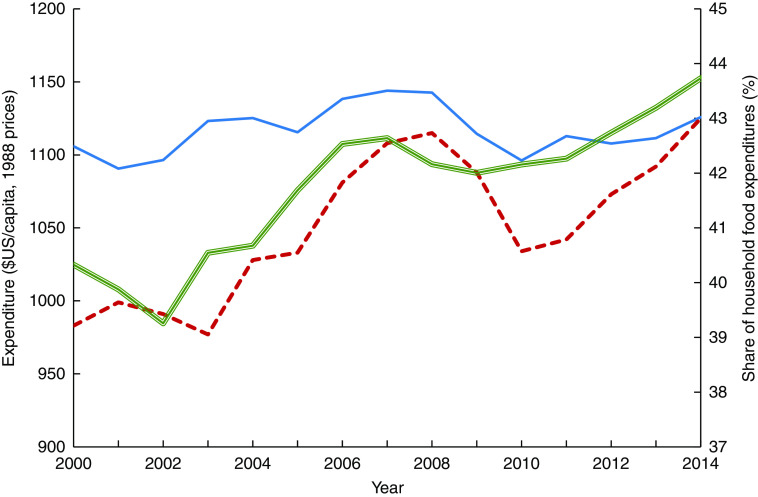
 ) and away-from-home(
 )food expenditures, and share of food expenditures on food away from home(
 ),2000–2014 (source: US Department of Agriculture, Economic Research Service, Food Expenditures, tables 10 and 13(
37
))
),2000–2014 (source: US Department of Agriculture, Economic Research Service, Food Expenditures, tables 10 and 13(
37
))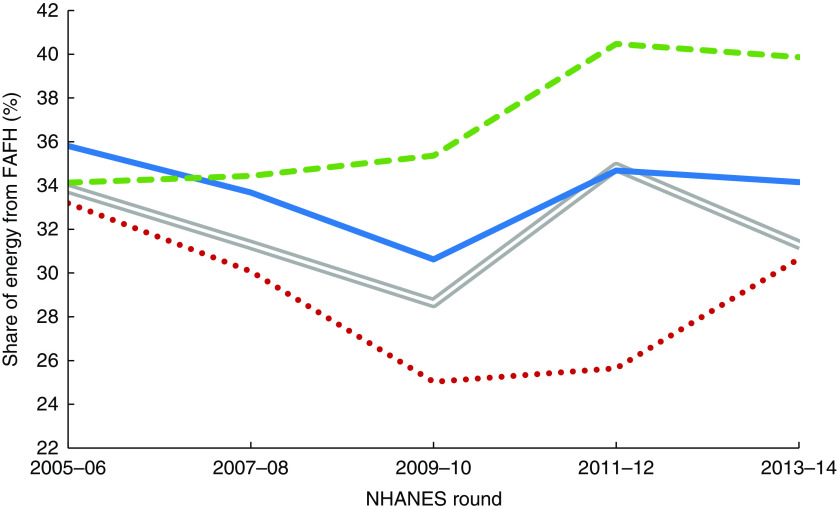
 , 1951–60;
  , 1961–70;
  , 1971–80;
  , 1981–90) and survey round: US adults participating in the 2005–2014 National Health and Nutrition Examination Survey (NHANES). Birth year was estimated by subtracting the individual’s reported age from the first year of the survey round
References
-
- Kinsey J (1983) Working wives and the marginal propensity to consume food away from home. Am J Agric Econ 65, 10–19.
-
- McCracken VA & Brandt JA (1987) Household consumption of food-away-from-home: total expenditure and by type of food facility. Am J Agric Econ 69, 274–284.
-
- Yen ST (1993) Working wives and food away from home: the Box–Cox double hurdle model. Am J Agric Econ 75, 884–895.
-
- Jekanowski MD, Binkley JK & Eales J (2001) Convenience, accessibility, and the demand for fast food. J Agric Resour Econ 26, 58–74.
-
- Lin B-H & Guthrie J (2012) Nutritional Quality of Food Prepared at Home and Away from Home, 1977–2008. Economic Information Bulletin no. EIB-105. Washington, DC: US Department of Agriculture, Economic Research Service.
MeSH terms
Substances
LinkOut - more resources
Full Text Sources
Other Literature Sources
