


Childhood close family relationships and health
- PMID: 28880102
- PMCID: PMC5598786
- DOI: 10.1037/amp0000067
Childhood close family relationships and health
Abstract
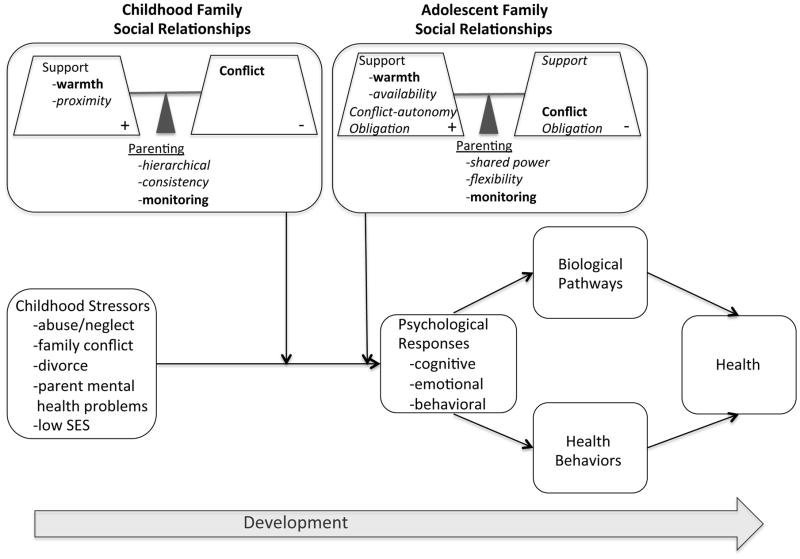
Emerging data suggest that during childhood, close family relationships can ameliorate the impact that adversity has on life span physical health. To explain this phenomenon, a developmental stress buffering model is proposed in which characteristics of family relationships including support, conflict, obligation, and parenting behaviors evolve and change from childhood to adolescence. Together, these characteristics govern whether childhood family relationships are on balance positive enough to fill a moderating role in which they mitigate the effects that childhood adversities have on physical health. The benefits of some family relationship characteristics are hypothesized to stay the same across childhood and adolescence (e.g., the importance of comfort and warmth from family relationships) whereas the benefits of other characteristics are hypothesized to change from childhood to adolescence (e.g., from a need for physical proximity to parents in early childhood to a need for parental availability in adolescence). In turn, close, positive family relationships in childhood operate via a variety of pathways, such as by reducing the impact that childhood stressors have on biological processes (e.g., inflammation) and on health behaviors that in turn can shape physical health over a lifetime. (PsycINFO Database Record
(c) 2017 APA, all rights reserved).
Figures
References
-
- Allen JP. The attachment system in adolescence. In: Cassidy J, Shaver PR, editors. Handbook of Attachment (2nd edition) New York, NY: Guilford Press; 2008. pp. 419–435.
-
- Andersson G. Children’s experience of family disruption and family formation: Evidence from 16 FFS countries. Demographic Research. 2002;7:343–364.
-
- Barnes GM, Farrell MP. Parental support and control as predictors of adolescent drinking, delinquency, and related problem behaviors. Journal of Marriage and Family. 1992;54:763–776.
MeSH terms
Grants and funding
LinkOut - more resources
Full Text Sources
Other Literature Sources
Medical