Review
. 2018 Aug;175(16):3251-3262.
doi: 10.1111/bph.13966. Epub 2017 Sep 9.

Melatonin: does it have utility in the treatment of haematological neoplasms?

Affiliations
Review

Melatonin: does it have utility in the treatment of haematological neoplasms?

Tian Li et al. Br J Pharmacol. 2018 Aug.

Abstract

Melatonin, discovered in 1958 in the bovine pineal tissue, is an indoleamine that modulates circadian rhythms and has a wide variety of other functions. Haematological neoplasms are the leading cause of death in children and adolescents throughout the world. Research has demonstrated that melatonin is a low-toxicity protective molecule against experimental haematological neoplasms, but the mechanisms remain poorly defined. Here, we provide an introduction to haematological neoplasms and melatonin, especially as they relate to the actions of melatonin on haematological carcinogenesis. Secondly, we summarize what is known about the mechanisms of action of melatonin in the haematological system, including its pro-apoptotic, pro-oxidative, anti-proliferative and immunomodulatory actions. Thirdly, we discuss the advantages of melatonin in combination with other drugs against haematological malignancy, as well as its other benefits on the haematological system. Finally, we summarize the findings that are contrary to the suppressive effects of melatonin on cancers of haematological origin. We hope that this information will be helpful in the design of studies related to the therapeutic efficacy of melatonin in haematological neoplasms. LINKED ARTICLES: This article is part of a themed section on Recent Developments in Research of Melatonin and its Potential Therapeutic Applications. To view the other articles in this section visit http://onlinelibrary.wiley.com/doi/10.1111/bph.v175.16/issuetoc.


Figures

Figure 1
Figure 1
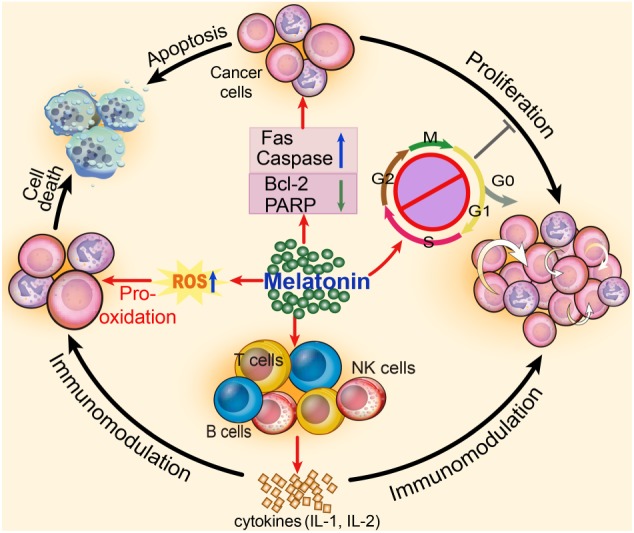
Roles of melatonin in haematological neoplasms. Melatonin is a pivotal endocrine compound, with actions against haematological carcinogenesis. Melatonin up‐regulates the levels of Fas and caspase family and down‐regulates the levels of PARP and Bcl‐2, as well as enhancing the production of ROS for promoting the apoptosis of haematological cancer cells. Melatonin also blocks the cell cycle of cancer cells to inhibit their proliferation. Additionally, activity of immunocytes and secretion of cytokines can be enhanced by melatonin, thereby inducing immunomodulation against haematological neoplasms.
Figure 2
Figure 2
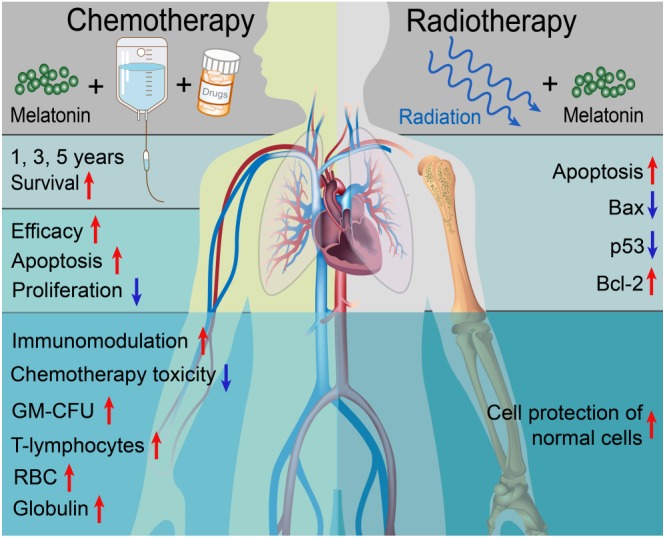
Actions of melatonin on chemo‐ and radiotherapy. Combination of melatonin with chemotherapeutic agents promotes survival, enhances the efficacy and immunomodulation and ameliorates toxicity due to chemotherapy, in patients with haematological neoplasms. Melatonin combined with radiotherapy promotes the apoptosis of haematological cancer cells while protecting the normal splenocytes, suggesting its selective cytotoxicity to haematological neoplasms.

References

    1. Acuna‐Castroviejo D, Escames G, Venegas C, Diaz‐Casado ME, Lima‐Cabello E, Lopez LC et al (2014). Extrapineal melatonin: sources, regulation, and potential functions. Cell Mol Life Sci 71: 2997–3025. - PMC - PubMed
    1. Ahlbom IC, Cardis E, Green A, Linet M, Savitz D, Swerdlow A et al (2001). Review of the epidemiologic literature on EMF and health. Environ Health Perspect 109 (Suppl 6): 911–933. - PMC - PubMed
    1. Alexander SPH, Davenport AP, Kelly E, Marrion N, Peters JA, Benson HE et al (2015a). The Concise Guide to PHARMACOLOGY 2015/16: G protein‐coupled receptors. Br J Pharmacol 172: 5744–5869. - PMC - PubMed
    1. Alexander SPH, Kelly E, Marrion N, Peters JA, Benson HE, Faccenda E et al (2015b). The Concise Guide to PHARMACOLOGY 2015/16: Overview. Br J Pharmacol 172: 5729–5743. - PMC - PubMed
    1. Alexander SPH, Fabbro D, Kelly E, Marrion N, Peters JA, Benson HE et al (2015c). The Concise Guide to PHARMACOLOGY 2015/16: Enzymes. Br J Pharmacol 172: 6024–6109. - PMC - PubMed

Publication types