


Molecular genetics of syndromic and non-syndromic forms of parathyroid carcinoma
- PMID: 28881068
- PMCID: PMC5698716
- DOI: 10.1002/humu.23337
Molecular genetics of syndromic and non-syndromic forms of parathyroid carcinoma
Abstract
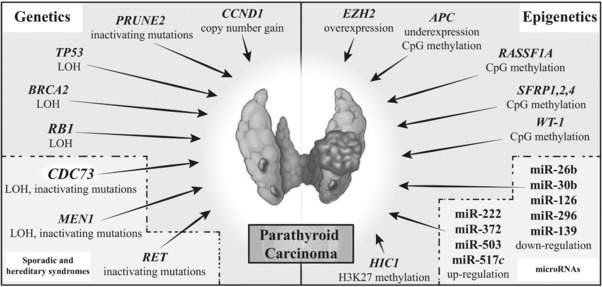
Parathyroid carcinoma (PC) may occur as part of a complex hereditary syndrome or an isolated (i.e., non-syndromic) non-hereditary (i.e., sporadic) endocrinopathy. Studies of hereditary and syndromic forms of PC, which include the hyperparathyroidism-jaw tumor syndrome (HPT-JT), multiple endocrine neoplasia types 1 and 2 (MEN1 and MEN2), and familial isolated primary hyperparathyroidism (FIHP), have revealed some genetic mechanisms underlying PC. Thus, cell division cycle 73 (CDC73) germline mutations cause HPT-JT, and CDC73 mutations occur in 70% of sporadic PC, but in only ∼2% of parathyroid adenomas. Moreover, CDC73 germline mutations occur in 20%-40% of patients with sporadic PC and may reveal unrecognized HPT-JT. This indicates that CDC73 mutations are major driver mutations in the etiology of PCs. However, there is no genotype-phenotype correlation and some CDC73 mutations (e.g., c.679_680insAG) have been reported in patients with sporadic PC, HPT-JT, or FIHP. Other genes involved in sporadic PC include germline MEN1 and rearranged during transfection (RET) mutations and somatic alterations of the retinoblastoma 1 (RB1) and tumor protein P53 (TP53) genes, as well as epigenetic modifications including DNA methylation and histone modifications, and microRNA misregulation. This review summarizes the genetics and epigenetics of the familial syndromic and non-syndromic (sporadic) forms of PC.
Keywords: CDC73; familial isolated primary hyperparathyroidism; genetic syndromes; hyperparathyroidism-jaw tumor syndrome; multiple endocrine neoplasia type 1.
© 2017 The Authors. Human Mutation published by Wiley Periodicals, Inc.
Figures
References
-
- Abdulla, A. , O'Leary, E. M. , Isorena, J. P. , Diaz, M. F. , & Yeh, M. W. (2013). Recurrent hyperparathyroidism and a novel nonsense mutation in a patient with hyperparathyriodism‐jaw tumor syndrome. Endocrine Practice, 19(6), e134–e137. - PubMed
-
- Agha, A. , Carpenter, R. , Bhattacharya, S. , Edmonson, S. J. , Carlsen, E. , & Monson, J. P. (2007). Parathyroid carcinoma in multiple endocrine neoplasia type 1 (MEN1) syndrome: Two case reports of an unrecognised entity. Journal of Endocrinological Investigation, 30(2), 145–149. - PubMed
-
- Aldred, M. J. , Talacko, A. A. , Savarirayan, R. , Murdolo, V. , Mills, A. E. , Radden, B. G. , … Larsson, C. (2006). Dental findings in a family with hyperparathyroidism‐jaw tumor syndrome and a novel HRPT2 gene mutation. Oral Surgery, Oral Medicine, Oral Pathology, Oral Radiology, and Endodontology, 101(2), 212–218. - PubMed
-
- Andreasson, A. , Sulaiman, L. , do Vale, S. , Martins, J. M. , Ferreira, F. , Miltenberger‐Miltenyi, G. , … Juhlin, C. C. (2012). Molecular characterization of parathyroid tumors from two patients with hereditary colorectal cancer syndromes. Familial Cancer, 11(3), 355–362. - PubMed
Publication types
MeSH terms
Substances
Supplementary concepts
Grants and funding
LinkOut - more resources
Full Text Sources
Other Literature Sources
Research Materials
Miscellaneous
