


Intrinsic fluorescence of the clinically approved multikinase inhibitor nintedanib reveals lysosomal sequestration as resistance mechanism in FGFR-driven lung cancer
- PMID: 28882160
- PMCID: PMC5590147
- DOI: 10.1186/s13046-017-0592-3
Intrinsic fluorescence of the clinically approved multikinase inhibitor nintedanib reveals lysosomal sequestration as resistance mechanism in FGFR-driven lung cancer
Abstract
Background: Studying the intracellular distribution of pharmacological agents, including anticancer compounds, is of central importance in biomedical research. It constitutes a prerequisite for a better understanding of the molecular mechanisms underlying drug action and resistance development. Hyperactivated fibroblast growth factor receptors (FGFRs) constitute a promising therapy target in several types of malignancies including lung cancer. The clinically approved small-molecule FGFR inhibitor nintedanib exerts strong cytotoxicity in FGFR-driven lung cancer cells. However, subcellular pharmacokinetics of this compound and its impact on therapeutic efficacy remain obscure.
Methods: 3-dimensional fluorescence spectroscopy was conducted to asses cell-free nintedanib fluorescence properties. MTT assay was used to determine the impact of the lysosome-targeting agents bafilomycin A1 and chloroquine combined with nintedanib on lung cancer cell viability. Flow cytometry and live cell as well as confocal microscopy were performed to analyze uptake kinetics as well as subcellular distribution of nintedanib. Western blot was conducted to investigate protein expression. Cryosections of subcutaneous tumor allografts were generated to detect intratumoral nintedanib in mice after oral drug administration.
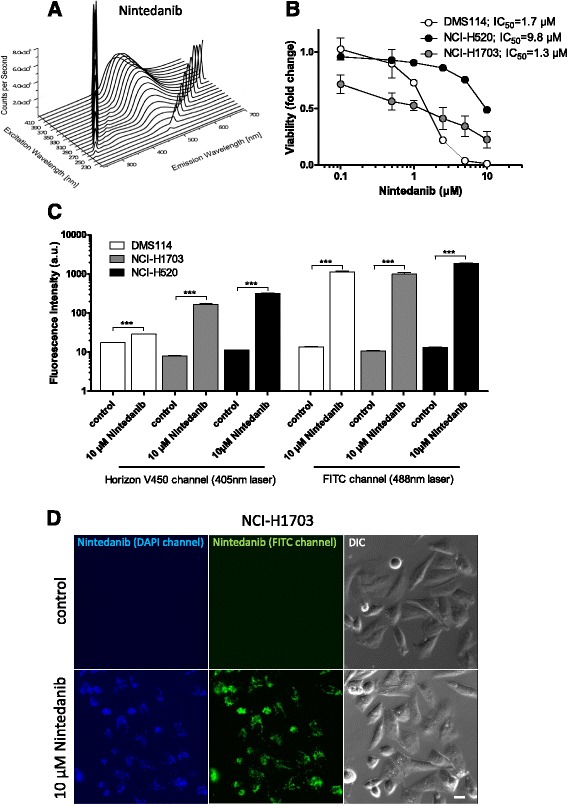
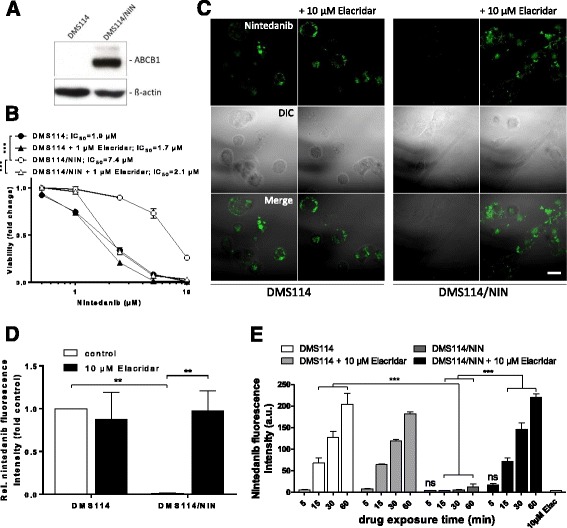
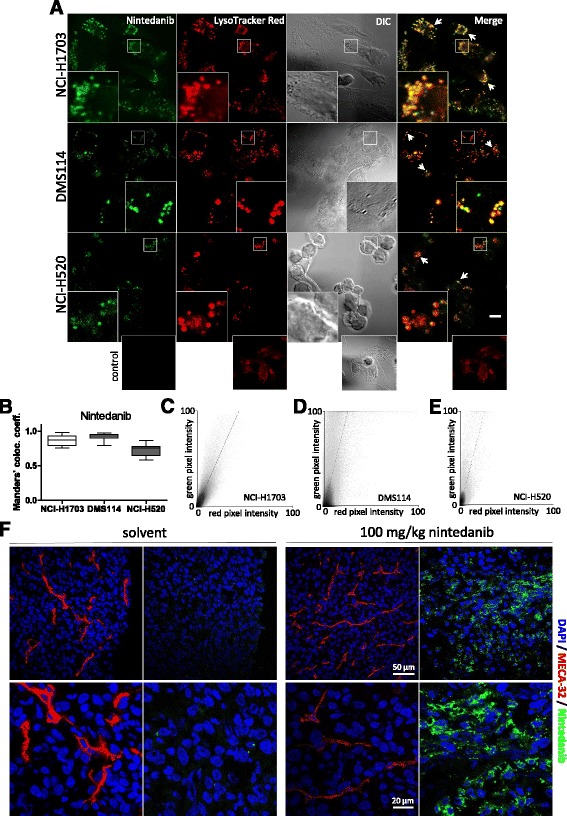
Results: Here, we report for the first time drug-intrinsic fluorescence properties of nintedanib in living and fixed cancer cells as well as in cryosections derived from allograft tumors of orally treated mice. Using this feature in conjunction with flow cytometry and confocal microscopy allowed to determine cellular drug accumulation levels, impact of the ABCB1 efflux pump and to uncover nintedanib trapping into lysosomes. Lysosomal sequestration - resulting in an organelle-specific and pH-dependent nintedanib fluorescence - was identified as an intrinsic resistance mechanism in FGFR-driven lung cancer cells. Accordingly, combination of nintedanib with agents compromising lysosomal acidification (bafilomycin A1, chloroquine) exerted distinctly synergistic growth inhibitory effects.
Conclusion: Our findings provide a powerful tool to dissect molecular factors impacting organismal and intracellular pharmacokinetics of nintedanib. Regarding clinical application, prevention of lysosomal trapping via lysosome-alkalization might represent a promising strategy to circumvent cancer cell-intrinsic nintedanib resistance.
Keywords: FGFR1; Fluorescence; Lysosomes; Nintedanib; Resistance.
Conflict of interest statement
Ethics approval and consent to participate
Animal experiments were authorized by the Ethics committee at the Medical University of Vienna and carried out in accordance with the guidelines for the welfare and use of animals in cancer research, as well as meeting the Federation of Laboratory Animal Science Associations (FELASA) guidelines’ definition of humane endpoints and the Arrive guidelines for animal care and protection.
Consent for publication
Not applicable.
Competing interests
The authors declare that they have no competing interests.
Publisher’s Note
Springer Nature remains neutral with regard to jurisdictional claims in published maps and institutional affiliations.
Figures


References
Publication types
MeSH terms
Substances
Grants and funding
LinkOut - more resources
Full Text Sources
Other Literature Sources
Medical
Miscellaneous
