. 2017 Sep 7;7(1):10825.
doi: 10.1038/s41598-017-11160-w.

Virulence of current German PEDV strains in suckling pigs and investigation of protective effects of maternally derived antibodies

Affiliations

Virulence of current German PEDV strains in suckling pigs and investigation of protective effects of maternally derived antibodies

S Leidenberger et al. Sci Rep. .

Abstract

Porcine epidemic diarrhea (PED) has caused tremendous losses to the United States pig industry since 2013. From 2014, outbreaks were also reported from Central Europe. To characterize the Central European PEDV strains regarding their virulence in suckling piglets, and to assess the protective effect of maternally derived antibodies (MDA), four trial groups were randomly assigned, each consisting of two pregnant sows and their litter. To induce MDA in a subset of piglets, two sows received a cell culture-adapted PEDV strain, and another two sows were inoculated with field material from German PED outbreaks. Four sows stayed naïve. Subsequently, all piglets were inoculated with the corresponding PEDV strains at an age of 3 to 6 days, and virus shedding, clinical signs and occurrence of specific antibodies were assessed. Piglets without MDA showed a morbidity of 100% and low lethality, while almost all MDA-positive piglets stayed clinically healthy and showed considerably lower virus shedding. Taken together, the Central European PEDV strains showed rather low virulence under experimental conditions, and pre-inoculation of sows led to a solid protection of their offspring. The latter is the prerequisite for a sow vaccination concept that could help to prevent PED induced losses in the piglet sector.


Conflict of interest statement

The authors were part of an industrial funded research project from Boehringer Ingelheim. The PEDV cell culture isolate was kindly provided by Boehringer Ingelheim. No other conflicts of interest exist.

Figures
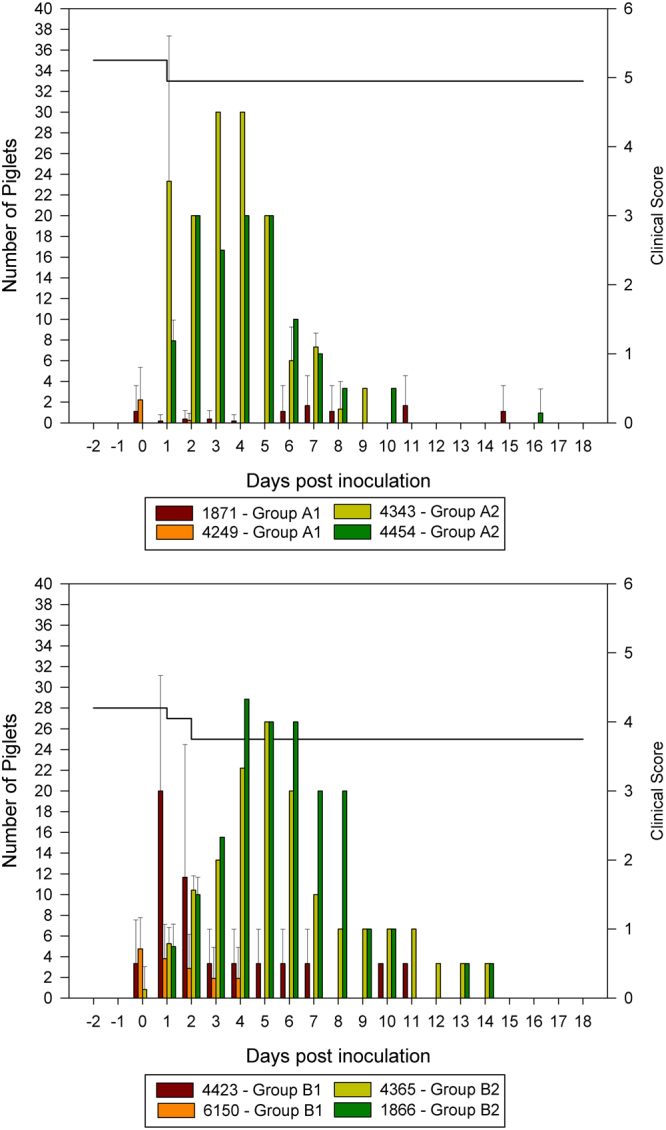
Figure 1
Figure 1
Cumulative clinical scores and piglet survival shown per litter per sow: The bars indicate the clinical scores of each litter per sow and the black line across the top of the graph represents the number of surviving piglets over time; upper chart: animals inoculated with cell culture adapted PEDV-strain (Group A1 (sows 1871 and 4249) and A2 (sows 4343 and 4454)), lower chart: animals inoculated with German field material (Group B1 (sows 4423 and 6150) and B2 (sows 4365 and 1866)), standard deviation is shown in error bars.
Figure 2
Figure 2
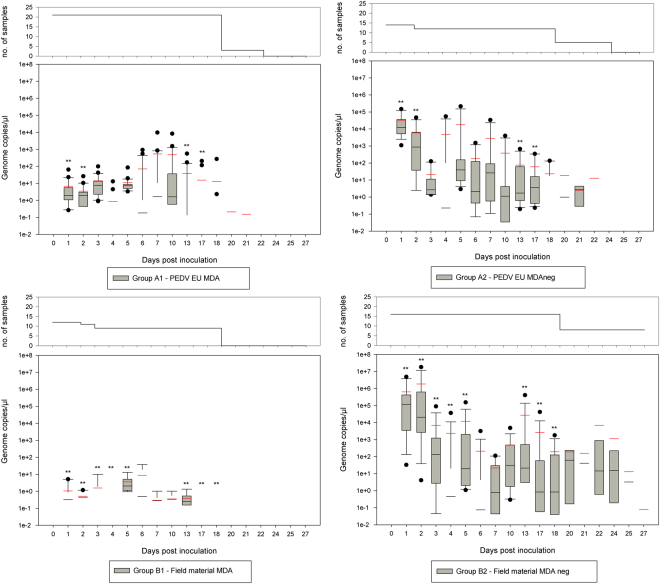
PEDV-shedding detected via RT-qPCR: The graph shows the amount of genome copies per group using a logarithmic scale with 1e + 8 meaning 108; red lines mark the mean (average) of each box plot, black lines mark the median of each box plot; upper chart: Group A1 and A2 (cell culture isolate; PEDV EU), lower chart: B1 and B2 (German field material, DE); statistically significant differences between groups with and without maternal derived antibodies (compared by day) are marked with **(p-values between 0.001 and 0.034). To indicate the number of samples included in each boxplot, the survival curve is given above the respective figure part.
Figure 3
Figure 3
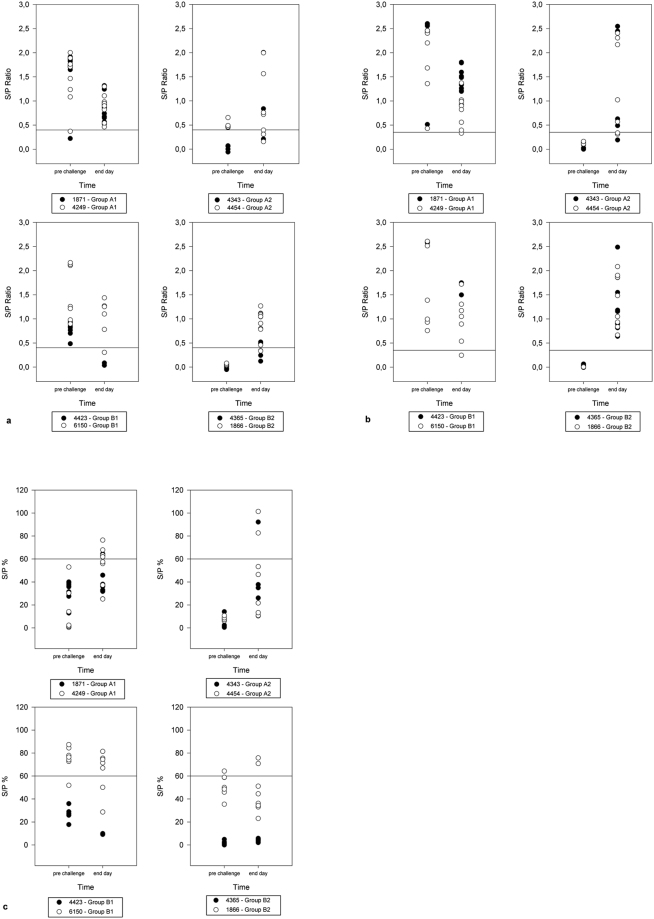
IgG detection in serum samples of piglets prior to challenge and at day of death using commercial indirect ELISA kits: Comparison of three commercial ELISA assays for PEDV specific IgG antibodies, results are shown as sample-to-positive ratio for each individual piglet, the horizontal line marks ELISA cut-off; (a) BIOVET; (b) INGENASA; (c) IDVet; upper graphs: PEDV cell culture isolate (PEDV EU): upper left: Group A1, upper right: Group A2; lower graphs: German field material (DE): lower left: Group B1, lower right: Group B2.

References

    1. Shibata I, et al. Isolation of porcine epidemic diarrhea virus in porcine cell cultures and experimental infection of pigs of different ages. Veterinary microbiology. 2000;72:173–182. doi: 10.1016/S0378-1135(99)00199-6. - DOI - PMC - PubMed
    1. Thomas JT, et al. Effect of Porcine Epidemic Diarrhea Virus Infectious Doses on Infection Outcomes in Naive Conventional Neonatal and Weaned Pigs. Plos One. 2015;10:1–18. - PMC - PubMed
    1. Jung K, Annamalai T, Lu Z, Saif LJ. Comparative pathogenesis of US porcine epidemic diarrhea virus (PEDV) strain PC21A in conventional 9-day-old nursing piglets vs. 26-day-old weaned pigs. Veterinary microbiology. 2015;178:31–40. doi: 10.1016/j.vetmic.2015.04.022. - DOI - PMC - PubMed
    1. Carstens EB. Ratification vote on taxonomic proposals to the International Committee on Taxonomy of Viruses (2009) Archives of virology. 2010;155:133–146. doi: 10.1007/s00705-009-0547-x. - DOI - PMC - PubMed
    1. Wood EN. An apparently new syndrome of porcine epidemic diarrhoea. Vet Rec. 1977;100:243–244. doi: 10.1136/vr.100.12.243. - DOI - PubMed

Publication types

MeSH terms

Substances

LinkOut - more resources