Review
. 2018 Jun;67(6):981-988.
doi: 10.1007/s00262-017-2058-z. Epub 2017 Sep 7.

Transcriptomic analysis of the tumor microenvironment to guide prognosis and immunotherapies

Affiliations
Review

Transcriptomic analysis of the tumor microenvironment to guide prognosis and immunotherapies

Florent Petitprez et al. Cancer Immunol Immunother. 2018 Jun.

Abstract

Tumors are highly heterogeneous tissues where malignant cells are surrounded by and interact with a complex tumor microenvironment (TME), notably composed of a wide variety of immune cells, as well as vessels and fibroblasts. As the dialectical influence between tumor cells and their TME is known to be clinically crucial, we need tools that allow us to study the cellular composition of the microenvironment. In this focused research review, we report MCP-counter, a methodology based on transcriptomic markers that assesses the proportion of several immune and stromal cell populations in the TME from transcriptomic data, and we highlight how it can provide a way to decipher the complex mechanisms at play in tumors. In several malignancies, MCP-counter scores have been used to show various prognostic impacts of the TME, which we also show to be linked with the mutational burden of tumors. We also compared established molecular classifications of colorectal cancer and clear-cell renal cell carcinoma with the output of MCP-counter, and show that molecular subgroups have different TME profiles, and that these profiles are consistent within a given subgroup. Finally, we provide insights as to how knowing the TME composition may shape patient care in the near future.

Keywords: Gene expression; Immune cells; MCP-counter; NIBIT 2016; Transcriptome; Tumor microenvironment.


Conflict of interest statement

Yann A. Vano has received speaker honoraria from Novartis, Pfizer, Bristol-Myers-Squibb, and Astellas Sanofi, and has received financial support for attending symposia from Bristol-Myers-Squibb and Novartis. Aurélien de Reyniès holds intellectual property rights for patents related to immune cell population abundance estimation through transcriptomic analysis. Wolf H. Fridman is a consultant for Pierre Fabre Medicament, Sanofi, Bristol-Myers-Squibb, Novartis, Curetech, Servier, Efranet, Efralys, and Adaptimmune. All other authors declare no conflicts of interest.

Figures
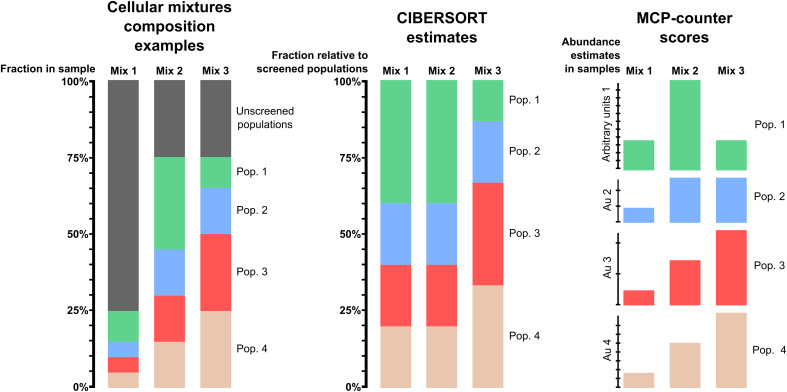
Fig. 1
Fig. 1
Comparison of CIBERSORT estimates and MCP-counter scores for different configurations of mixture compositions. The left panel is a schematic representation of three possible cell mixtures, while the middle and right panels represent, respectively, the estimates that would be suggested by CIBERSORT and MCP-counter. We notice that the estimates of CIBERSORT for the first two mixes are similar, as they are expressed as percentages of cells among the screened populations only, regardless of the total infiltration in the sample. Conversely, MCP-counter scores are proportional to the amount of each cell population in the total sample, which allows inter-sample comparison for each population. However, these scores are expressed in a different arbitrary unit for each population, which prevents intra-sample comparison between populations. CIBERSORT allows this type of comparison
Fig. 2
Fig. 2
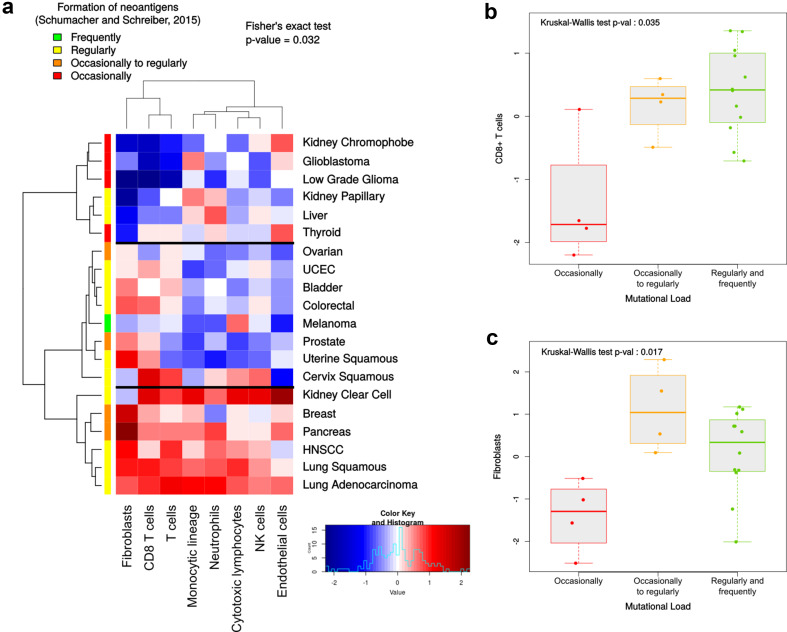
a Classification of 20 malignancies based on the TME composition assessed by MCP-counter, along with the estimation of the frequency of neoantigens proposed by Schumacher and Schreiber [27]. b, c Infiltration by CD8+ T cells (b) and fibroblasts (c) is significantly lower in tumors in which mutations occur only occasionally
Fig. 3
Fig. 3
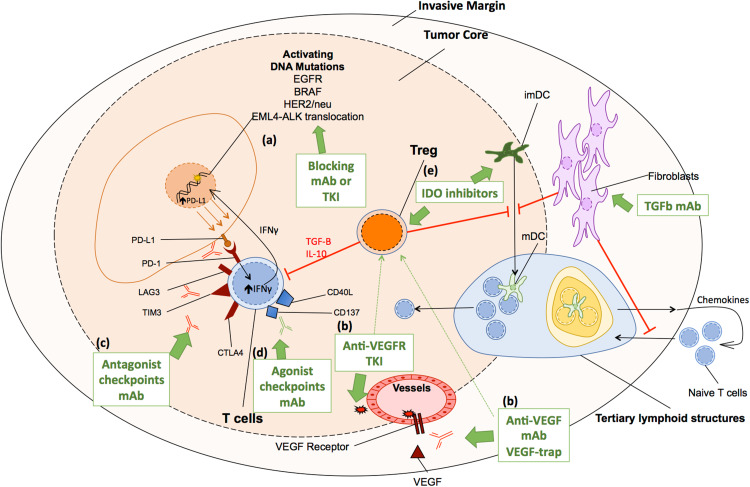
Mainly targeted therapies currently approved or at a late stage of development for human solid tumors. Targeted therapies act directly on tumor cells or on populations of the tumor microenvironment (TME). a Tumor cells harbor activating DNA mutations or translocations which can be efficiently targeted by monoclonal antibodies (mAb) or TKI. b Endothelial cells involved in neoangiogenesis are efficiently targeted either by a VEGF or a VEGFR blocking mAb, a VEGF-trap, or a VEGFR-TKI. Effector function of CD8 T cells can be restored by c antagonist mAb of co-inhibition signals such as PD-1, Tim-3, Lag-3, or CTLA-4, or by d agonist mAb of co-stimulation signals such as CD137, CD40L. Regulatory T cells (Treg) impede the anti-tumor immune response by a direct effect on CD8 T cells and by the blockade of the maturation of dendritic cells. Treg functions, as well as Myeloid-Derived Suppressor Cells (MDSC), may be suppressed by e IDO inhibitors or VEGF–VEGFR axis inhibitors. Fibroblasts control the trafficking of T cells from the invasive margin (IM) to the tumor stroma, hamper DC maturation, inhibit T-cell proliferation, and sustain angiogenesis. Fibroblasts might be targeted by TGFb blocking mAb

References

    1. Becht E, Giraldo NA, Germain C, et al. Immune contexture, immunoscore, and malignant cell molecular subgroups for prognostic and theranostic classifications of cancers. Adv Immunol. 2016;130:95–190. doi: 10.1016/bs.ai.2015.12.002. - DOI - PubMed
    1. Fridman WH, Pagès F, Sautès-Fridman C, Galon J. The immune contexture in human tumours: impact on clinical outcome. Nat Rev Cancer. 2012;12:298–306. doi: 10.1038/nrc3245. - DOI - PubMed
    1. Hanahan D, Coussens LM. Accessories to the crime: functions of cells recruited to the tumor microenvironment. Cancer Cell. 2012;21:309–322. doi: 10.1016/j.ccr.2012.02.022. - DOI - PubMed
    1. Becht E, Giraldo NA, Dieu-Nosjean M-C, et al. Cancer immune contexture and immunotherapy. Curr Opin Immunol. 2016;39:7–13. doi: 10.1016/j.coi.2015.11.009. - DOI - PubMed
    1. Pagès F, Berger A, Camus M, et al. Effector memory T cells, early metastasis, and survival in colorectal cancer. N Engl J Med. 2005;353:2654–2666. doi: 10.1056/NEJMoa051424. - DOI - PubMed

Publication types