


Complement (C1q) Binding De Novo Donor-Specific Antibodies and Cardiac-Allograft Vasculopathy in Pediatric Heart Transplant Recipients
- PMID: 28885488
- PMCID: PMC5820172
- DOI: 10.1097/TP.0000000000001944
Complement (C1q) Binding De Novo Donor-Specific Antibodies and Cardiac-Allograft Vasculopathy in Pediatric Heart Transplant Recipients
Abstract
Background: We hypothesized C1q binding de novo donor-specific antibody (DSA) after heart transplant (HT) is a higher risk for development of coronary artery vasculopathy (CAV) in children.
Methods: A retrospective analysis of 127 pediatric HT recipients transplanted between January 2005 and December 2014 was used to determine complement (C1q)-binding de novo DSA on the outcomes of HT and the ability of the C1q assay to predict CAV development.
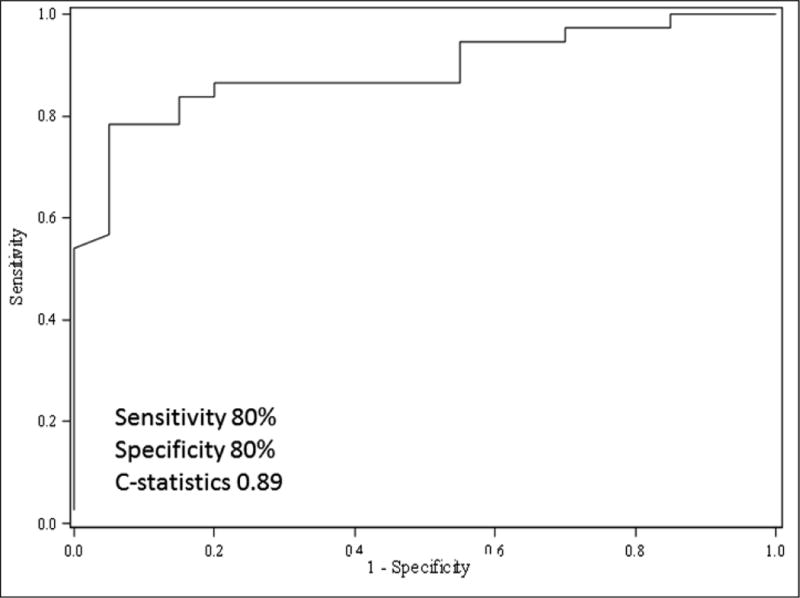
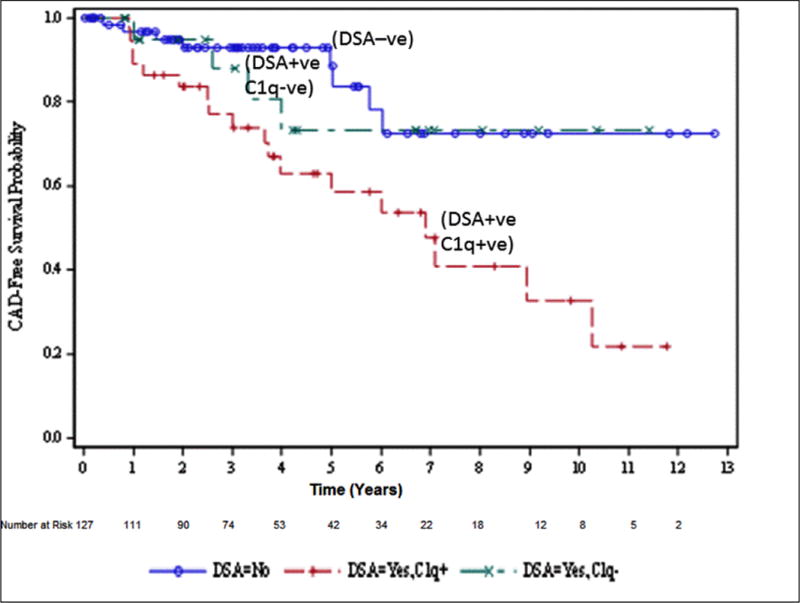
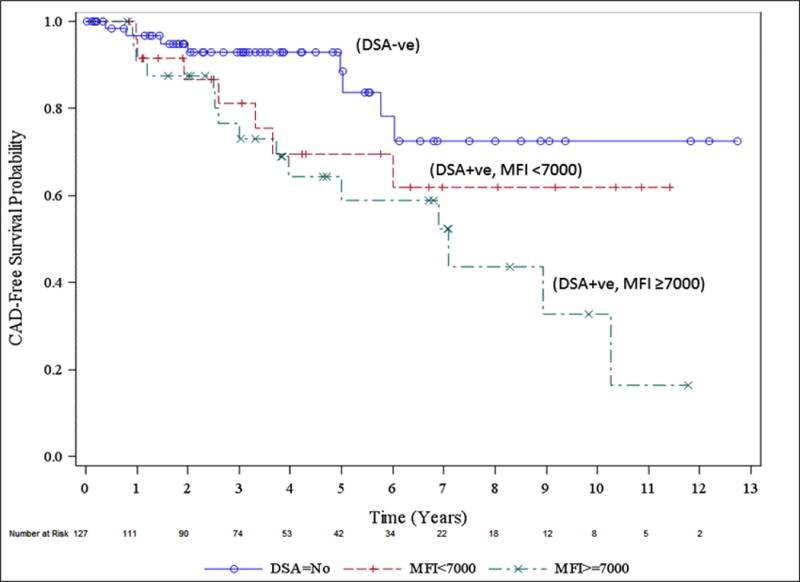
Results: Of 127 patients, 59 (46.4%) developed de novo DSA, 37 of those had C1q+ DSA. There was no difference in baseline characteristics except patients who developed C1q+ DSA more often received a donor heart from a female compared with C1q- DSA group (P = 0.034). The DSA median fluorescent intensity (MFI) value of 7000 or greater had 80% sensitivity and 80% specificity (C statistics 0.89, P <0.05) for predicting positive C1q binding. Multivariate analyses identified C1q binding DSA as an independent risk for CAV with a hazard ratio (HR) of 3.25 (95% confidence interval [CI], 1.33-7.93; P = 0.0095). In multivariable Cox proportional hazard models, the covariates associated with graft loss included: C1q+ DSA (HR, 3.2; 95% CI, 1.34-7.86; P < 0.009), pre-HT renal insufficiency (HR, 11.3; 95% CI, 3.71-34.29; P < 0.0001), and pre-HT ventilator support (HR, 3.3; 95% CI, 1.39-7.81; P = 0.007).
Conclusions: The DSA strength in MFI correlates with positive C1q-binding activity and hence functional capabilities of DSA. Close monitoring of DSA strength in MFI and function (C1q assay) may be useful for identifying pediatric HT recipient at risk for development of CAV.
Conflict of interest statement
The authors declare no conflicts of interest
Figures
References
-
- Ho EK, Vlad G, Vasilescu ER, et al. Pre- and post-transplantation allosensitization in heart allograft recipients: major impact of de novo alloantibody production on allograft survival. Hum Immunol. 2011;72(1):5–10. - PubMed
-
- Tran A, Fixler D, Huang R, Meza T, Lacelle C, Das B. Donor-specific HLA alloantibodies: Impact on cardiac allograft vasculopathy, rejection, and survival after pediatric heart transplantation. J Heart Lung Transplant. 2016;35(1):87–91. - PubMed
-
- Chin C, Chen G, Sequeria F, et al. Clinical usefulness of a novel C1q assay to detect immunoglobulin G antibodies capable of fixing complement in sensitized pediatric heart transplant patients. J Heart Lung Transplant. 2011;30(2):158–63. - PubMed
-
- Sutherland SM, Chen G, Sequeira FA, Lou CD, Alexander SR, Tyan DB. Complement-fixing donor-specific antibodies identified by a novel C1q assay are associated with allograft loss. Pediatric Transplant. 2012;16(1):12–17. - PubMed
Publication types
MeSH terms
Substances
Grants and funding
LinkOut - more resources
Full Text Sources
Other Literature Sources
Medical
