


Meta-Analysis of Comparative Trials Evaluating a Prophylactic Single-Use Negative Pressure Wound Therapy System for the Prevention of Surgical Site Complications
- PMID: 28885895
- PMCID: PMC5649123
- DOI: 10.1089/sur.2017.156
Meta-Analysis of Comparative Trials Evaluating a Prophylactic Single-Use Negative Pressure Wound Therapy System for the Prevention of Surgical Site Complications
Abstract
Background: We report the first meta-analysis on the impact of prophylactic use of a specific design of negative pressure wound therapy (NPWT) device on surgical site complications.
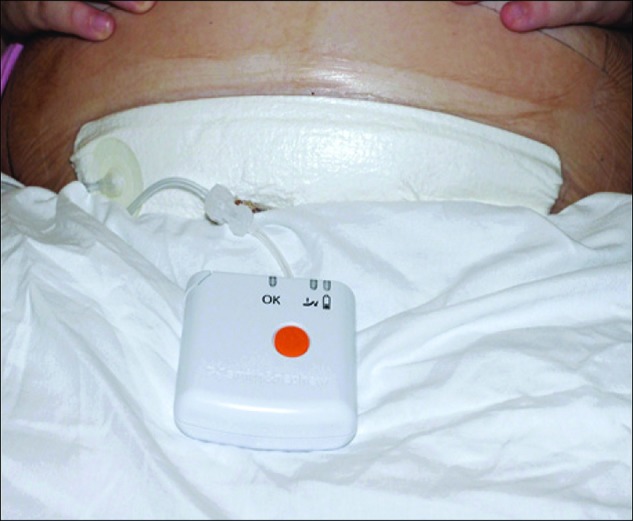
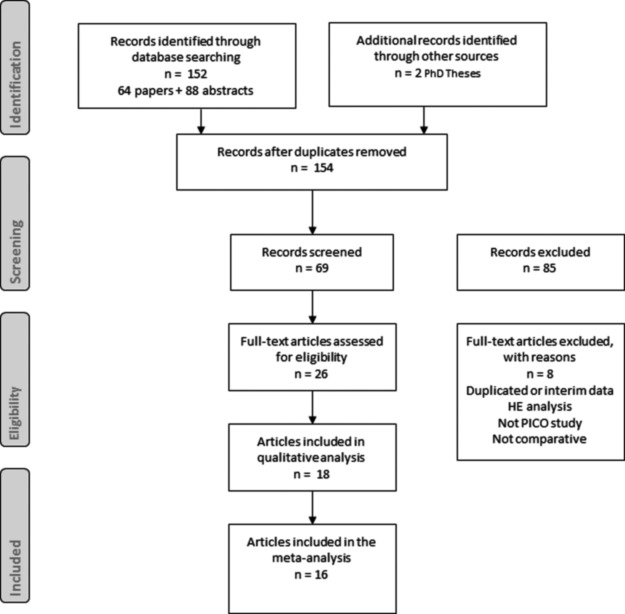
Methods: Articles were identified in which the specific single-use NPWT device (PICO⋄, Smith & Nephew) was compared with standard care for surgical site infection (SSI), dehiscence, or length of stay (LOS). Risk ratio (RR) ±95% confidence interval (CI) (SSI; dehiscence) or mean difference in LOS ±95% CI was calculated using RevMan v5.3.
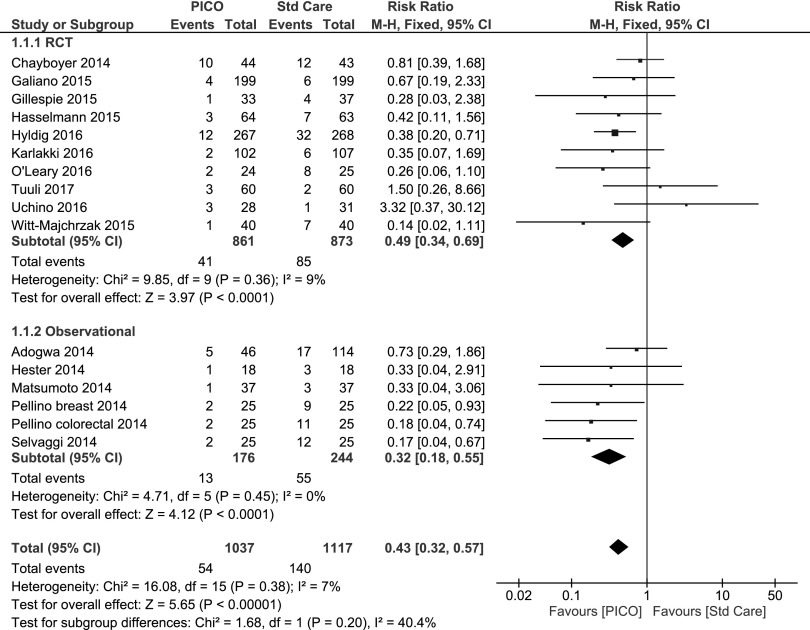
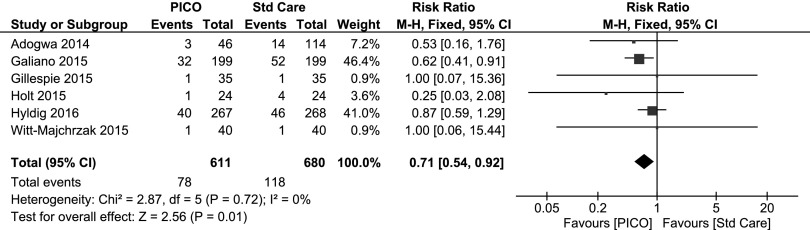
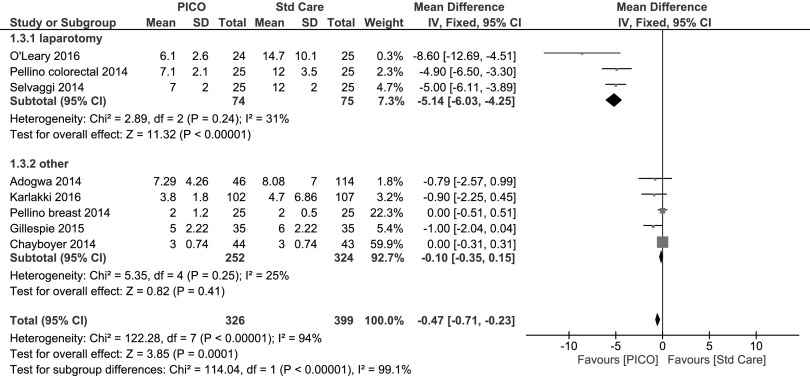
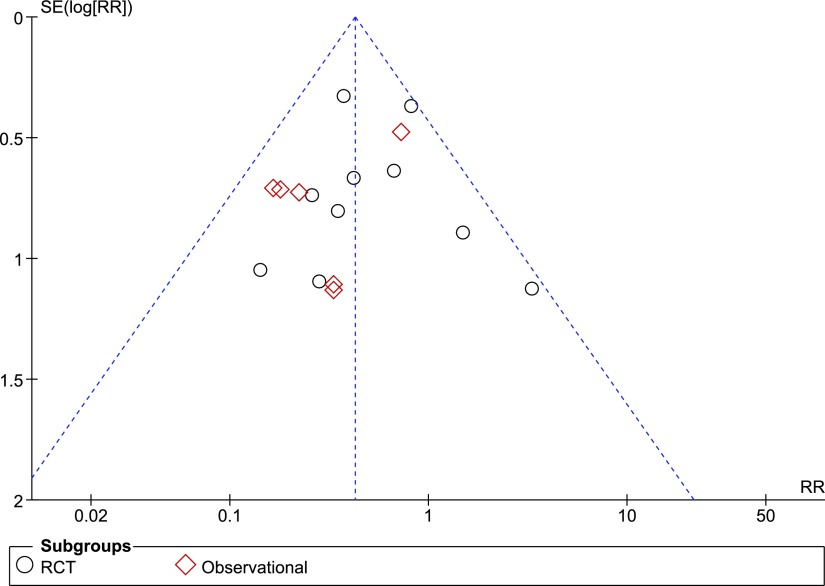
Results: There were 1863 patients (2202 incisions) represented by 16 articles. Among 10 randomized studies, there was a significant reduction in SSI rate of 51% from 9.7% to 4.8% with NPWT intervention (RR 0.49 [95% CI 0.34-0.69] p < 0.0001). There were six observational studies assessing reduction in SSI rate of 67% from 22.5% to 7.4% with NPWT (RR 0. 32 [95% CI 0.18-0.55] p < 0.0001). Combining all 16 studies, there was a significant reduction in SSI of 58% from 12.5% to 5.2% with NPWT (RR 0.43 [95% CI 0.32-0.57] p < 0.0001). Similar effects were seen irrespective of the kind of surgery (orthopedic, abdominal, colorectal, or cesarean section), although the numbers needed to treat (NNT) were lower in operations with higher frequencies of complications. There was a significant reduction in dehiscence from 17.4% to 12.8% with NPWT (RR 0.71 [95% CI 0.54-0.92] p < 0.01). The mean reduction in hospital LOS by NPWT was also significant (-0.47 days [95% CI -0.71 to -0.23] p < 0.0001).
Conclusions: The significant reduction in SSI, wound dehiscence, and LOS on the basis of pooled data from 16 studies shows a benefit of the PICO single-use NPWT system compared with standard care in closed surgical incisions.
Keywords: postoperative complication; prophylaxis; surgical site infection; wound infection; wound management.
Conflict of interest statement
VS and RM are employees of Smith & Nephew plc.
Figures
References
-
- Sugrue M, Ciprandi G, Djohan R, et al. World Union of Wound Healing Societies (WUWHS) Consensus Document. Closed surgical incision management: Understanding the role of NPWT. Wounds Int [Internet]. 2016. www.woundsinternational.com/wuwhs/view/consensus-document-closed-surgica... (Last accessed July29, 2017)
-
- Mangram AJ, Horan TC, Pearson ML, et al. Guideline for prevention of SSI, 1999. Infect Control Hosp Epidemiol 1999;20:250–278 - PubMed
-
- Tanner J, Padley W, Assadian O, et al. Do surgical care bundles reduce the risk of surgical site infections in patients undergoing colorectal surgery? A systematic review and cohort meta-analysis of 8,515 patients. Surgery 2015;158:66–77 - PubMed
Publication types
MeSH terms
LinkOut - more resources
Full Text Sources
Other Literature Sources
Medical
