Complete genome sequences of two strains of Treponema pallidum subsp. pertenue from Ghana, Africa: Identical genome sequences in samples isolated more than 7 years apart
- PMID: 28886021
- PMCID: PMC5607219
- DOI: 10.1371/journal.pntd.0005894
Complete genome sequences of two strains of Treponema pallidum subsp. pertenue from Ghana, Africa: Identical genome sequences in samples isolated more than 7 years apart
Abstract
Background: Treponema pallidum subsp. pertenue (TPE) is the causative agent of yaws, a multi-stage disease, endemic in tropical regions of Africa, Asia, Oceania, and South America. To date, four TPE strains have been completely sequenced including three TPE strains of human origin (Samoa D, CDC-2, and Gauthier) and one TPE strain (Fribourg-Blanc) isolated from a baboon. All TPE strains are highly similar to T. pallidum subsp. pallidum (TPA) strains. The mutation rate in syphilis and related treponemes has not been experimentally determined yet.
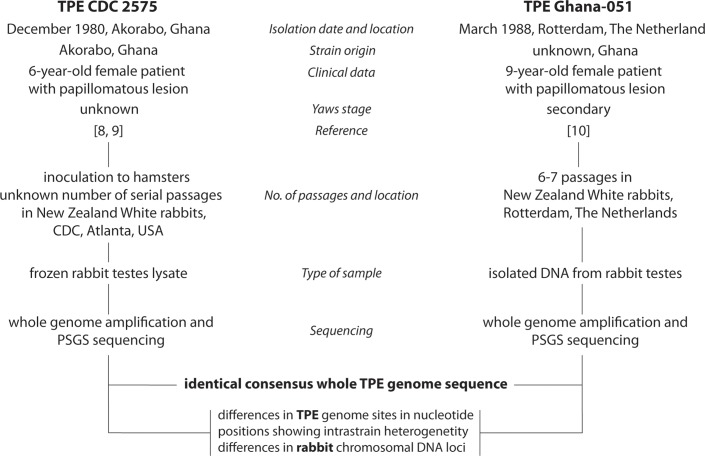
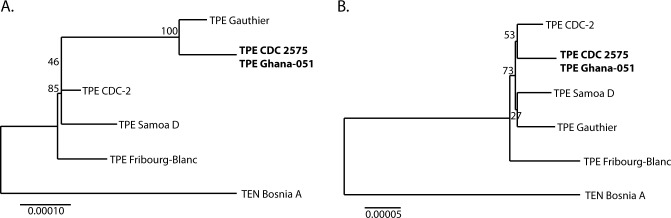
Methodology/principal findings: Complete genomes of two TPE strains, CDC 2575 and Ghana-051, that infected patients in Ghana and were isolated in 1980 and 1988, respectively, were sequenced and analyzed. Both strains had identical consensus genome nucleotide sequences raising the question whether TPE CDC 2575 and Ghana-051 represent two different strains. Several lines of evidence support the fact that both strains represent independent samples including regions showing intrastrain heterogeneity (13 and 5 intrastrain heterogeneous sites in TPE Ghana-051 and TPE CDC 2575, respectively). Four of these heterogeneous sites were found in both genomes but the frequency of alternative alleles differed. The identical consensus genome sequences were used to estimate the upper limit of the yaws treponeme evolution rate, which was 4.1 x 10⁻¹⁰ nucleotide changes per site per generation.
Conclusions/significance: The estimated upper limit for the mutation rate of TPE was slightly lower than the mutation rate of E. coli, which was determined during a long-term experiment. Given the known diversity between TPA and TPE genomes and the assumption that both TPA and TPE have a similar mutation rate, the most recent common ancestor of syphilis and yaws treponemes appears to be more than ten thousand years old and likely even older.
Conflict of interest statement
The authors have declared that no competing interests exist.
Figures
References
-
- Giacani L, Lukehart SA. The endemic treponematoses. Clin Microbiol Rev. 2014;27(1): 89–115. doi: 10.1128/CMR.00070-13 - DOI - PMC - PubMed
-
- Čejková D, Zobaníková M, Chen L, Pospíšilová P, Strouhal M, Qin X, et al. Whole genome sequences of three Treponema pallidum ssp. pertenue strains: yaws and syphilis treponemes differ in less than 0.2% of the genome sequence. PLoS Negl Trop Dis. 2012;6(1): e1471 doi: 10.1371/journal.pntd.0001471 - DOI - PMC - PubMed
-
- Zobaníková M, Strouhal M, Mikalová L, Čejková D, Ambrožová L, Pospíšilová P, et al. Whole genome sequence of the Treponema Fribourg-Blanc: unspecified simian isolate is highly similar to the yaws subspecies. PLoS Negl Trop Dis. 2013;7(4): e2172 doi: 10.1371/journal.pntd.0002172 - DOI - PMC - PubMed
-
- Štaudová B, Strouhal M, Zobaníková M, Čejková D, Fulton LL, Chen L, et al. Whole genome sequence of the Treponema pallidum subsp. endemicum strain Bosnia A: the genome is related to yaws treponemes but contains few loci similar to syphilis treponemes. PLoS Negl Trop Dis. 2014;8(11): e3261 doi: 10.1371/journal.pntd.0003261 - DOI - PMC - PubMed
-
- Šmajs D, Norris SJ, Weinstock GM. Genetic diversity in Treponema pallidum: implications for pathogenesis, evolution and molecular diagnostics of syphilis and yaws. Infect Genet Evol. 2012;12(2): 191–202. doi: 10.1016/j.meegid.2011.12.001 - DOI - PMC - PubMed
MeSH terms
LinkOut - more resources
Full Text Sources
Other Literature Sources
Miscellaneous