


Population genetics, community of parasites, and resistance to rodenticides in an urban brown rat (Rattus norvegicus) population
- PMID: 28886097
- PMCID: PMC5590879
- DOI: 10.1371/journal.pone.0184015
Population genetics, community of parasites, and resistance to rodenticides in an urban brown rat (Rattus norvegicus) population
Abstract
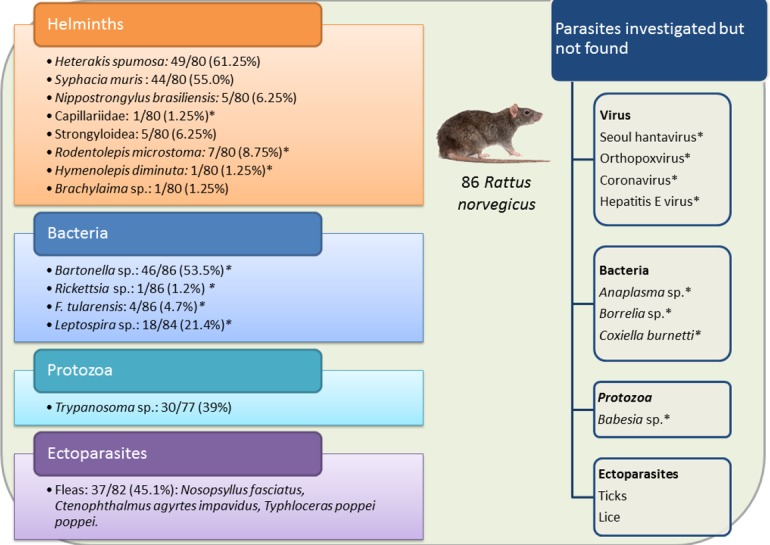
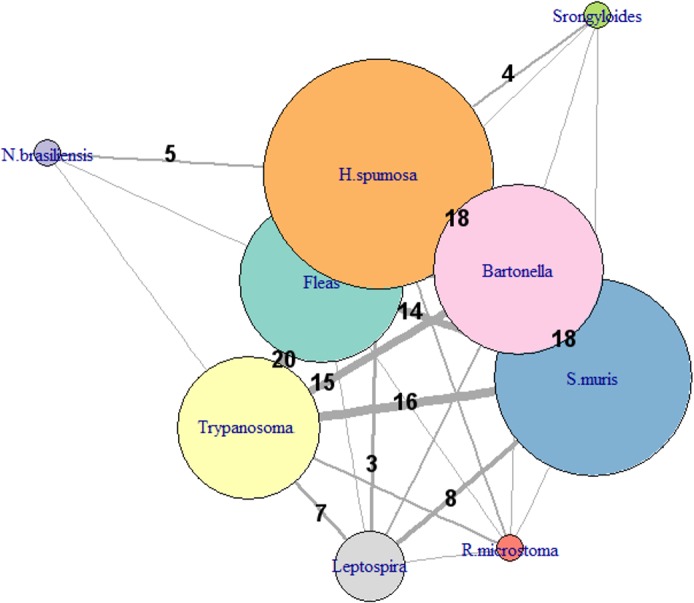
Brown rats are one of the most widespread urban species worldwide. Despite the nuisances they induce and their potential role as a zoonotic reservoir, knowledge on urban rat populations remains scarce. The main purpose of this study was to characterize an urban brown rat population from Chanteraines park (Hauts-de-Seine, France), with regards to haematology, population genetics, immunogenic diversity, resistance to anticoagulant rodenticides, and community of parasites. Haematological parameters were measured. Population genetics was investigated using 13 unlinked microsatellite loci. Immunogenic diversity was assessed for Mhc-Drb. Frequency of the Y139F mutation (conferring resistance to rodenticides) and two linked microsatellites were studied, concurrently with the presence of anticoagulant residues in the liver. Combination of microscopy and molecular methods were used to investigate the occurrence of 25 parasites. Statistical approaches were used to explore multiple parasite relationships and model parasite occurrence. Eighty-six rats were caught. The first haematological data for a wild urban R. norvegicus population was reported. Genetic results suggested high genetic diversity and connectivity between Chanteraines rats and surrounding population(s). We found a high prevalence (55.8%) of the mutation Y139F and presence of rodenticide residues in 47.7% of the sampled individuals. The parasite species richness was high (16). Seven potential zoonotic pathogens were identified, together with a surprisingly high diversity of Leptospira species (4). Chanteraines rat population is not closed, allowing gene flow and making eradication programs challenging, particularly because rodenticide resistance is highly prevalent. Parasitological results showed that co-infection is more a rule than an exception. Furthermore, the presence of several potential zoonotic pathogens, of which four Leptospira species, in this urban rat population raised its role in the maintenance and spread of these pathogens. Our findings should stimulate future discussions about the development of a long-term rat-control management program in Chanteraines urban park.
Conflict of interest statement
Figures
References
-
- Battersby S, Hirschorn RB, Amman BR. Commensal rodents. In: Bonnefoy X, Kampen H, Sweeney K, editors. Public health significance of urban pest. Geneva, Switzerland: World Health Organization; 2008. pp. 387–419.
-
- Aplin KP, Suzuki H, Chinen AA, Chesser RT, ten Have J, Donnellan SC, et al. Multiple geographic origins of commensalism and complex dispersal history of black rats. PLoS One. 2011; 6(11): e26357 doi: 10.1371/journal.pone.0026357 - DOI - PMC - PubMed
-
- Pascal M. Rats. In: Simberloff D, Rejmanek M, editors. Encyclopedia of Biological Invasions. Berkeley and Los Angeles, California, USA: University of California Press; 2011. pp. 571–575.
-
- Courchamp F, Chapuis JL, Pascal M. Mammals invaders on islands: impact, control and control impact. Biol Rev Camb Philos Soc. 2003; 78: 347–383. - PubMed
-
- Pascal M, Lorvelec O, Vigne JD. Invasions biologiques et extinctions: 11 000 ans d'histoire des vertébrés en France. Belin & Quae ed; Paris; 2006.
MeSH terms
Substances
LinkOut - more resources
Full Text Sources
Other Literature Sources
Research Materials
