Review
. 2017 Oct 2;5(4):e1367458.
doi: 10.1080/21688370.2017.1367458. Epub 2017 Sep 8.

Airway epithelial barrier dysfunction in the pathogenesis and prognosis of respiratory tract diseases in childhood and adulthood

Affiliations
Review

Airway epithelial barrier dysfunction in the pathogenesis and prognosis of respiratory tract diseases in childhood and adulthood

Hasan Yuksel et al. Tissue Barriers. .

Abstract

The lungs are in direct contact with the environment through the tubular structure that constitutes the airway. Starting from the nasal orifice, the airway is exposed to foreign particles including infectious agents, allergens, and other substances that can damage the airways. Therefore, the airway must have a functional epithelial barrier both in the upper and lower airways to protect against these threats. As with the skin, it is likely that the pathogenesis of respiratory diseases is a consequence of epithelial barrier defects in these airways. The characteristics of this system, starting from the beginning of life and extending into maturing and aging, determine the prognosis of respiratory diseases. In this article, we discuss the pathogenesis, clinical phenotype, and prognosis of respiratory diseases from newborns to adulthood in the context of epithelial barrier function and dysfunction.

Keywords: airway; barrier; dysfunction; epithelium; respiratory disease.


Figures
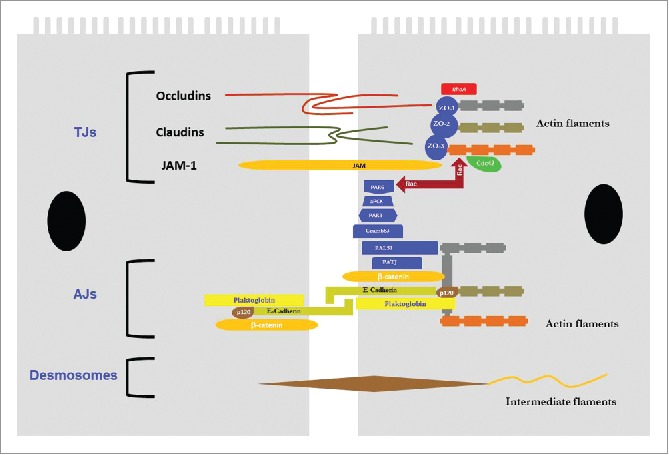
Figure 1.
Figure 1.
Junction components that form the barrier between adjacent epithelial cells in the airway. TJs, Tight junctions; AJs, Adherens junctions; JAM, Junctional adhesion molecule; ZO, Zonula occludens.
Figure 2.
Figure 2.
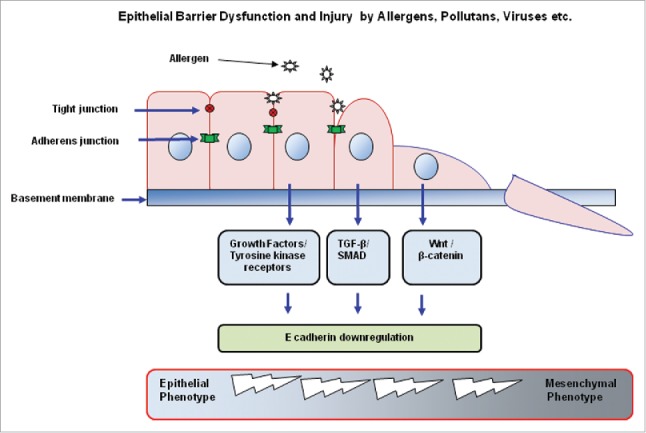
The main features and elements of epithelial-mesenchymal transition. TGF, Transforming growth factor; SMAD, Sma and mad related family; Wnt, Wingless / integrated.
Figure 3.
Figure 3.
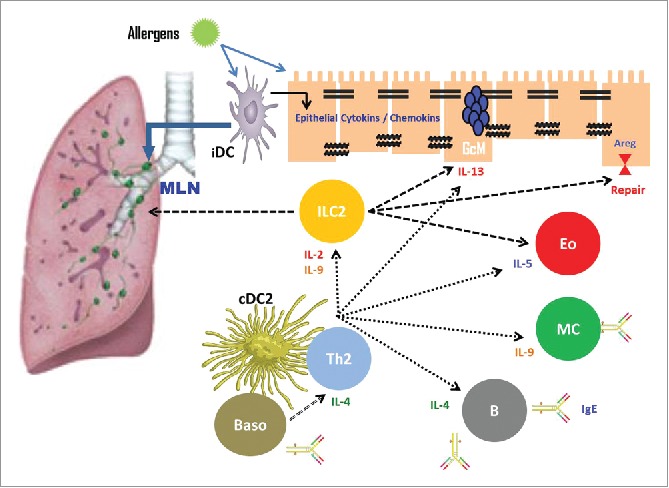
Indirect suppression of barrier proteins by inflammatory mediators in allergen-induced epithelial barrier damage. IL, Interleukin; ILC, Innate lymphoid cells; MLN, Mediastinal lymph nodes; MC, Macrophage cell; cDC, Conventional dendritic cell; Th2, T helper 2; B, B lymphocytes; Eo, Eosinophil; GCM, goblet-cell metaplasia.

References

    1. Ganesan S, Comstock AT, Sajjan US. Barrier function of airway tract epithelium. Tissue Barriers. 2013;1(4):e24997. doi:10.4161/tisb.24997. PMID:24665407. - DOI - PMC - PubMed
    1. Colebatch HJ, Ng CK. Estimating alveolar surface area during life. Respir Physiol. 1992;88(1-2):163-70. doi:10.1016/0034-5687(92)90037-W. PMID:1626135. - DOI - PubMed
    1. Wang DY, Li Y, Yan Y, Li C, Shi L. Upper airway stem cells: understanding the nose and role for future cell therapy. Curr Allergy Asthma Rep. 2015;15(1):490. doi:10.1007/s11882-014-0490-0. PMID:25430951. - DOI - PMC - PubMed
    1. Yu F, Zhao X, Li C, Li Y, Yan Y, Shi L, Gordon BR, Wang DY. Airway stem cells: review of potential impact on understanding of upper airway diseases. Laryngoscope. 2012;122(7):1463-9. doi:10.1002/lary.23320. PMID:22555982. - DOI - PubMed
    1. Smits HH, van der Vlugt LE, von Mutius E, Hiemstra PS. Childhood allergies and asthma: New insights on environmental exposures and local immunity at the lung barrier. Curr Opin Immunol. 2016;42:41-7. doi:10.1016/j.coi.2016.05.009. PMID:27254380. - DOI - PubMed

LinkOut - more resources