


Modeling the impact of novel male contraceptive methods on reductions in unintended pregnancies in Nigeria, South Africa, and the United States
- PMID: 28887053
- PMCID: PMC5732079
- DOI: 10.1016/j.contraception.2017.08.015
Modeling the impact of novel male contraceptive methods on reductions in unintended pregnancies in Nigeria, South Africa, and the United States
Abstract
Objective: We modeled the potential impact of novel male contraceptive methods on averting unintended pregnancies in the United States, South Africa, and Nigeria.
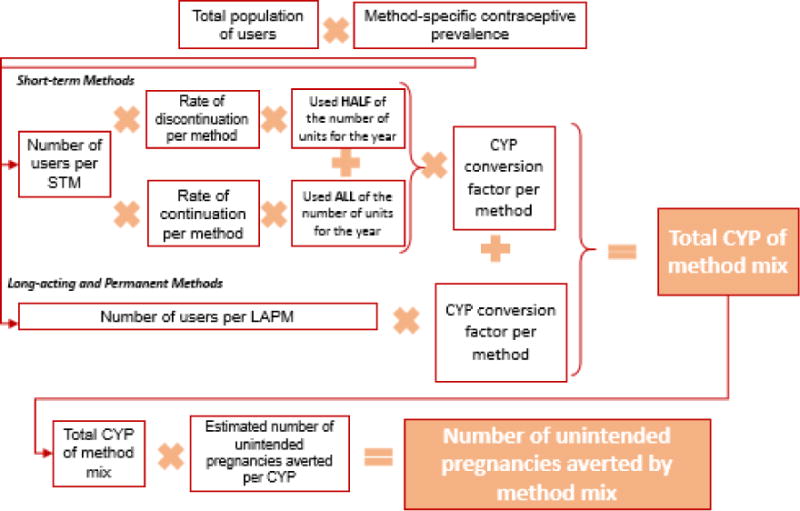
Study design: We used an established methodology for calculating the number of couple-years of protection provided by a given contraceptive method mix. We compared a "current scenario" (reflecting current use of existing methods in each country) against "future scenarios," (reflecting whether a male oral pill or a reversible vas occlusion was introduced) in order to estimate the impact on unintended pregnancies averted. Where possible, we based our assumptions on acceptability data from studies on uptake of novel male contraceptive methods.
Results: Assuming that only 10% of interested men would take up a novel male method and that users would comprise both switchers (from existing methods) and brand-new users of contraception, the model estimated that introducing the male pill or reversible vas occlusion would decrease unintended pregnancies by 3.5% to 5.2% in the United States, by 3.2% to 5% in South Africa, and by 30.4% to 38% in Nigeria. Alternative model scenarios are presented assuming uptake as high as 15% and as low as 5% in each location. Model results were sensitive to assumptions regarding novel method uptake and proportion of switchers vs. new users.
Conclusion: Even under conservative assumptions, the introduction of a male pill or temporary vas occlusion could meaningfully contribute to averting unintended pregnancies in a variety of contexts, especially in settings where current use of contraception is low.
Implications: Novel male contraceptives could play a meaningful role in averting unintended pregnancies in a variety of contexts. The potential impact is especially great in settings where current use of contraception is low and if novel methods can attract new contraceptive users.
Keywords: CYP; Male contraception; Male pill; Mathematical model; Reversible vas occlusion; Unintended pregnancy.
Copyright © 2017 The Author(s). Published by Elsevier Inc. All rights reserved.
Figures
References
-
- Alkema L, Kantorova V, Menozzi C, Biddlecom A. National, regional, and global rates and trends in contraceptive prevalence and unmet need for family planning between 1990 and 2015: a systematic and comprehensive analysis. Lancet. 2013;381(9878):1642–1652. - PubMed
-
- Westoff C, Bietsch K, Koffman D. (DHS Analytical Studies No. 34).Indicators of Trends in Fertility in SubSaharan Africa. 2013
MeSH terms
Grants and funding
LinkOut - more resources
Full Text Sources
Other Literature Sources
Medical
