


Effects of low concentrations of erythromycin, penicillin, and virginiamycin on bacterial resistance development in vitro
- PMID: 28887450
- PMCID: PMC5591201
- DOI: 10.1038/s41598-017-09593-4
Effects of low concentrations of erythromycin, penicillin, and virginiamycin on bacterial resistance development in vitro
Abstract
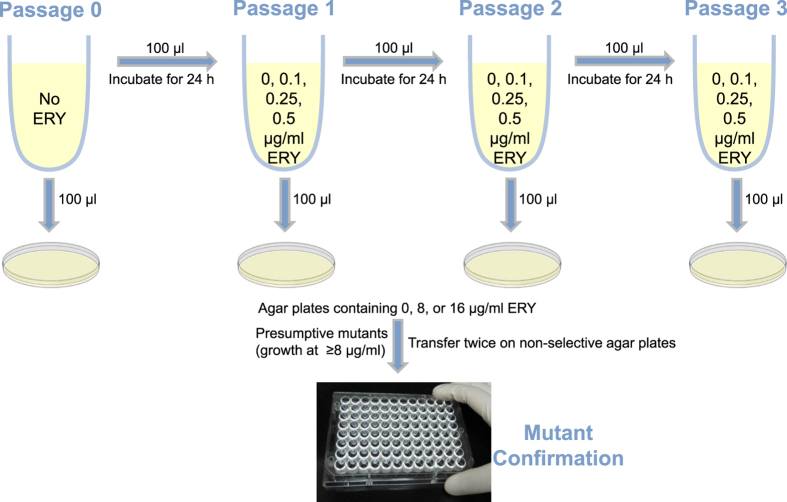
Distillers grains are co-products of the corn ethanol industry widely used in animal feed. We examined the effects of erythromycin, penicillin, and virginiamycin at low concentrations reflective of those detected in distillers grains on bacterial resistance selection. At 0.1 µg/ml erythromycin, macrolide-resistant mutants were induced in one Campylobacter coli and one Enterococcus faecium strain, while these strains plus three additional C. coli, one additional E. faecium, and one C. jejuni also developed resistance when exposed to 0.25 µg/ml erythromycin. At 0.5 µg/ml erythromycin, a total of eight strains (four Campylobacter and four Enterococcus) obtained macrolide-resistant mutants, including two strains from each genus that were not selected at lower erythromycin concentrations. For penicillin, three of five E. faecium strains but none of five Enterococcus faecalis strains consistently developed resistance at all three selection concentrations. Virginiamycin at two M1:S1 ratios did not induce resistance development in four out of five E. faecium strains; however, increased resistance was observed in the fifth one under 0.25 and 0.5 µg/ml virginiamycin selections. Although not yet tested in vivo, these findings suggest a potential risk of stimulating bacterial resistance development in the animal gut when distillers grains containing certain antibiotic residues are used in animal feed.
Conflict of interest statement
The authors declare that they have no competing interests.
Figures
References
-
- U.S. Grains Council. A guide to distiller’s dried grains with solubles (DDGS) – 3rdEdition, http://www.grains.org/sites/default/files/ddgs-handbook/Complete%202012%... (2012).
-
- Renewable Fuels Association. Building partnerships growing markets: 2017 ethanol industry outlook, http://www.ethanolrfa.org/wp-content/uploads/2017/02/Ethanol-Industry-Ou... (2017).
-
- Olmstead, J. Bugs in the system, https://www.iatp.org/sites/default/files/2012_05_02_AntibioticsInEthanol... (2012).
-
- Luther, M. Report of FY 2008 nationwide survey of distillers products for antibiotic residues, http://www.fda.gov/AnimalVeterinary/Products/AnimalFoodFeeds/Contaminant... (2012).
-
- Luther, M. Report of FY 2010 nationwide survey of distillers products for antibiotic residues, http://www.fda.gov/AnimalVeterinary/Products/AnimalFoodFeeds/Contaminant... (2012).
MeSH terms
Substances
LinkOut - more resources
Full Text Sources
Other Literature Sources
Medical
Molecular Biology Databases
