. 2017 Sep 8;7(1):10981.
doi: 10.1038/s41598-017-11496-3.

Dormant 5-lipoxygenase in inflammatory macrophages is triggered by exogenous arachidonic acid

Affiliations

Dormant 5-lipoxygenase in inflammatory macrophages is triggered by exogenous arachidonic acid

Carlos A Sorgi et al. Sci Rep. .

Abstract

The differentiation of resident tissue macrophages from embryonic precursors and that of inflammatory macrophages from bone marrow cells leads to macrophage heterogeneity. Further plasticity is displayed through their ability to be polarized as subtypes M1 and M2 in a cell culture microenvironment. However, the detailed regulation of eicosanoid production and its involvement in macrophage biology remains unclear. Using a lipidomics approach, we demonstrated that eicosanoid production profiles between bone marrow-derived (BMDM) and peritoneal macrophages differed drastically. In polarized BMDMs, M1 and M2 phenotypes were distinguished by thromboxane B2, prostaglandin (PG) E2, and PGD2 production, in addition to lysophospholipid acyltransferase activity. Although Alox5 expression and the presence of 5-lipoxygenase (5-LO) protein in BMDMs was observed, the absence of leukotrienes production reflected an impairment in 5-LO activity, which could be triggered by addition of exogenous arachidonic acid (AA). The BMDM 5-LO regulatory mechanism was not responsive to PGE2/cAMP pathway modulation; however, treatment to reduce glutathione peroxidase activity increased 5-LO metabolite production after AA stimulation. Understanding the relationship between the eicosanoids pathway and macrophage biology may offer novel strategies for macrophage-associated disease therapy.


Conflict of interest statement

The authors declare that they have no competing interests.

Figures
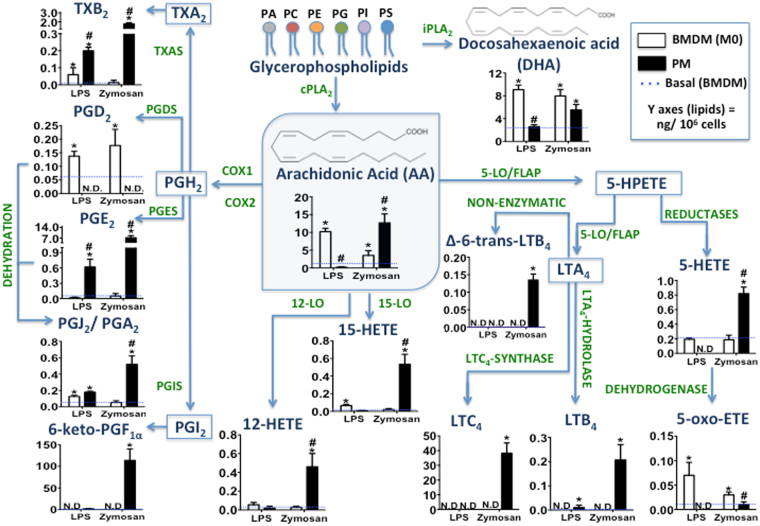
Figure 1
Figure 1
Comparative eicosanoid catabolism profile in BMDMs and PMs stimulated with microbial particles. BMDMs and PMs (1 × 106 cells/well) were adhered on cell culture plates for 24 h. Macrophages were stimulated with LPS (500 ng/mL) or zymosan (30 particles/cell) for 6 and 1.5 h, respectively. The lipid mediators in cell culture supernatants were identified and quantified by HPLC-MS/MS (MRM mode) for eicosanoids: TXB2, PGD2, PGE2, PGJ2/PGA2, 6-keto-PGF, 12-HETE, 15-HETE, 5-HETE, 5-oxo-ETE, LTC4, LTB4, and Δ-6-trans-LTB4 as well as for the release of fatty acids: AA and DHA. Results are expressed as the means ± s.e.m. of three experiments (n = 3). Differences were considered when p < 0.05, *BMDMs and PMs stimulated or not, compared to non-stimulated basal BMDM production (dashed line), #PM compared to BMDM eicosanoid production, after LPS or zymosan stimulation.
Figure 2
Figure 2
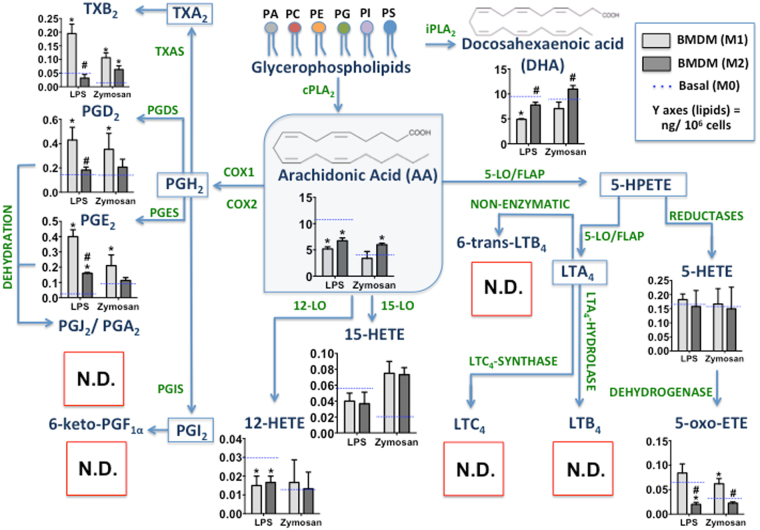
Effect of BMDM polarization on eicosanoids production after microbial particle stimulation. BMDMs were treated with IFN-γ (100 ng/mL) (M1), IL-4 + IL-13 (10 ng/mL) (M2), or only adhered (M0). Then, BMDMs were stimulated with LPS (500 ng/mL) or zymosan (30 particles/cell) for 6 and 1.5 h, respectively. The lipid mediators in cell culture supernatants were identified and quantified by HPLC-MS/MS (MRM mode) for eicosanoids: TXB2, PGD2, PGE2, PGJ2/PGA2, 6-keto-PGF, 12-HETE, 15-HETE, 5-HETE, 5-oxo-ETE, LTC4, LTB4, and Δ-6-trans-LTB4, as well as for the release of fatty acids: AA and DHA. The absence of specific eicosanoid production is represented by a red square (N.D.). Results are expressed as the means ± s.e.m. of three experiments (n = 3). Differences were considered significant when p < 0.05, *M1 and M2 compared to M0 and #M2 compare to M1.
Figure 3
Figure 3
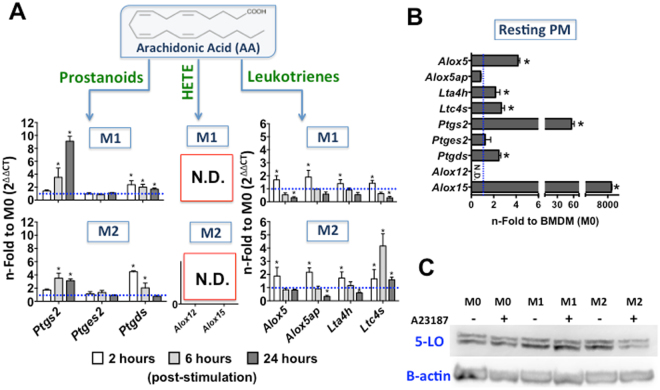
Characterization of macrophage eicosanoid catabolism enzyme mRNA expression and 5-LO protein synthesis. For mRNA expression (A) BMDMs were treated with IFN-γ (100 ng/mL) (M1), IL-4 + IL-13 (10 ng/mL) (M2), or only adhered (M0) for 2, 6, and 24 h in vitro; or (B) resting PMs were used. Total RNA was extracted, synthesized as cDNA, and the relative expression (ΔΔCt) was analysed by qRT-PCR. Transcripts encoding cyclooxygenase and lipoxygenase pathway genes were analysed. The results were normalized to endogenous expression of the internal controls Actb and Gapdh. The blue dotted lines show the mRNA expression on non-primed BMDMs (M0). The results are presented as the means ± s.e.m. of three independent experiments (n = 3). *p < 0.05 compared to non-primed BMDMs (M0). Qualitative data for (C) 5-LO protein synthesis was demonstrated by Western Blot assay using a rabbit-polyclonal anti-5-LO antibody (78 kDa). The membranes were incubated with specific conjugated secondary antibodies (goat anti-rabbit IgG-HRP) and detected with chemiluminescence (ECL) reagent. Representative result from two independent experiments is shown.
Figure 4
Figure 4
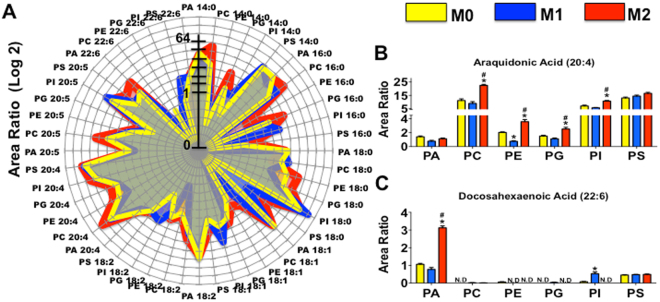
LPAT activity assay by double choice of substrate on polarized BMDMs. Microsomes were used to test BMDM - LPAT activity using a mixture of six lysophospholipids and eight acyl-CoA esters as described in Materials and Methods. The total area ratio of all newly formed phospholipids is expressed in the radar graphic (A). The specific production of AA-anchored (B) or DHA-anchored phospholipids (C) is represented for polarized BMDMs. The results indicate the area ratio for the incorporation of fatty acid residues in polar groups by internal deuterated standard. Data are representative for BMDMs, 24 h adherent (M0), primed with IFN-γ for 24 h (M1) or with IL-4 + IL-13 for 24 h (M2). All 48 possible products were quantified using HPLC-MS/MS. The Y-axis represents the area ratio (Log2) of newly formed phospholipids. Two independent microsomal preparations were tested in duplicate and the data shown represent the means ± s.e.m. * p < 0.05 comparing M1 or M2 to M0; # p < 0.05 for M2 compared to M1.
Figure 5
Figure 5
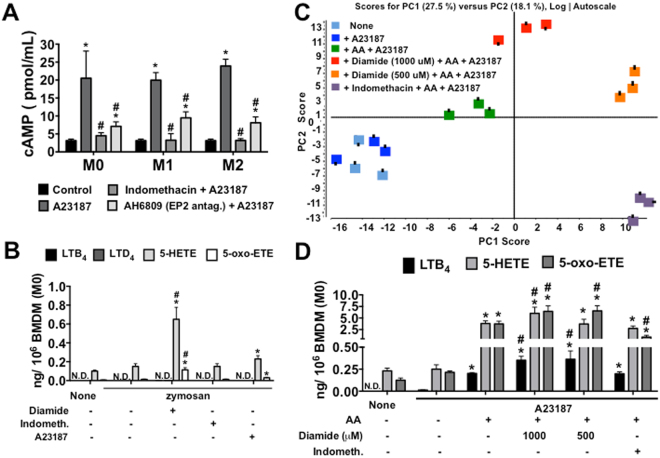
Identification of 5-LO derivative metabolites in BMDMs after exogenous AA stimulation and treatments. BMDMs were treated with IFN-γ (100 ng/mL) (M1), IL-4 + IL-13 (10 ng/mL) (M2) for 24 h, or only adhered (M0). (A) cAMP in BMDMs pretreated or not with indomethacin (10 mM) for 30 min, or EP2 antagonist (AH6809, 1 mM); with or without subsequent ionophore A23187 (0.5 μM) stimulation for 9 min (two independent experiments in duplicate, n = 2). Lipids in cell culture supernatants were identified and quantified for BMDMs (M0) pretreated with or without indomethacin (10 mM) for 30 min, or diamide (1000 or 500 μM) for 10 min; with or without subsequent ionophore A23187 (0.5 μM) stimulation for 15 min and/or zymosan (10 μg/mL) for 1.5 h diluted in DMEM. In addition, BMDMs were incubated with or without AA (40 μM) for 10 min before treatment and stimulation. (B) HPLC-MS/MS (MRMHR) for eicosanoids: LTB4, LTD4, 5-HETE, and 5-oxo-ETE. (C) PCA with Log autoscaling on HPLC-TOF-MS polar lipids. PCA score discrimination of BMDM total polar lipids with or without AA-stimulation and/or ionophore A23187 post-stimulation (n = 3 from each depot, analysed in duplicate). (D) HPLC-MS/MS (MRMHR) for eicosanoids: LTB4, 5-HETE, and 5-oxo-ETE on AA-stimulated BMDMs with or without treatment, and post-stimulation with ionophore A23187 (n = 3, analysed in duplicate). (A,B, and D) The results are presented as the means ± s.e.m. Differences are considered significant when p < 0.05, *comparing stimulated-BMDMs versus non-stimulated; #treatment versus non-treated stimulated-BMDMs.

References

    1. Geissmann F, Gordon S, Hume DA, Mowat AM, Randolph GJ. Unravelling mononuclear phagocyte heterogeneity. Nature reviews. Immunology. 2010;10:453–460. doi: 10.1038/nri2784. - DOI - PMC - PubMed
    1. Cassado Ados A, D’Imperio Lima MR, Bortoluci KR. Revisiting mouse peritoneal macrophages: heterogeneity, development, and function. Front Immunol. 2015;6:225. - PMC - PubMed
    1. Yona S, et al. Fate mapping reveals origins and dynamics of monocytes and tissue macrophages under homeostasis. Immunity. 2013;38:79–91. doi: 10.1016/j.immuni.2012.12.001. - DOI - PMC - PubMed
    1. Hashimoto D, et al. Tissue-resident macrophages self-maintain locally throughout adult life with minimal contribution from circulating monocytes. Immunity. 2013;38:792–804. doi: 10.1016/j.immuni.2013.04.004. - DOI - PMC - PubMed
    1. Auffray C, et al. CX3CR1+ CD115+ CD135+ common macrophage/DC precursors and the role of CX3CR1 in their response to inflammation. The Journal of experimental medicine. 2009;206:595–606. doi: 10.1084/jem.20081385. - DOI - PMC - PubMed

Publication types

MeSH terms

LinkOut - more resources