


Relationship of Sleep Duration With All-Cause Mortality and Cardiovascular Events: A Systematic Review and Dose-Response Meta-Analysis of Prospective Cohort Studies
- PMID: 28889101
- PMCID: PMC5634263
- DOI: 10.1161/JAHA.117.005947
Relationship of Sleep Duration With All-Cause Mortality and Cardiovascular Events: A Systematic Review and Dose-Response Meta-Analysis of Prospective Cohort Studies
Abstract
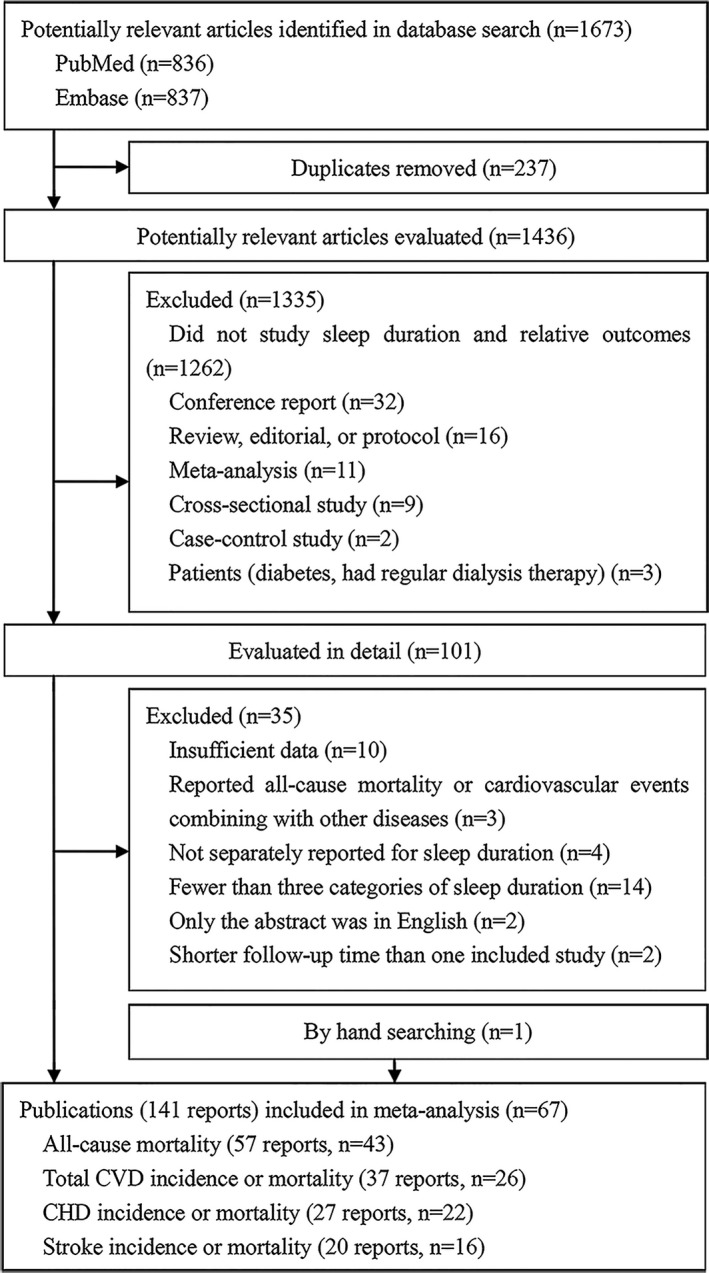
Background: Effects of extreme sleep duration on risk of mortality and cardiovascular outcomes remain controversial. We aimed to quantify the dose-response relationships of sleep duration with risk of all-cause mortality, total cardiovascular disease, coronary heart disease, and stroke.
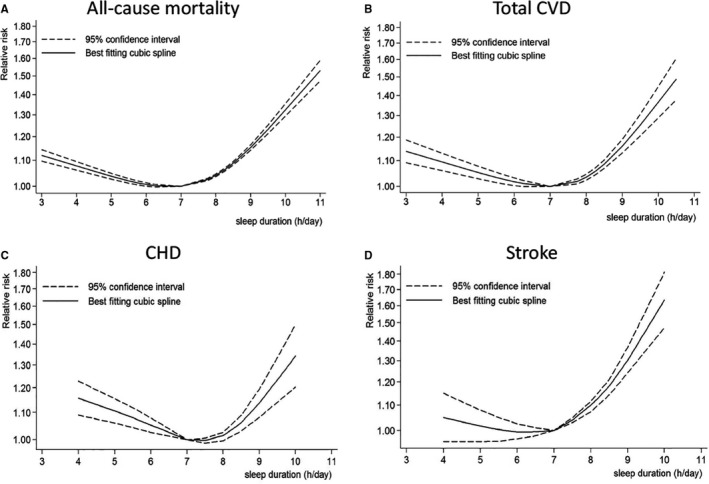
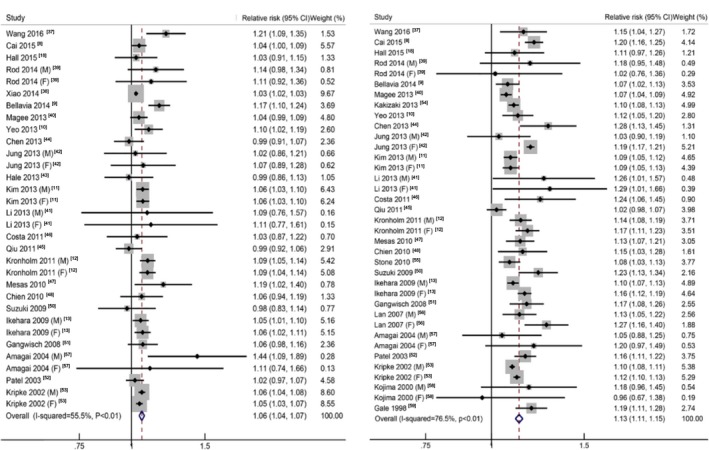
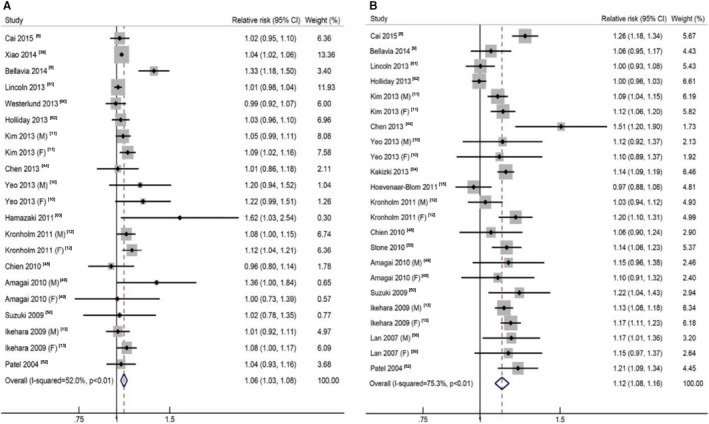
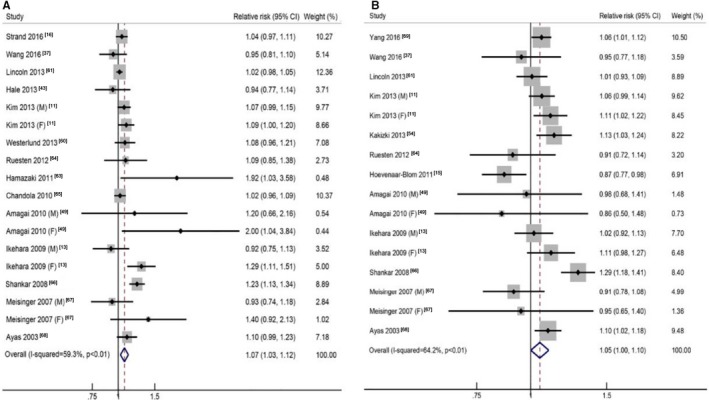
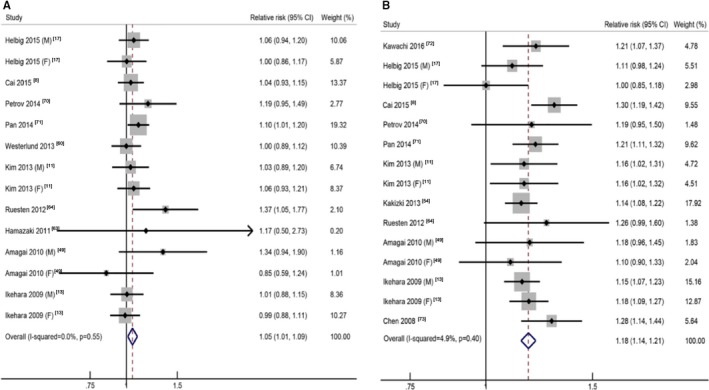
Methods and results: PubMed and Embase were systematically searched for prospective cohort studies published before December 1, 2016, that examined the associations between sleep duration and at least 1 of the 4 outcomes in generally healthy populations. U-shaped associations were indicated between sleep duration and risk of all outcomes, with the lowest risk observed for ≈7-hour sleep duration per day, which was varied little by sex. For all-cause mortality, when sleep duration was <7 hours per day, the pooled relative risk (RR) was 1.06 (95% CI, 1.04-1.07) per 1-hour reduction; when sleep duration was >7 hours per day, the pooled RR was 1.13 (95% CI, 1.11-1.15) per 1-hour increment. For total cardiovascular disease, the pooled RR was 1.06 (95% CI, 1.03-1.08) per 1-hour reduction and 1.12 (95% CI, 1.08-1.16) per 1-hour increment of sleep duration. For coronary heart disease, the pooled RR was 1.07 (95% CI, 1.03-1.12) per 1-hour reduction and 1.05 (95% CI, 1.00-1.10) per 1-hour increment of sleep duration. For stroke, the pooled RR was 1.05 (95% CI, 1.01-1.09) per 1-hour reduction and 1.18 (95% CI, 1.14-1.21) per 1-hour increment of sleep duration.
Conclusions: Our findings indicate that both short and long sleep duration is associated with an increased risk of all-cause mortality and cardiovascular events.
Keywords: all‐cause death; cardiovascular disease; coronary heart disease; meta‐analysis; sleep; stroke.
© 2017 The Authors. Published on behalf of the American Heart Association, Inc., by Wiley.
Figures
References
-
- World Heart Federation . World congress of cardiology & cardiovascular health 2016. Available at: www.world-heart-federation.org/resources/world-congress-cardiology-cardi.... Accessed December 1, 2016.
-
- World Health Organization . Global action plan for the prevention and control of NCDS 2013–2020. Available at: www.Who.Int/nmh/publications/ncd-action-plan/en/. Accessed December 1, 2016.
-
- Shan Z, Ma H, Xie M, Yan P, Guo Y, Bao W, Rong Y, Jackson CL, Hu FB, Liu L. Sleep duration and risk of type 2 diabetes: a meta‐analysis of prospective studies. Diabetes Care. 2015;38:529–537. - PubMed
Publication types
MeSH terms
LinkOut - more resources
Full Text Sources
Other Literature Sources
Medical
