Discovery of the Second Messenger Cyclic di-GMP
- PMID: 28889281
- PMCID: PMC5931213
- DOI: 10.1007/978-1-4939-7240-1_1
Discovery of the Second Messenger Cyclic di-GMP
Abstract
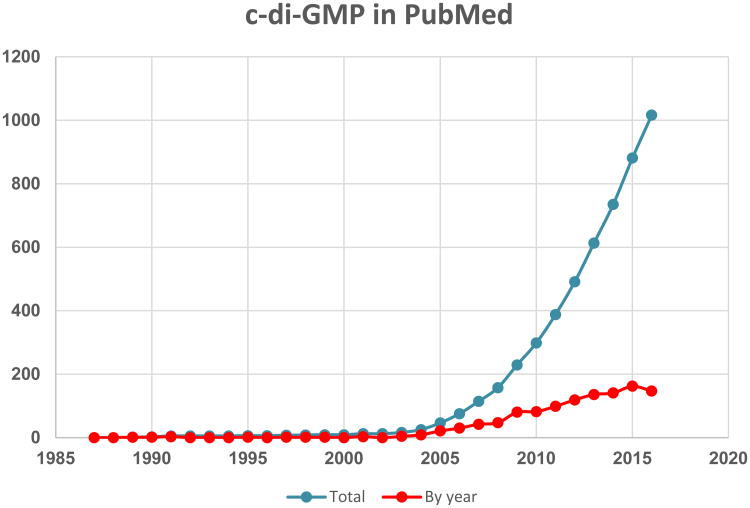
The nearly ubiquitous bacterial second messenger cyclic di-GMP is involved in a multitude of fundamental physiological processes such as sessility/motility transition and the switch between the acute and chronic infection status, combined with cell cycle control. The discovery of cyclic di-GMP, though, has been an example par excellence of scientific serendipity. We recapitulate here its years-long discovery process as an activator of the cellulose synthase of the environmental bacterium Komagataeibacter xylinus and its consequences for follow-up research. Indeed, the discovery of cyclic di-GMP as a ubiquitous second messenger contributed to the change in perception of bacteria as simple unicellular organisms just randomly building-up multicellular communities. Subsequently, cyclic di-GMP also paved the way to the identification of other pro- and eukaryotic cyclic dinucleotide second messengers.
Keywords: Biofilm; Cellulose biosynthesis; Cyclic dinucleotide; Moshe Benziman.
Figures
References
-
- Ross P, Weinhouse H, Aloni Y, Michaeli D, Weinberger-Ohana P, Mayer R, Braun S, de Vroom E, van der Marel GA, van Boom JH, Benziman M. Regulation of cellulose synthesis in Acetobacter xylinum by cyclic diguanylic acid. Nature. 1987;325:279–281. - PubMed
-
- Delmer DP. Structure and biosynthesis of cellulose Part II: Biosynthesis. In: Kung SD, Yang SF, editors. Discoveries in Plant Biology. Vol. 3. World Scientific Publishing Co; Singapore - Hackensack, NJ - London: 2000. pp. 199–216.
-
- Amikam D, Weinhouse H, Galperin MY. Moshe Benziman and the discovery of cyclic di-GMP. In: Wolfe AJ, Visick KL, editors. The Second Messenger Cyclic Di-GMP. ASM Press; Washington, DC: 2010. pp. 11–23.
Publication types
MeSH terms
Substances
Grants and funding
LinkOut - more resources
Full Text Sources
Other Literature Sources