


AKI on CKD: heightened injury, suppressed repair, and the underlying mechanisms
- PMID: 28890325
- PMCID: PMC5683166
- DOI: 10.1016/j.kint.2017.06.030
AKI on CKD: heightened injury, suppressed repair, and the underlying mechanisms
Abstract
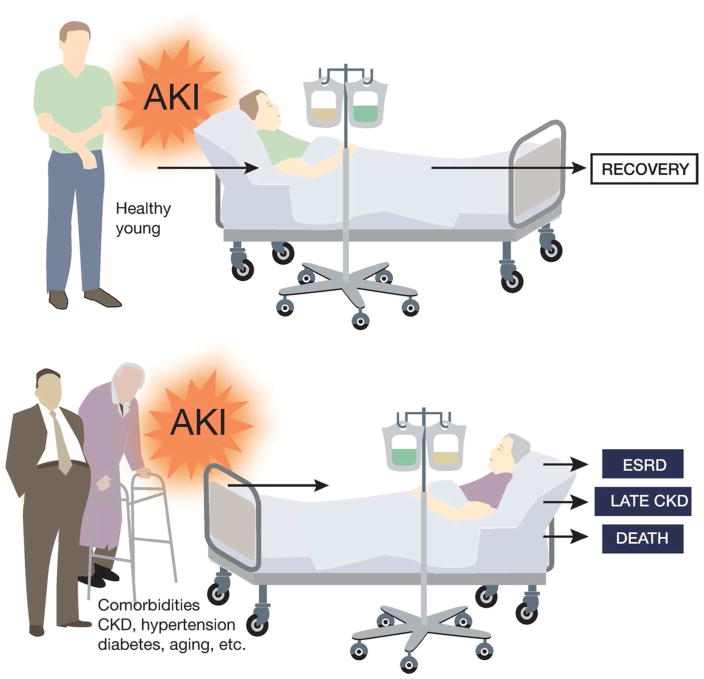
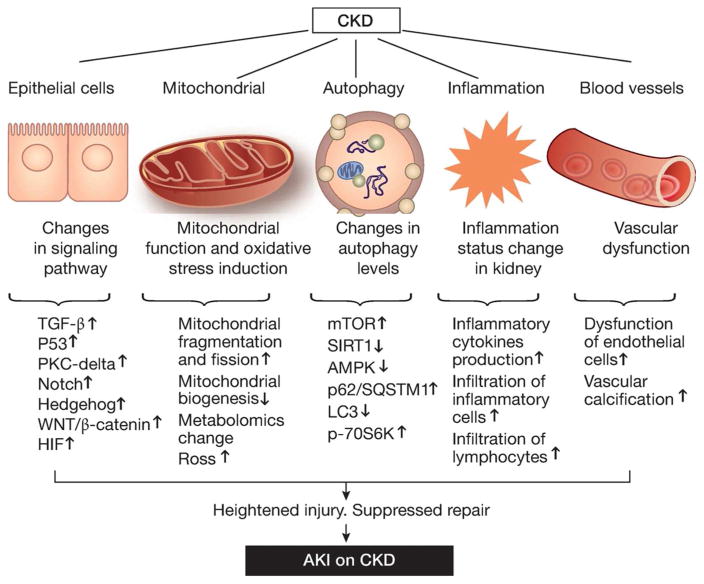
Acute kidney injury (AKI) and chronic kidney disease (CKD) are interconnected. Although AKI-to-CKD transition has been intensively studied, the information of AKI on CKD is very limited. Nonetheless, AKI, when occurring in patients with CKD, is known to be more severe and difficult to recover. CKD is associated with significant changes in cell signaling in kidney tissues, including the activation of transforming growth factor-β, p53, hypoxia-inducible factor, and major developmental pathways. At the cellular level, CKD is characterized by mitochondrial dysfunction, oxidative stress, and aberrant autophagy. At the tissue level, CKD is characterized by chronic inflammation and vascular dysfunction. These pathologic changes may contribute to the heightened sensitivity of, and nonrecovery from, AKI in patients with CKD.
Keywords: acute kidney injury; cell signaling; chronic kidney disease; fibrosis; inflammation; mitochondria.
Copyright © 2017 International Society of Nephrology. Published by Elsevier Inc. All rights reserved.
Figures
References
-
- Couser WG, Remuzzi G, Mendis S, et al. The contribution of chronic kidney disease to the global burden of major noncommunicable diseases. Kidney Int. 2011;80:1258–1270. - PubMed
-
- Coresh J, Selvin E, Stevens LA, et al. Prevalence of chronic kidney disease in the United States. JAMA. 2007;298:2038–2047. - PubMed
-
- Zhang L, Wang F, Wang L, et al. Prevalence of chronic kidney disease in China: a cross-sectional survey. Lancet. 2012;379:815–822. - PubMed
Publication types
MeSH terms
Substances
Grants and funding
LinkOut - more resources
Full Text Sources
Other Literature Sources
Medical
Molecular Biology Databases
Research Materials
Miscellaneous
