Effectiveness and economic assessment of routine larviciding for prevention of chikungunya and dengue in temperate urban settings in Europe
- PMID: 28892499
- PMCID: PMC5608415
- DOI: 10.1371/journal.pntd.0005918
Effectiveness and economic assessment of routine larviciding for prevention of chikungunya and dengue in temperate urban settings in Europe
Abstract
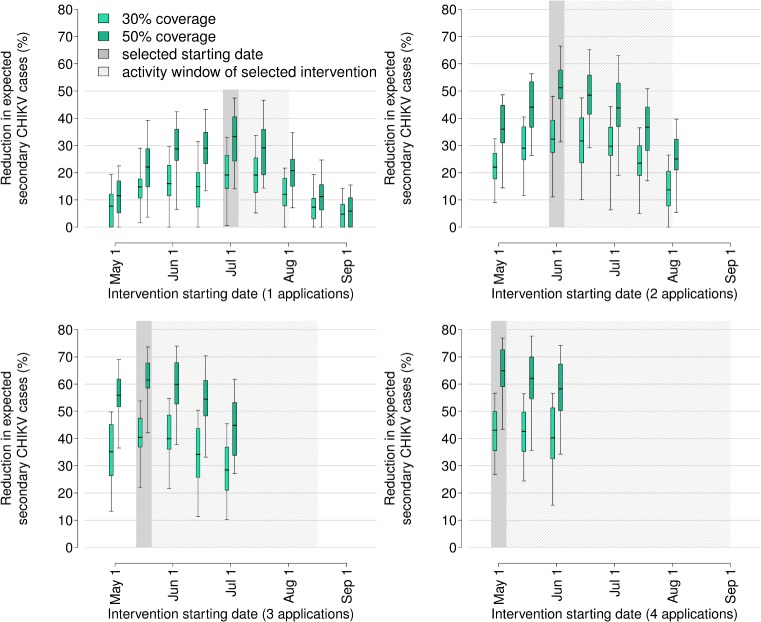
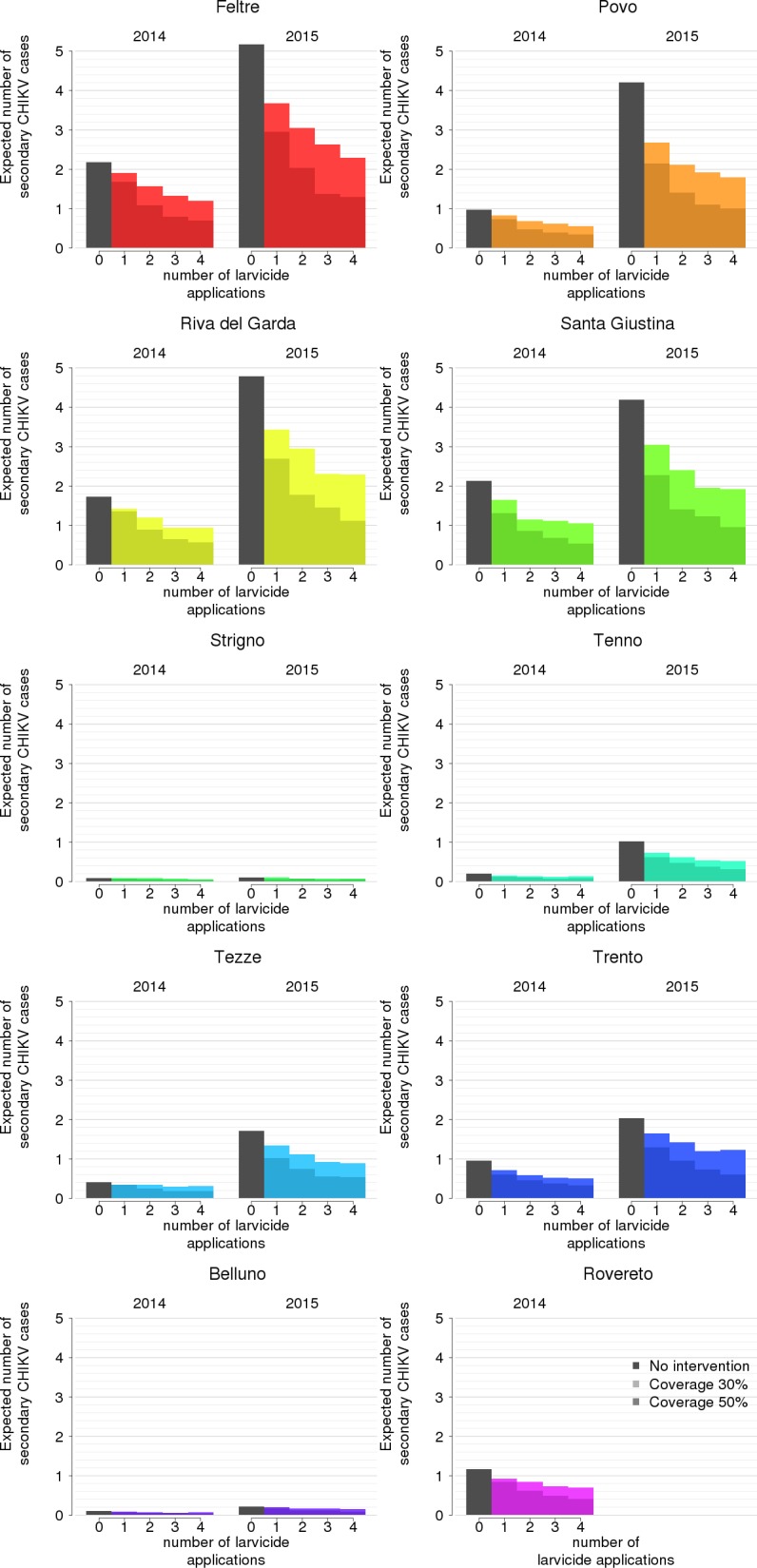
In the last decades, several European countries where arboviral infections are not endemic have faced outbreaks of diseases such as chikungunya and dengue, initially introduced by infectious travellers from tropical endemic areas and then spread locally via mosquito bites. To keep in check the epidemiological risk, interventions targeted to control vector abundance can be implemented by local authorities. We assessed the epidemiological effectiveness and economic costs and benefits of routine larviciding in European towns with temperate climate, using a mathematical model of Aedes albopictus populations and viral transmission, calibrated on entomological surveillance data collected from ten municipalities in Northern Italy during 2014 and 2015.We found that routine larviciding of public catch basins can limit both the risk of autochthonous transmission and the size of potential epidemics. Ideal larvicide interventions should be timed in such a way to cover the month of July. Optimally timed larviciding can reduce locally transmitted cases of chikungunya by 20% - 33% for a single application (dengue: 18-22%) and up to 43% - 65% if treatment is repeated four times throughout the season (dengue: 31-51%). In larger municipalities (>35,000 inhabitants), the cost of comprehensive larviciding over the whole urban area overcomes potential health benefits related to preventing cases of disease, suggesting the adoption of more localized interventions. Small/medium sized towns with high mosquito abundance will likely have a positive cost-benefit balance. Involvement of private citizens in routine larviciding activities further reduces transmission risks but with disproportionate costs of intervention. International travels and the incidence of mosquito-borne diseases are increasing worldwide, exposing a growing number of European citizens to higher risks of potential outbreaks. Results from this study may support the planning and timing of interventions aimed to reduce the probability of autochthonous transmission as well as the nuisance for local populations living in temperate areas of Europe.
Conflict of interest statement
The authors have declared that no competing interests exist.
Figures
References
-
- Medlock JM, Hansford KM, Schaffner F, Versteirt V, Hendrickx G, Zeller H, Van Bortel W. A review of the invasive mosquitoes in Europe: ecology, public health risks, and control options. Vector Borne Zoonotic Dis. 2012. 12(6):435–47. doi: 10.1089/vbz.2011.0814 - DOI - PMC - PubMed
-
- Caputo B, Manica M, D’Alessandro A, Bottà G, Filipponi F, Protano C, Vitali M, Rosà R, della Torre A. Assessment of the Effectiveness of a Seasonal-Long Insecticide-Based Control Strategy against Aedes albopictus Nuisance in an Urban Area. PLoS Negl Trop Dis. 2016;10(3):e0004463 doi: 10.1371/journal.pntd.0004463 - DOI - PMC - PubMed
-
- Burattini MN, Chen M, Chow A, Coutinho FA, Goh KT, Lopez LF, Ma S, Massad E. Modelling the control strategies against dengue in Singapore. Epidemiol Infect. 2008;136(3):309–19. doi: 10.1017/S0950268807008667 - DOI - PMC - PubMed
-
- Sochacki T, Jourdain F, Perrin Y, Noel H, Paty MC, de Valk H, Septfons A, Simard F, Fontenille D, Roche B. Imported chikungunya cases in an area newly colonised by Aedes albopictus: mathematical assessment of the best public health strategy. Euro Surveill. 2016;21(18). - PubMed
-
- Bellini R, Albieri A, Carrieri M, Colonna R, Donati L, Magnani M, Pilani R, Veronesi R, Chiot G, Lanza N. Efficacy and lasting activity of four IGRs formulations against mosquitoes in catch basins of northern Italy. Eur Mosq Bull. 2009; 27:33–46.
MeSH terms
Substances
LinkOut - more resources
Full Text Sources
Other Literature Sources
Medical