


Economic burden of malaria on rural households in Gwanda district, Zimbabwe
- PMID: 28893077
- PMCID: PMC5594239
- DOI: 10.4102/phcfm.v9i1.1317
Economic burden of malaria on rural households in Gwanda district, Zimbabwe
Abstract
Background: Malaria is a serious public health problem in sub-Saharan Africa and is a leading cause of morbidity and mortality.
Aim: To estimate the economic burden of malaria in rural households.
Setting: The study was conducted in Gwanda district of Matabeleland South in Zimbabwe. A total of five malarious wards and all their households were selected for the study frame, out of which 80 households were chosen using clinic records.
Methods: A retrospective analysis of secondary data and a cross-sectional household survey were conducted to estimate the household economic burden of malaria. Eighty households from five rural wards were identified from the health facility malaria registers and followed up. A household was eligible for inclusion if there had been at least one reported malaria case during the period of 2013-2015. Interviewer administered questionnaires were used to collect household data on economic costs of malaria.
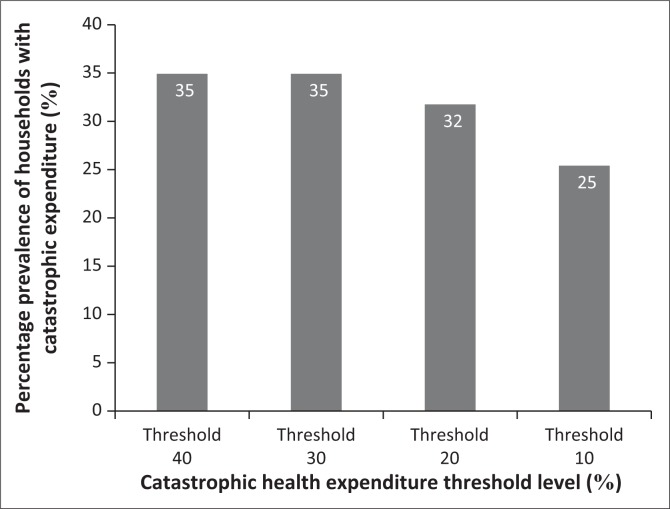
Results: Our findings showed that households spent an average of $3.22 and $56.60 for managing an uncomplicated and a complicated malaria episode respectively. A household lost an average of eight productive working days per each malaria episode resulting in an average loss of 24% of the monthly household income. An estimated 35%, mostly poorer households suffered catastrophic health expenditures.
Conclusion: Malaria imposes significant economic burdens particularly on the poorer and vulnerable households. Although there are no user fees at rural clinics, households incur other costs to manage a malaria patient. These costs are far worse for complicated cases.
Conflict of interest statement
The authors declare that they have no financial or personal relationships that may have inappropriately influenced them in writing this article.
Figures
References
-
- WHO World malaria report. Geneva, Switzerland: World Health Organization; 2016.
-
- Castillo-Riquelme M, McIntyre D, Barnes K. Household burden of malaria in South Africa and Mozambique: Is there a catastrophic impact? Trop Med Int Health. 2008;13(1):108–122. https://doi.org/10.1111/j.1365-3156.2007.01979.x - DOI - PubMed
-
- Sachs J, Malaney P. The economic and social burden of malaria. Nature. 2002;415(6872):680–685. https://doi.org/10.1038/415680a - DOI - PubMed
-
- Gallup JL, Sachs JD. The economic burden of malaria. Am J Trop Med Hyg. 2001;64(1–2 Suppl):85–96. - PubMed
-
- Zimbabwe National Statistics Agency Multiple indicator cluster survey. Harare, Zimbabwe: Zimbabwe National Statistics Agency; 2014.
MeSH terms
LinkOut - more resources
Full Text Sources
Other Literature Sources
Medical