


Chronic kidney disease and diabetes associated with long-term outcomes in patients receiving percutaneous coronary intervention
- PMID: 28893175
- PMCID: PMC5594538
- DOI: 10.1186/s12872-017-0673-4
Chronic kidney disease and diabetes associated with long-term outcomes in patients receiving percutaneous coronary intervention
Abstract
Background: The effect of diabetes mellitus (DM) and chronic kidney disease (CKD) on long-term outcomes in patients receiving percutaneous coronary intervention (PCI) is unclear.
Methods: A total of 1394 patients who underwent PCI were prospectively enrolled and divided into 4 groups according to the presence or absence of DM or CKD. Baseline characteristics, risk factors, medications, and angiographic findings were compared. Determinants of long-term outcomes in patients undergoing PCI were analyzed.
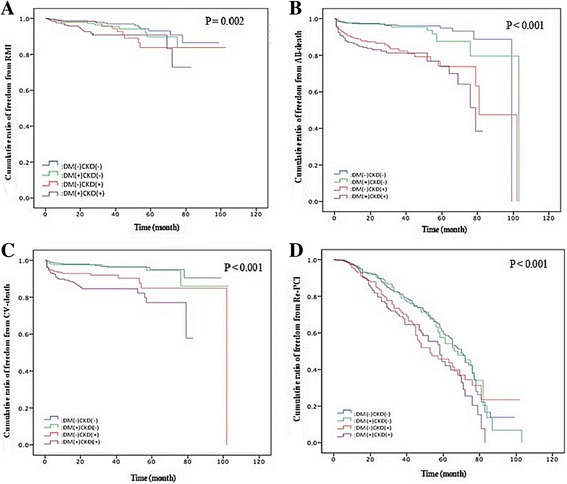
Results: Patients with DM and CKD had the highest all-cause mortality and cardiovascular mortality (both P < 0.01) but there were no differences existed in myocardial infarction (MI) or repeated PCI among the 4 groups (P = 0.19, P = 0.87, respectively). Patients with DM and CKD had the lowest even-free rate of all-cause mortality, cardiovascular mortality, MI, and repeated PCI (P < 0.001, P < 0.001, P < 0.001, and P = 0.002, respectively). In the Cox proportional hazard model, patients with both DM and CKD had the highest risk of all-cause mortality (HR: 3.25, 95% CI: 1.85-5.59), cardiovascular mortality (HR: 3.58, 95% CI: 1.97-6.49), MI (HR: 2.43, 95% CI: 1.23-4.08), and repeated PCI (HR: 1.79, 95% CI: 1.33-2.41). Patients with CKD alone had the second highest risk of all-cause mortality (HR: 2.04, 95% CI: 1.15-3.63), cardiovascular mortality (HR: 2.13, 95% CI: 1.13-4.01), and repeated PCI (HR: 1.47, 95% CI: 1.09-1.97).
Conclusions: DM and CKD had additive effect on adverse long-term outcomes in patients receiving PCI; CKD was a more significant adverse predictor than DM.
Keywords: Chronic kidney disease; Diabetes mellitus; PCI.
Conflict of interest statement
Ethics approval and consent to participate
The study protocol was approved by the Institution Review Board and ethics committee of Taichung Tzu Chi Hospital, Taiwan (REC104–19) and written inform consents were obtained from all participants..
Consent for publication
Not applicable.
Competing interests
The authors declare that they have no competing interest.
Publisher’s Note
Springer Nature remains neutral with regard to jurisdictional claims in published maps and institutional affiliations.
Figures
References
-
- Mathew V, Gersh BJ, Williams BA, Laskey WK, Willerson JT, et al. Outcomes in patients with diabetes mellitus undergoing percutaneous coronary intervention in the current era: a report from the prevention of REStenosis with Tranilast and its outcomes (PRESTO) trial. Circulation. 2004;109:476–480. doi: 10.1161/01.CIR.0000109693.64957.20. - DOI - PubMed
-
- Laskey WK, Seizer F, Viachos HA, Johnston J, Jacobs A, et al. Comparison of in-hospital and one-year outcomes in patients with and without diabetes mellitus undergoing percutaneous catheter intervention (from the national, heart, lung, and blood institute dynamic registry) Am J Cardiol. 2002;90:1062–1067. doi: 10.1016/S0002-9149(02)02770-4. - DOI - PubMed
-
- Best PJ, Berger PB, Davis BR, Grines CL, Sadeghi HM, PRESTO Investigators Impact of mild or moderate chronic kidney disease on the frequency of restenosis: results from the PRESTO trial. J Am Coll Cardiol. 2004;44:1786–1791. - PubMed
MeSH terms
Substances
LinkOut - more resources
Full Text Sources
Other Literature Sources
Medical
Miscellaneous
