


Plasminogen activator inhibitor-1 deficiency enhances subchondral osteopenia after induction of osteoarthritis in mice
- PMID: 28893232
- PMCID: PMC5594514
- DOI: 10.1186/s12891-017-1752-5
Plasminogen activator inhibitor-1 deficiency enhances subchondral osteopenia after induction of osteoarthritis in mice
Abstract
Background: Subchondral osteopenia is important for the pathophysiology of osteoarthritis (OA). Although previous studies suggest that plasminogen activator inhibitor-1 (PAI-1), an inhibitor of fibrinolysis, is related to bone metabolism, its role in OA remains unknown. We therefore investigated the roles of PAI-1 in the subchondral bone in OA model mice.
Methods: Wild type (WT) and PAI-1-deficient (KO) mice were ovariectomized (OVX), and then destabilization of the medial meniscus (DMM) surgery was performed.
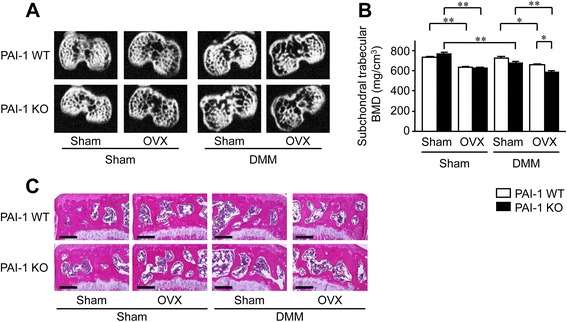
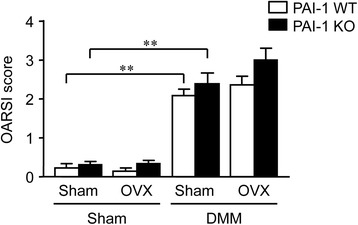
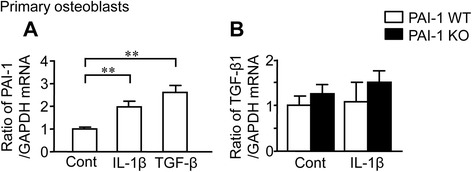
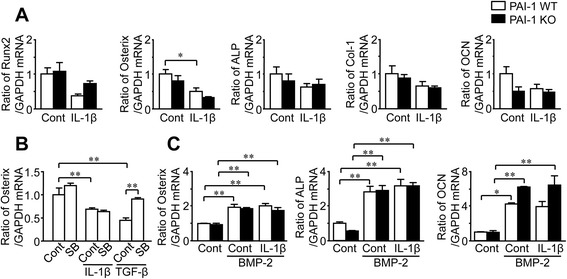
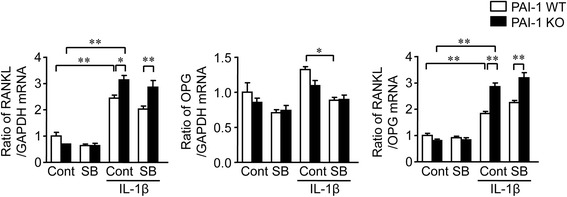
Results: DMM and OVX significantly decreased the trabecular bone mineral density of the subchondral bone evaluated by quantitative computed tomography in PAI-1 KO mice. The effects of OVX and/or PAI-1 deficiency on the OARSI score for the evaluation of the progression of knee degeneration were not significant. PAI-1 deficiency significantly augmented receptor activator nuclear factor κB ligand mRNA levels enhanced by IL-1β in mouse primary osteoblasts, although it did not affect osteoblast differentiation. Moreover, PAI-1 deficiency significantly increased osteoclast formation from mouse bone marrow cells.
Conclusion: We showed that PAI-1 deficiency accelerates the subchondral osteopenia after induction of OA in mice. PAI-1 might suppress an enhancement of bone resorption and subsequent subchondral osteopenia after induction of OA in mice.
Keywords: Osteoarthritis; Osteoclast; Ovariectomy; Plasminogen activator inhibitor-1; Subchondral bone.
Conflict of interest statement
Ethics approval
All animal experiments were approved by the Committee for the Care and Use of Laboratory Animals at Kindai University (KAME-28-19). All procedures for animal experiments were performed according to the guidelines of the National Institutes of Health and the institutional rules for the use and care of laboratory animals at Kindai University.
Consent for publication
Not applicable
Competing interests
The authors declare there are no competing interests.
Publisher’s Note
Springer Nature remains neutral with regard to jurisdictional claims in published maps and institutional affiliations.
Figures

References
MeSH terms
Substances
LinkOut - more resources
Full Text Sources
Other Literature Sources
Medical
Molecular Biology Databases
Research Materials
Miscellaneous
