Review
. 2017 Sep 12;14(1):39.
doi: 10.1186/s12981-017-0169-4.

Role of sex hormones and the vaginal microbiome in susceptibility and mucosal immunity to HIV-1 in the female genital tract

Affiliations
Review

Role of sex hormones and the vaginal microbiome in susceptibility and mucosal immunity to HIV-1 in the female genital tract

Danielle Vitali et al. AIDS Res Ther. .

Abstract

While the prevalence of Human immunodeficiency virus-1 (HIV-1) infection has stabilized globally, it continues to be the leading cause of death among women of reproductive age. The majority of new infections are transmitted heterosexually, and women have consistently been found to be more susceptible to HIV-1 infection during heterosexual intercourse compared to men. This emphasizes the need for a deeper understanding of how the microenvironment in the female genital tract (FGT) could influence HIV-1 acquisition. This short review focuses on our current understanding of the interplay between estrogen, progesterone, and the cervicovaginal microbiome and their immunomodulatory effects on the FGT. The role of hormonal contraceptives and bacterial vaginosis on tissue inflammation, T cell immunity and HIV-1 susceptibility is discussed. Taken together, this review provides valuable information for the future development of multi-purpose interventions to prevent HIV-1 infection in women.

Keywords: Female genital tract; HIV-1 susceptibility; Microbiome; Mucosal immunity; Sex hormones.


Figures
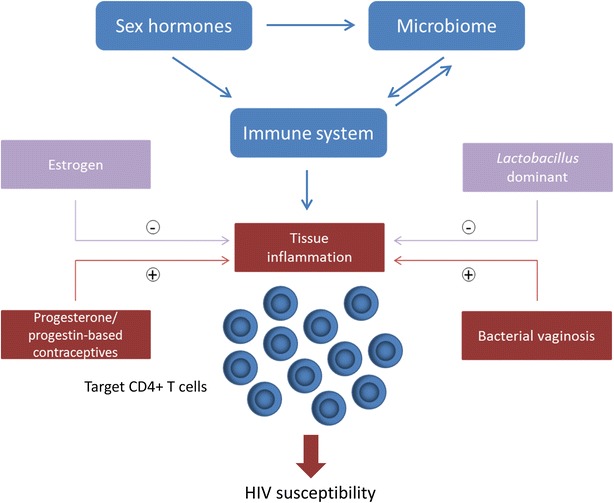
Fig. 1
Fig. 1
The sex hormone-microbiome-immune system axis in the female genital tract (FGT). The hormonal milieu, consisting of estradiol and progesterone, regulates the vaginal microbiome and both these factors participate in cross-talk with the immune system in the FGT (blue), determining the level of innate inflammation in the genital tissue. Higher estrogen levels correlate with a vaginal microbiome dominated by Lactobacillus spp. which can decrease genital inflammation and reduce HIV-1 susceptibility (pink). Alternatively, the use of progestin-based contraceptives or the presence of BV can initiate an inflammatory cytokine microenvironment that attracts T cells and induce their activation (red). Elevated levels of CD4+ CCR5+ activated T cells in the tissue as a result of an inflammatory genital profile increases the risk of HIV-1 acquisition in women

References

    1. UNAIDS: Global AIDS update 2016. Geneva: UNAIDS. 2016.
    1. Ferreira VH, Kafka JK, Kaushic C. Influence of common mucosal co-factors on HIV infection in the female genital tract. Am J Reprod Immunol. 2014;71:543–554. doi: 10.1111/aji.12221. - DOI - PubMed
    1. Wira CR, Rodriguez-Garcia M, Patel MV. The role of sex hormones in immune protection of the female reproductive tract. Nat Rev Immunol. 2015;15:217–230. doi: 10.1038/nri3819. - DOI - PMC - PubMed
    1. Wira CR, Fahey JV. A new strategy to understand how HIV infects women: identification of a window of vulnerability during the menstrual cycle. AIDS. 2008;22:1909–1917. doi: 10.1097/QAD.0b013e3283060ea4. - DOI - PMC - PubMed
    1. Huang B, Fettweis JM, Brooks JP, Jefferson KK, Buck GA. The changing landscape of the vaginal microbiome. Clin Lab Med. 2014;34:747–761. doi: 10.1016/j.cll.2014.08.006. - DOI - PMC - PubMed

MeSH terms
