


Exposure to unpredictable maternal sensory signals influences cognitive development across species
- PMID: 28893979
- PMCID: PMC5625898
- DOI: 10.1073/pnas.1703444114
Exposure to unpredictable maternal sensory signals influences cognitive development across species
Abstract
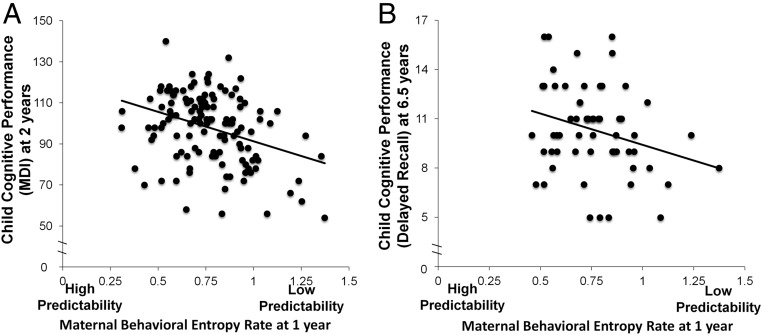
Maternal care is a critical determinant of child development. However, our understanding of processes and mechanisms by which maternal behavior influences the developing human brain remains limited. Animal research has illustrated that patterns of sensory information is important in shaping neural circuits during development. Here we examined the relation between degree of predictability of maternal sensory signals early in life and subsequent cognitive function in both humans (n = 128 mother/infant dyads) and rats (n = 12 dams; 28 adolescents). Behaviors of mothers interacting with their offspring were observed in both species, and an entropy rate was calculated as a quantitative measure of degree of predictability of transitions among maternal sensory signals (visual, auditory, and tactile). Human cognitive function was assessed at age 2 y with the Bayley Scales of Infant Development and at age 6.5 y with a hippocampus-dependent delayed-recall task. Rat hippocampus-dependent spatial memory was evaluated on postnatal days 49-60. Early life exposure to unpredictable sensory signals portended poor cognitive performance in both species. The present study provides evidence that predictability of maternal sensory signals early in life impacts cognitive function in both rats and humans. The parallel between experimental animal and observational human data lends support to the argument that predictability of maternal sensory signals causally influences cognitive development.
Keywords: brain development; cognition; cross-species; early experiences; maternal care.
Conflict of interest statement
The authors declare no conflict of interest.
Figures


References
-
- Belsky J, Fearon RM. Early attachment security, subsequent maternal sensitivity, and later child development: Does continuity in development depend upon continuity of caregiving? Attach Hum Dev. 2002;4:361–387. - PubMed
-
- NICHD Early Care Research Network Infant-mother attachment classification: Risk and protection in relation to changing maternal caregiving quality. Dev Psychol. 2006;42:38–58. - PubMed
-
- Feldman R. Parent-infant synchrony and the construction of shared timing; physiological precursors, developmental outcomes, and risk conditions. J Child Psychol Psychiatry. 2007;48:329–354. - PubMed
-
- Feldman R. Mutual influences between child emotion regulation and parent-child reciprocity support development across the first 10 years of life: Implications for developmental psychopathology. Dev Psychopathol. 2015;27:1007–1023. - PubMed
Publication types
MeSH terms
Grants and funding
LinkOut - more resources
Full Text Sources
Other Literature Sources
Medical
