. 2017 Aug 28:8:552.
doi: 10.3389/fphar.2017.00552. eCollection 2017.

Molecular Connectivity Predefines Polypharmacology: Aliphatic Rings, Chirality, and sp3 Centers Enhance Target Selectivity

Affiliations

Molecular Connectivity Predefines Polypharmacology: Aliphatic Rings, Chirality, and sp3 Centers Enhance Target Selectivity

Stefania Monteleone et al. Front Pharmacol. .

Abstract

Dark chemical matter compounds are small molecules that have been recently identified as highly potent and selective hits. For this reason, they constitute a promising class of possible candidates in the process of drug discovery and raise the interest of the scientific community. To this purpose, Wassermann et al. (2015) have described the application of 2D descriptors to characterize dark chemical matter. However, their definition was based on the number of reported positive assays rather than the number of known targets. As there might be multiple assays for one single target, the number of assays does not fully describe target selectivity. Here, we propose an alternative classification of active molecules that is based on the number of known targets. We cluster molecules in four classes: black, gray, and white compounds are active on one, two to four, and more than four targets respectively, whilst inactive compounds are found to be inactive in the considered assays. In this study, black and inactive compounds are found to have not only higher solubility, but also a higher number of chiral centers, sp3 carbon atoms and aliphatic rings. On the contrary, white compounds contain a higher number of double bonds and fused aromatic rings. Therefore, the design of a screening compound library should consider these molecular properties in order to achieve target selectivity or polypharmacology. Furthermore, analysis of four main target classes (GPCRs, kinases, proteases, and ion channels) shows that GPCR ligands are more selective than the other classes, as the number of black compounds is higher in this target superfamily. On the other side, ligands that hit kinases, proteases, and ion channels bind to GPCRs more likely than to other target classes. Consequently, depending on the target protein family, appropriate screening libraries can be designed in order to minimize the likelihood of unwanted side effects early in the drug discovery process. Additionally, synergistic effects may be obtained by library design toward polypharmacology.

Keywords: chemical properties; dark chemical matter; drug discovery; drug repurposing; molecular descriptors; off-targets; screening library design; stereochemistry.


Figures
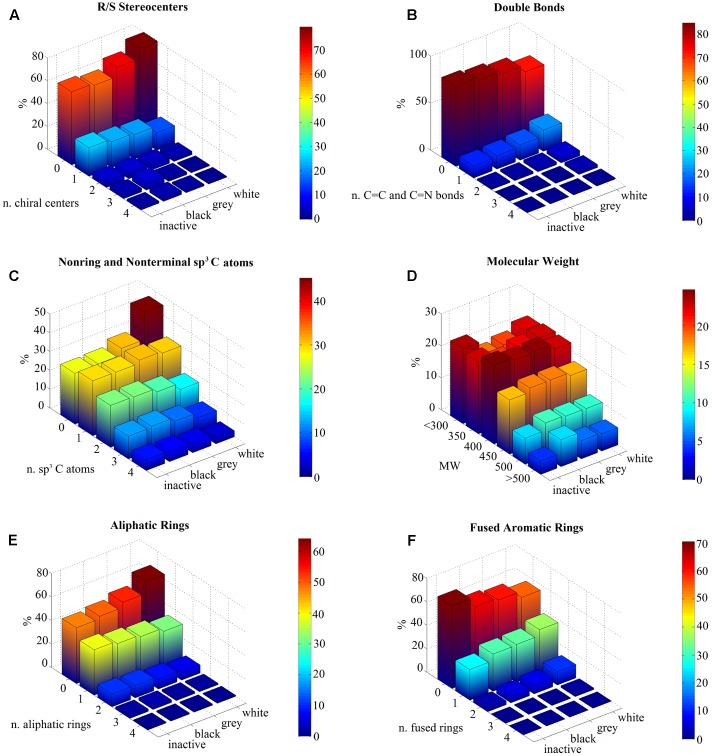
FIGURE 1
FIGURE 1
Statistical analysis of molecular descriptors per ligand class (inactive, black, gray, and white). Data are represented as 3D bar plots, colored according to the percentage values for each subset (see color bar). (A) The number of R/S stereocenters per molecule shows that most of white compounds have no chiral centers, whereas inactive molecules show the highest percentage of compounds with one stereocenter. (B) The number of carbon–carbon or carbon–nitrogen double bonds is higher for white ligands compared to the other classes, which normally have none. (C) Inactive and black sets exhibit higher content of non-ring and non-terminal sp3 carbon atoms with respect to white compounds, which tend to be sp2 hybridized. (D) The molecular weight (MW) is similar for all subsets in the range 300–500 Da, but shows different results for smaller and higher values. Indeed, inactive and white compounds exhibit higher percentages for values lower than 300 Da, with respect to black and gray sets. On the contrary, black compounds can be rather complex structures as their MW can be higher than 500 Da. The MW axis is divided into different ranges and its labels represent the highest boundary. For instance, “350” indicates compounds with MW values between 300 and 350. (E) Most of white molecules have no aliphatic rings, which characterize instead inactive and black datasets. (F) In contrast, a higher number of fused aromatic rings is a chemical feature of white molecules.
FIGURE 2
FIGURE 2
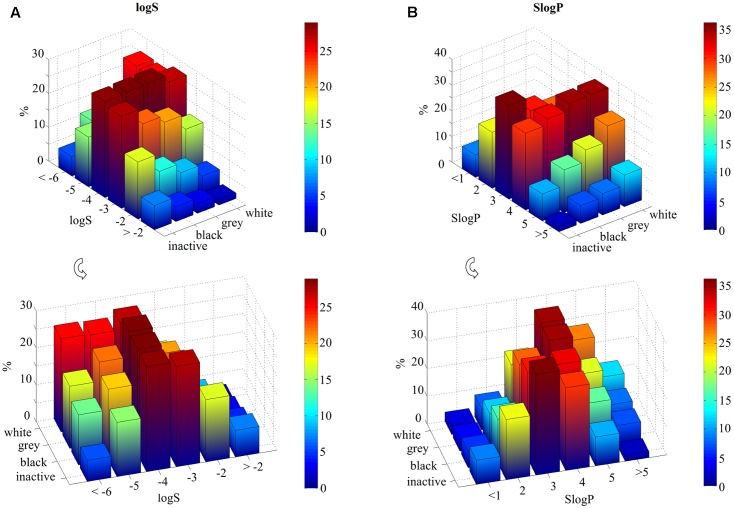
Statistical analysis of molecular solubility (logS) and hydrophobicity (SlogP) per ligand class (inactive, black, gray, and white). Data are represented as 3D bar plots, colored according to the percentage values for each subset (see color bar). The logS and SlogP axes are divided into different ranges and labels represent the highest boundary of each range. (A) Molecular solubility, reported as logS, is higher for inactive and black compounds for values higher than 4. Whereas white compounds have logS values lower than 4. (B) White compounds show SlogP values higher than 4. In contrast, inactive and black molecules have values lower than 4.
FIGURE 3
FIGURE 3
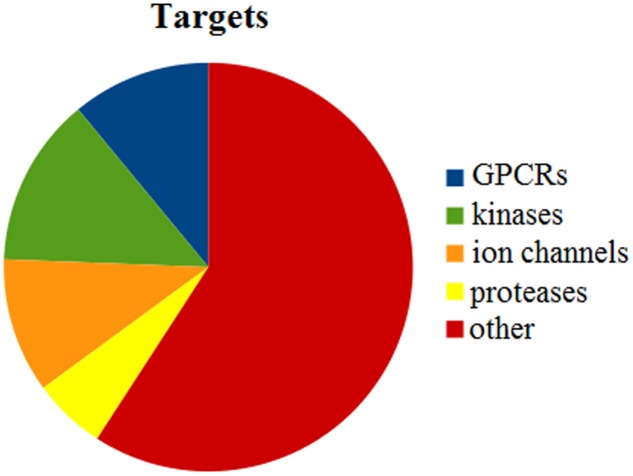
Statistical analysis of targets that are present in the entire dataset. In total, we identified 2,715 different targets. GPCRs represent 10.98%, kinases 13.41%, ion channels 10.68%, and proteases 5.78%. Other targets include further enzymes, nuclear receptors, and transcription factors.
FIGURE 4
FIGURE 4
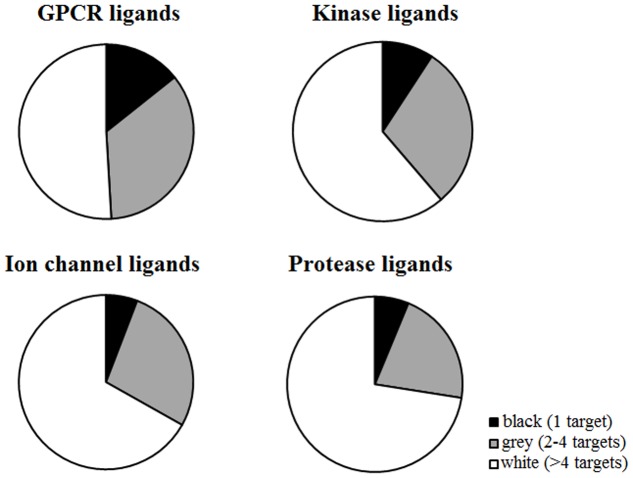
Distribution of black, gray, and white compounds in every target class. The number of black compounds is higher for GPCR ligands (14.30%) compared to other targets (5.80% ion channels, 6.25% ion channels, 9.21% kinases). In contrast, ion channels and proteases have higher percentages of white molecules.
FIGURE 5
FIGURE 5
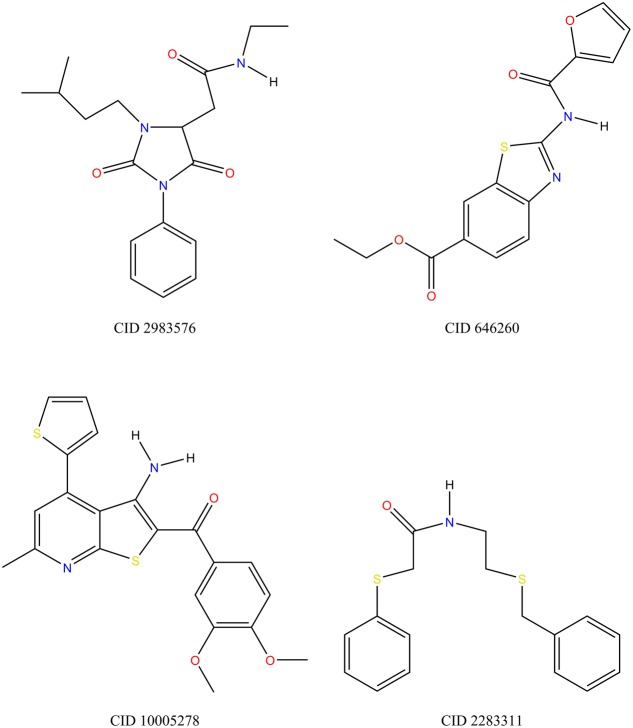
Ligands that represent the dataset. Compounds are labeled according to the compound identifier (CID) from PubChem. CID 2983576 is a selective GPCR ligand: its absolute stereochemistry is undefined in PubChem and, hence, not shown here. CID 646260 is a protease ligand, which binds also to other non-protease targets. CID 1005278 is a kinase ligand that binds also to other non-kinase targets. CID 2283311 is a selective kinase ligand that is active only on one target.
FIGURE 6
FIGURE 6
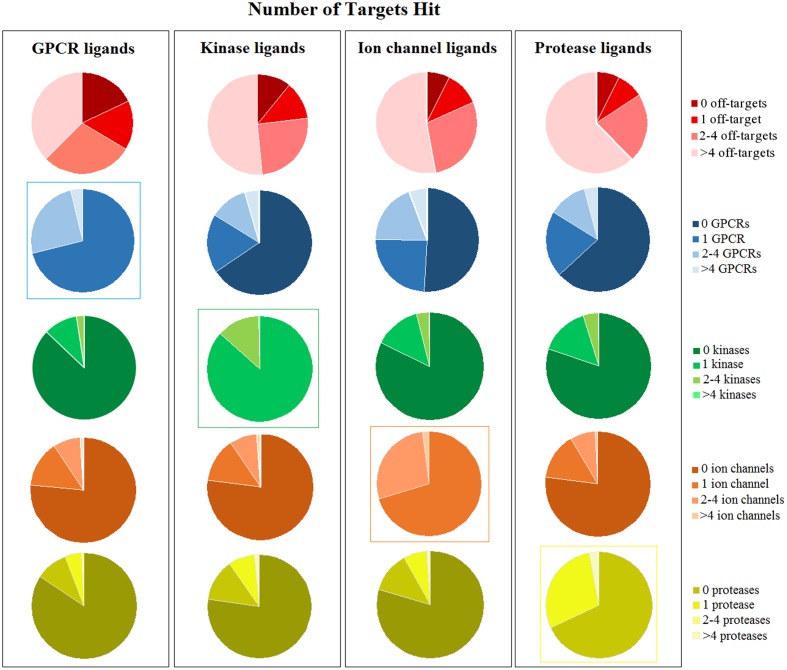
Number of targets hit by every ligand class (GPCRs, kinases, ion channels, and proteases). The first row shows if ligands can hit other targets that are not included in their own target class: for instance, GPCR ligands might hit only GPCRs (indicated as “0 off-targets”) or also other non-GPCR targets (larger number of off-targets). The following rows of pie charts show the number of ligands that hit a specific target class: for instance, GPCR ligands hit at least one GPCR, whereas kinase or ion channel or protease ligands can hit GPCRs or not (indicated as “0 GPCRs”). The same is shown for all four target classes. Intra-class selectivity is highlighted by colored boxes around the pie charts.

References

    1. Anighoro A., Bajorath J., Rastelli G. (2014). Polypharmacology: challenges and opportunities in drug discovery. J. Med. Chem. 57 7874–7887. 10.1021/jm5006463 - DOI - PubMed
    1. Azzaoui K., Hamon J., Faller B., Whitebread S., Jacoby E., Bender A., et al. (2007). Modeling promiscuity based on in vitro safety pharmacology profiling data. Chemmedchem 2 874–880. 10.1002/cmdc.200700036 - DOI - PubMed
    1. Bateman A., Martin M. J., O’donovan C., Magrane M., Apweiler R., Alpi E., et al. (2015). UniProt: a hub for protein information. Nucleic Acids Res. 43 D204–D212. 10.1093/nar/gku989 - DOI - PMC - PubMed
    1. Bento A. P., Gaulton A., Hersey A., Bellis L. J., Chambers J., Davies M., et al. (2014). The ChEMBL bioactivity database: an update. Nucleic Acids Res. 42 D1083–D1090. 10.1093/nar/gkt1031 - DOI - PMC - PubMed
    1. Besnard J., Ruda G. F., Setola V., Abecassis K., Rodriguiz R. M., Huang X. P., et al. (2012). Automated design of ligands to polypharmacological profiles. Nature 492 215–220. 10.1038/nature11691 - DOI - PMC - PubMed