


Characterization of Enterococcus Isolates Colonizing the Intestinal Tract of Intensive Care Unit Patients Receiving Selective Digestive Decontamination
- PMID: 28894438
- PMCID: PMC5581364
- DOI: 10.3389/fmicb.2017.01596
Characterization of Enterococcus Isolates Colonizing the Intestinal Tract of Intensive Care Unit Patients Receiving Selective Digestive Decontamination
Abstract
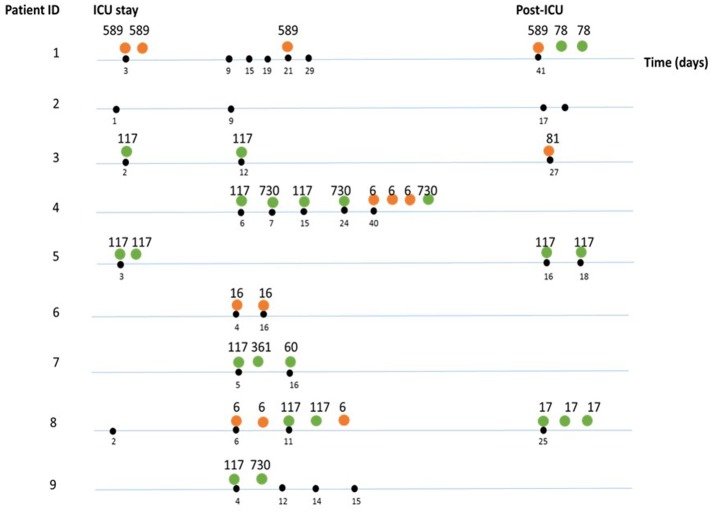
Enterococci have emerged as important opportunistic pathogens in intensive care units (ICUs). In this study, enterococcal population size and Enterococcus isolates colonizing the intestinal tract of ICU patients receiving Selective Digestive Decontamination (SDD) were investigated. All nine patients included in the study showed substantial shifts in the enterococcal 16S rRNA gene copy number in the gut microbiota during the hospitalization period. Furthermore, 41 Enterococcus spp. strains were isolated and characterized from these patients at different time points during and after ICU hospitalization, including E. faecalis (n = 13), E. faecium (n = 23), and five isolates that could not unequivocally assigned to a specific species (E. sp. n = 5) Multi locus sequence typing revealed a high prevalence of ST 6 in E. faecalis isolates (46%) and ST 117 in E. faecium (52%). Furthermore, antibiotic resistance phenotypes, including macrolide and vancomycin resistance, as well as virulence factor-encoding genes [asa1, esp-fm, esp-fs, hyl, and cyl (B)] were investigated in all isolates. Resistance to ampicillin and tetracycline was observed in 25 (61%) and 19 (46%) isolates, respectively. Furthermore, 30 out of 41 isolates harbored the erm (B) gene, mainly present in E. faecium isolates (78%). The most prevalent virulence genes were asa1 in E. faecalis (54%) and esp (esp-fm, 74%; esp-fs, 39%). Six out of nine patients developed nosocomial enterococcal infections, however, corresponding clinical isolates were unfortunately not available for further analysis. Our results show that multiple Enterococcus species, carrying several antibiotic resistance and virulence genes, occurred simultaneously in patients receiving SDD therapy, with varying prevalence dynamics over time. Furthermore, simultaneous presence and/or replacement of E. faecium STs was observed-, reinforcing the importance of screening multiple isolates to comprehensively characterize enterococcal diversity in ICU patients.
Keywords: Enterococcus; antibiotic prophylactic therapy; antibiotic resistance; intestinal colonization; selective digestive decontamination; virulence factors.
Figures


References
-
- Abriouel H., Omar N. B., Molinos A. C., López R. L., Grande M. J., Martínez-Viedma P., et al. (2008). Comparative analysis of genetic diversity and incidence of virulence factors and antibiotic resistance among enterococcal populations from raw fruit and vegetable foods, water and soil, and clinical samples. Int. J. Food Microbiol. 123, 38–49. 10.1016/j.ijfoodmicro.2007.11.067 - DOI - PubMed
-
- Austin D. J., Bonten M. J., Weinstein R. A., Slaughter S., Anderson R. M. (1999). Vancomycin-resistant enterococci in intensive-care hospital settings: transmission dynamics, persistence, and the impact of infection control programs. Proc. Natl. Acad. Sci. U.S.A. 96, 6908–6913. 10.1073/pnas.96.12.6908 - DOI - PMC - PubMed
-
- Bartosch S., Fite A., Macfarlane G. T., McMurdo M. E. T. (2004). Characterization of bacterial communities in feces from healthy elderly volunteers and hospitalized elderly patients by using real-time PCR and effects of antibiotic treatment on the fecal microbiota. Appl. Environ. Microbiol. 70, 3575–3581. 10.1128/AEM.70.6.3575-3581.2004 - DOI - PMC - PubMed
LinkOut - more resources
Full Text Sources
Other Literature Sources
Molecular Biology Databases
Miscellaneous
