Review
. 2017:2017:3494289.
doi: 10.1155/2017/3494289. Epub 2017 Aug 15.

FOXO Transcriptional Factors and Long-Term Living

Affiliations
Review

FOXO Transcriptional Factors and Long-Term Living

Ghulam Murtaza et al. Oxid Med Cell Longev. 2017.

Abstract

Several pathologies such as neurodegeneration and cancer are associated with aging, which is affected by many genetic and environmental factors. Healthy aging conceives human longevity, possibly due to carrying the defensive genes. For instance, FOXO (forkhead box O) genes determine human longevity. FOXO transcription factors are involved in the regulation of longevity phenomenon via insulin and insulin-like growth factor signaling. Only one FOXO gene (FOXO DAF-16) exists in invertebrates, while four FOXO genes, that is, FOXO1, FOXO3, FOXO4, and FOXO6 are found in mammals. These four transcription factors are involved in the multiple cellular pathways, which regulate growth, stress resistance, metabolism, cellular differentiation, and apoptosis in mammals. However, the accurate mode of longevity by FOXO factors is unclear until now. This article describes briefly the existing knowledge that is related to the role of FOXO factors in human longevity.


Figures
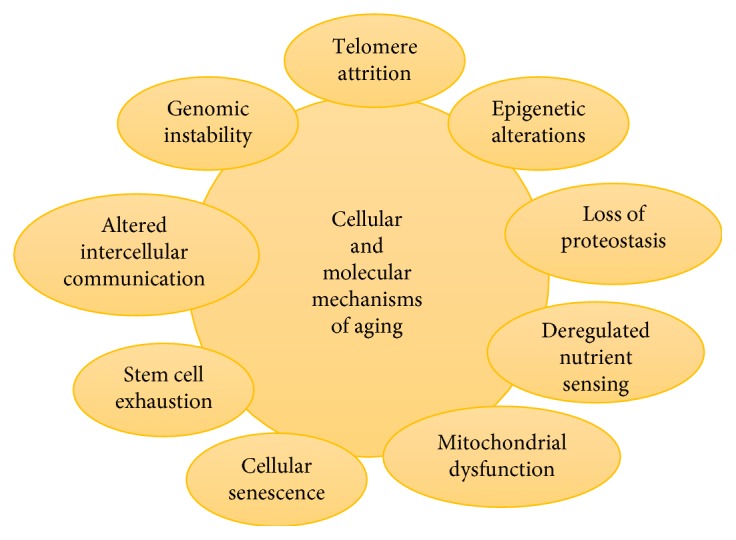
Figure 1
Figure 1
Various modes of aging.
Figure 2
Figure 2
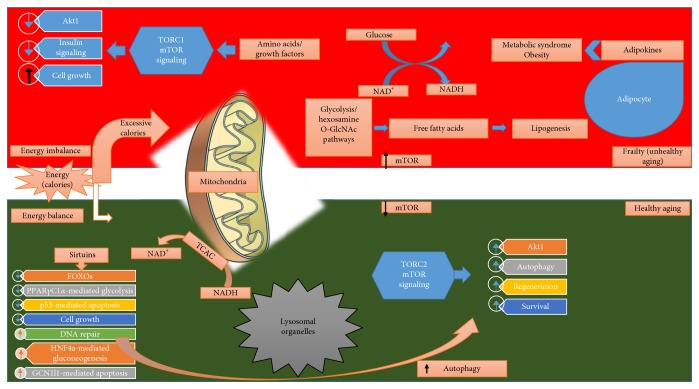
The crucial intracellular pathways targeted by FOXOs are presented here as modes of longevity effects of FOXOs. FOXOs are known to regulate translation of environment-induced stimuli into gene expression. FOXO-mediated longevity (especially through FOXO3) could be due to upregulated target genes pertained to apoptosis, cell cycle arrest, and resistance to stress leading to prevention of aging and age-associated diseases such as cancer and neurodegenerative diseases. The green part of the above figure illustrates cellular redox potential in mitochondria restoring NAD+. It results in the calorie restriction leading to various processes such as ameliorated autophagy, inhibited mTOR activity, and sirtuin-mediated activation of FOXOs giving rise to long-term living. While the red part of the above figure shows elevated levels of NADH due to excessive calorie intake resulting in lipogenesis, activated mTOR, excessive release of ROS, and suppressed autophagy leading to frailty. TCAC = tricarboxylic acid cycle; CAD = coronary artery disease; PPARγC1α = peroxisome proliferator-activated receptor-γ coactivator 1α; GCN1l1 = general control of amino acid synthesis 1-like 1; HNF4a = hepatocyte nuclear factor 4α; O-GlcNAc = O-linked N-acetylglucosamine.

Similar articles

Cited by

References

    1. Sebastiani P., Perls T. T. The genetics of extreme longevity: lessons from the new England centenarian study. Frontiers in Genetics. 2012;3:p. 277. doi: 10.3389/fgene.2012.00277. - DOI - PMC - PubMed
    1. Brooks-Wilson A. R. Genetics of healthy aging and longevity. Human Genetics. 2013;132:1323–1338. doi: 10.1007/s00439-013-1342-z. - DOI - PMC - PubMed
    1. Atzmon G., Schechter C., Greiner W., Davidson D., Rennert G., Barzilai N. Clinical phenotype of families with longevity. Journal of the American Geriatrics Society. 2004;52:274–277. - PubMed
    1. Willcox B. J., Willcox D. C., He Q., Curb J. D., Suzuki M. Siblings of Okinawan centenarians share lifelong mortality advantages. The Journals of Gerontology Series A: Biological Sciences and Medical Sciences. 2006;61:345–354. - PubMed
    1. Christensen K., Johnson T. E., Vaupel J. W. The quest for genetic determinants of human longevity: challenges and insights. Nature Reviews Genetics. 2006;7:436–448. doi: 10.1038/nrg1871. - DOI - PMC - PubMed

Substances

LinkOut - more resources