Solitary Plasmacytoma
- PMID: 28894561
- PMCID: PMC5584766
- DOI: 10.4084/MJHID.2017.052
Solitary Plasmacytoma
Abstract
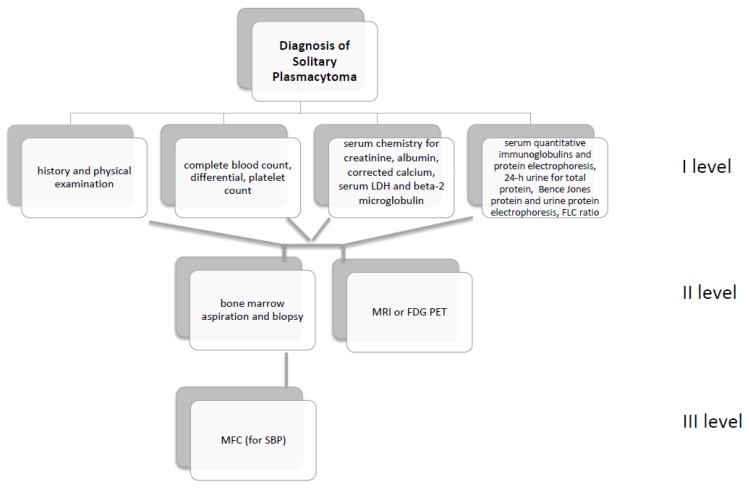
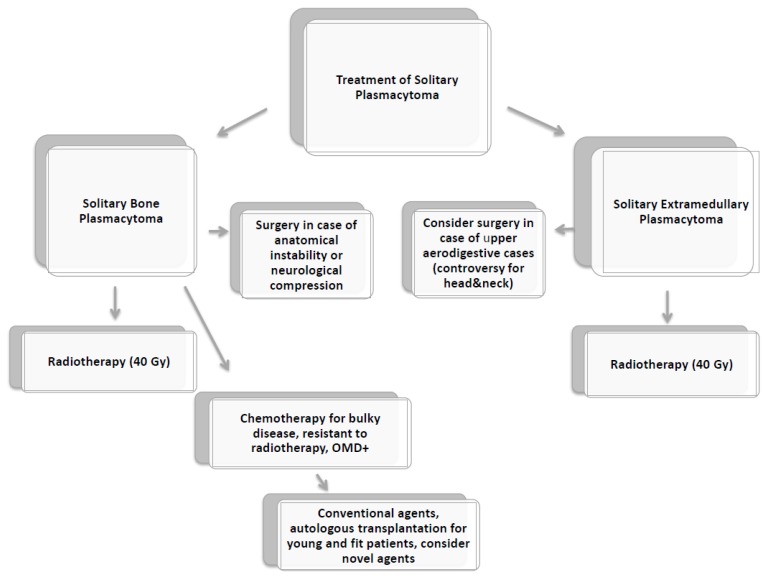
Solitary plasmacytoma is a rare disease characterized by a localized proliferation of neoplastic monoclonal plasma cells, without evidence of systemic disease. It can be subdivided into solitary bone plasmacytoma if the lesion originates in bone, or solitary extramedullary plasmacytoma if the lesion involves a soft tissue. The incidence of solitary bone plasmacytoma is higher than solitary extramedullary plasmacytoma. Also, the prognosis is different: even if both forms respond well to treatment, overall survival and progression-free survival of solitary bone plasmacytoma are poorer than solitary extramedullary plasmacytoma due to its higher rate of evolution in multiple myeloma. However, the recent advances in the diagnosis of multiple myeloma can better refine also the diagnosis of plasmacytoma. Flow cytometry studies and molecular analysis may reveal clonal plasma cells in the bone marrow; magnetic resonance imaging or 18 Fluorodeoxyglucose positron emission tomography could better define osteolytic bone lesions. A more explicit exclusion of possible occult systemic involvement can avoid cases of misdiagnosed multiple myeloma patients, which were previously considered solitary plasmacytoma and less treated, with an unavoidable poor prognosis. Due to the rarity of the disease, there is no uniform consensus about prognostic factors and treatment. Radiotherapy is the treatment of choice; however, some authors debate about the radiotherapy dose and the relationship with the response rate. Moreover, the role of surgery and chemotherapy is still under debate. Nevertheless, we must consider that the majority of studies include a small number of patients and analyze the efficacy of conventional chemotherapy; few cases are reported concerning the efficacy of novel agents.
Keywords: Myeloma; Osteolytic Lesions; Radiotherapy; Solitary Plasmacytoma.
Conflict of interest statement
Competing interests: The authors have declared that no competing interests exist.
Figures
References
-
- Knowling MA, Harwood AR, Bergsagel DE. Comparison of extramedullary plasmacytomas with solitary and multiple plasma cell tumors of bone. J Clin Oncol. 1983;1:255–62. https://doi.org/10.1200/JCO.1983.1.4.255. - DOI - PubMed
-
- Dimopoulos MA1, Hamilos G. Solitary bone plasmacytoma and extramedullary plasmacytoma. Curr Treat Options Oncol. 2002;3:255–9. https://doi.org/10.1007/s11864-002-0015-2. - DOI - PubMed
-
- Dores GM, Landgren O, McGlynn KA, Curtis RE, Linet MS, Devesa SS. Plasmacytoma of bone, extramedullary plasmacytoma, and multiple myeloma: incidence and survival in the United States, 1992–2004. Br J Haematol. 2009;144:86–94. https://doi.org/10.1111/j.1365-2141.2008.07421.x. - DOI - PMC - PubMed
-
- Rajkumar SV, Dimopoulos MA, Palumbo A, Blade J, Merlini G, Mateos MV, Kumar S, Hillengass J, Kastritis E, Richardson P, Landgren O, Paiva B, Dispenzieri A, Weiss B, LeLeu X, Zweegman S, Lonial S, Rosinol L, Zamagni E, Jagannath S, Sezer O, Kristinsson SY, Caers J, Usmani SZ, Lahuerta JJ, Johnsen HE, Beksac M, Cavo M, Goldschmidt H, Terpos E, Kyle RA, Anderson KC, Durie BG, Miguel JF. International Myeloma Working Group updated criteria for the diagnosis of multiple myeloma. Lancet Oncol. 2014;15:e538–48. https://doi.org/10.1016/S1470-2045(14)70442-5. - DOI - PubMed
-
- Soutar R, Lucraft H, Jackson G, Reece A, Bird J, Low E, Samson D Guidelines Working Group of the UK Myeloma Forum.; British Committee for Standards in Haematology.; British Society for Haematology. Guidelines on the diagnosis and management of solitary plasmacytoma of bone and solitary extramedullary plasmacytoma. Br J Haematol. 2004;124:717–26. https://doi.org/10.1111/j.1365-2141.2004.04834.x. - DOI - PubMed
Publication types
LinkOut - more resources
Full Text Sources
Other Literature Sources