Review
. 2017 Aug 28:7:186.
doi: 10.3389/fonc.2017.00186. eCollection 2017.

Quo natas, Danio? - Recent Progress in Modeling Cancer in Zebrafish

Affiliations
Review

Quo natas, Danio? - Recent Progress in Modeling Cancer in Zebrafish

Stefanie Kirchberger et al. Front Oncol. .

Abstract

Over the last decade, zebrafish has proven to be a powerful model in cancer research. Zebrafish form tumors that histologically and genetically resemble human cancers. The live imaging and cost-effective compound screening possible with zebrafish especially complement classic mouse cancer models. Here, we report recent progress in the field, including genetically engineered zebrafish cancer models, xenotransplantation of human cancer cells into zebrafish, promising approaches toward live investigation of the tumor microenvironment, and identification of therapeutic strategies by performing compound screens on zebrafish cancer models. Given the recent advances in genome editing, personalized zebrafish cancer models are now a realistic possibility. In addition, ongoing automation will soon allow high-throughput compound screening using zebrafish cancer models to be part of preclinical precision medicine approaches.

Keywords: cancer; compound screen; genetically engineered models; tumor microenvironment; xenograft models; zebrafish.


Figures
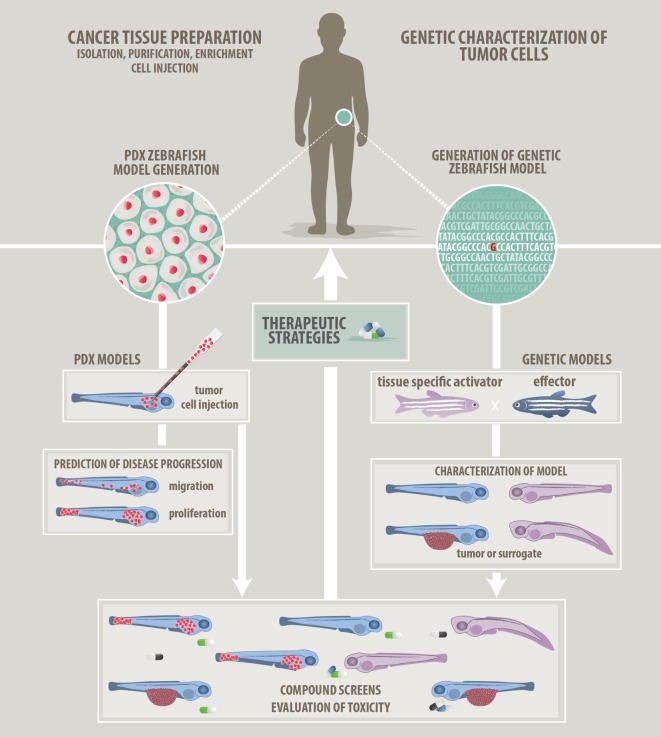
Figure 1
Figure 1
Approaches to modeling cancer in zebrafish. We describe two main approaches how zebrafish can be used in cancer research and how zebrafish will help to develop patient-tailored therapies in the future. (Left panel) Patient-derived xenograft approach: cancer cells prepared from resected or isolated patient material will be transplanted into zebrafish larvae. Monitoring of in vivo proliferation, migratory behavior, and interaction with host cells like endothelial cells might allow predictions of aggressiveness and disease progression. (Right panel) Genetic modeling approach: bioinformatic analyzes of Omics data will point at candidate target genes. Genetic models featuring single or combined mutations will be generated using the zebrafish tool kit. Genetic models will be used for in vivo investigation of tumorigenesis. In addition, a screenable phenotype will be identified. This can be an actual tumor, hyperproliferating cells, or developmental abnormalities. Studies of the tumor microenvironment are also possible on genetic models. (Common middle panel) Compound evaluation, compound screens, and development of therapeutic strategies: testing of single compounds, compound synergies, evaluation of toxicity, and screening for new compounds will help to advise on optimized and in the future individualized therapies.

References

    1. Streisinger G, Walker C, Dower N, Knauber D, Singer F. Production of clones of homozygous diploid zebra fish (Brachydanio rerio). Nature (1981) 291:293–6. 10.1038/291293a0 - DOI - PubMed
    1. Engeszer RE, Patterson LB, Rao AA, Parichy DM. Zebrafish in the wild: a review of natural history and new notes from the field. Zebrafish (2007) 4:21–40. 10.1089/zeb.2006.9997 - DOI - PubMed
    1. Driever W, Solnica-Krezel L, Schier AF, Neuhauss SC, Malicki J, Stemple DL, et al. A genetic screen for mutations affecting embryogenesis in zebrafish. Development (1996) 123:37–46. - PubMed
    1. Haffter P, Granato M, Brand M, Mullins MC, Hammerschmidt M, Kane DA, et al. The identification of genes with unique and essential functions in the development of the zebrafish, Danio rerio. Development (1996) 123:1–36. - PubMed
    1. Dooley K, Zon LI. Zebrafish: a model system for the study of human disease. Curr Opin Genet Dev (2000) 10:252–6. 10.1016/S0959-437X(00)00074-5 - DOI - PubMed

LinkOut - more resources
