


Postoperative Rehabilitation Strategies Used by Adults With Cochlear Implants: A Pilot Study
- PMID: 28894803
- PMCID: PMC5510267
- DOI: 10.1002/lio2.20
Postoperative Rehabilitation Strategies Used by Adults With Cochlear Implants: A Pilot Study
Abstract
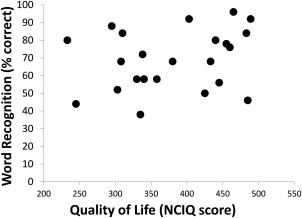
Objectives/hypothesis: Aural rehabilitation is not standardized for adults after cochlear implantation. Most cochlear implant (CI) centers in the United States do not routinely enroll adult CI users in focused postoperative rehabilitation programs due to poor reimbursement and lack of data supporting (or refuting) the efficacy of any one specific approach. Consequently, patients generally assume a self-driven approach toward rehabilitation. This exploratory pilot study examined rehabilitation strategies pursued by adults with CIs and associated these strategies with speech recognition and CI-specific quality of life (QOL).
Study design: Cross-sectional study of 23 postlingually deafened adults with CIs.
Methods: Participants responded to an open-ended questionnaire regarding rehabilitation strategies. A subset underwent in-depth interviews. Thematic content analysis was applied to the questionnaires and interview transcripts. Participants also underwent word recognition testing and completed a CI-related QOL measure. Participants were classified as having good or poor performance (upper or lower quartile for speech recognition) and high or low QOL (upper or lower quartile for QOL). Rehabilitation themes were compared and contrasted among groups.
Results: Five rehabilitation themes were identified: 1) Preimplant expectations of postoperative performance, 2) personal motivation, 3) social support, 4) specific rehabilitation strategies, and 5) patient-perceived role of the audiologist. Patients with good speech recognition and high QOL tended to pursue more active rehabilitation and had greater social support. Patient expectations and motivation played significant roles in postoperative QOL.
Conclusion: Postoperative patient-driven rehabilitation strategies are highly variable but appear to relate to outcomes. Larger-scale extensions of this pilot study are needed.
Keywords: Adult; auditory rehabilitation; cochlear implants; sensorineural hearing loss; thematic content analysis.
Figures
References
-
- Gaylor JM, Raman G, Chung M, et al. Cochlear implantation in adults: a systematic review and meta‐analysis. JAMA Otolaryngol Head Neck Surg 2013;139:265–272. - PubMed
-
- Firszt JB, Holden LK, Skinner MW, et al. Recognition of speech presented at soft to loud levels by adult cochlear implant recipients of three cochlear implant systems. Ear Hear 2004;25:375–387. - PubMed
-
- Gifford RH, Shallop JK, Peterson AM. Speech recognition materials and ceiling effects: considerations for cochlear implant programs. Audiol Neurootol 2008;13:193–205. - PubMed
-
- Friesen LM, Shannon RV, Baskent D, et al. Speech recognition in noise as a function of the number of spectral channels: comparison of acoustic hearing and cochlear implants. J Acoust Soc Am 2001;110:1150–1163. - PubMed
LinkOut - more resources
Full Text Sources
Other Literature Sources