


Distressing Symptoms, Disability, and Hospice Services at the End of Life: Prospective Cohort Study
- PMID: 28895118
- PMCID: PMC5777867
- DOI: 10.1111/jgs.15041
Distressing Symptoms, Disability, and Hospice Services at the End of Life: Prospective Cohort Study
Abstract
Objectives: To evaluate the relationship between the presence and number of restricting symptoms and number of disabilities and subsequent admission to hospice at the end of life.
Design: Prospective cohort study.
Setting: Greater New Haven, Connecticut, from March 1998 to December 2014.
Participants: Decedents from a cohort of 754 persons aged 70 and older (N = 562).
Measurements: Hospice admissions were identified primarily from Medicare claims, and 15 restricting symptoms and disability in 13 activities were assessed during monthly interviews.
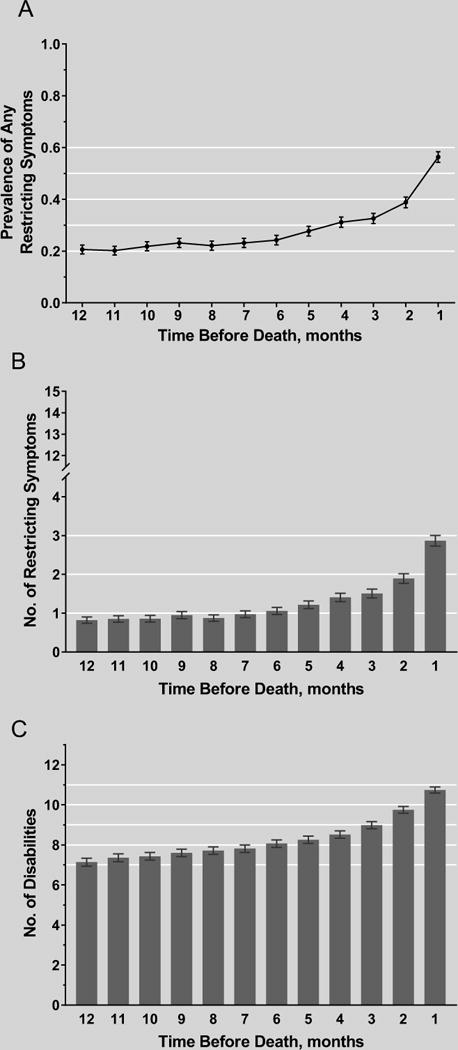
Results: During their last year of life, 244 (43.4%) participants were admitted to hospice. The median duration of hospice was 12.5 days (interquartile range 4-43 days). Although the largest increases were observed in the last 2 months of life, the prevalence of restricting symptoms and mean number of restricting symptoms and disabilities in the preceding months were high and trending upward. During a specific month, the likelihood of hospice admission increased by 66% (adjusted hazard ratio (aHR) = 1.66, 95% confidence interval (CI) = 1.30-2.12) in the setting of any restricting symptoms, by 9% (aHR = 1.09, 95% CI = 1.05-1.12) for each additional restricting symptom, and by 10% (aHR = 1.10, 95% CI = 1.05-1.14) for each additional disability. Each additional month with any restricting symptoms increased the likelihood of hospice admission by 7% (aHR = 1.07, 95% CI = 1.01-1.13).
Conclusion: Hospice services appear to be suitably targeted to older persons with the greatest needs at the end of life, although the short duration of hospice suggests that additional strategies are needed to better address the high burden of distressing symptoms and disability at the end of life.
Keywords: disability; end of life; hospice; longitudinal study; older persons; restricted activity.
© 2017, Copyright the Authors Journal compilation © 2017, The American Geriatrics Society.
Conflict of interest statement
Conflicts of Interest:
The authors have no conflicts of interest.
Figures
Comment in
-
Square Pegs; Round Holes: Our Healthcare System Is Failing Seriously Ill Older Americans in Their Last Years.J Am Geriatr Soc. 2018 Jan;66(1):15-17. doi: 10.1111/jgs.15161. Epub 2017 Nov 22. J Am Geriatr Soc. 2018. PMID: 29165786 Free PMC article. No abstract available.
References
-
- Casarett DJ. Rethinking Hospice Eligibility Criteria. JAMA. 2011;305:1031–1032. - PubMed
-
- Kutner JS. An 86-year-old woman with cardiac cachexia contemplating the end of her life: review of hospice care. JAMA. 2010;303:349–356. - PubMed
-
- Meier DE. When pain and suffering do not require a prognosis: working toward meaningful hospital-hospice partnership. J Palliat Med. 2003;6:109–115. - PubMed
-
- Unroe KT, Meier DE. Quality of hospice care for individuals with dementia. J Am Geriatr Soc. 2013;61:1212–1214. - PubMed
-
- Rubin R. Improving the quality of life at the end of life. JAMA. 2015;313:2110–2112. - PubMed
Publication types
MeSH terms
Grants and funding
LinkOut - more resources
Full Text Sources
Other Literature Sources
Medical
